A CSR strategy is only of value if it genuinely transforms a company's practices. Marketing is one of the first areas where these commitments become concrete and visible or, on the contrary, incoherent. So how do you align your marketing strategy with your company's CSR strategy? Clarisse Popower, an expert in responsible digital marketing, explains.

Aggressive campaigns, excessive promises, energy-hungry advertising formats, commercial pressure, non-inclusive creative... When these practices persist, the CSR (Corporate Social Responsibility) strategy loses credibility, even if the intentions are sincere. The discrepancy is immediately perceived by stakeholders: customers, employees, suppliers, etc.
Aligning marketing and CSR is not just a question of words. It's a question of operational choices and credibility.
Here's a practical method for :
- avoid discrepancies between marketing rhetoric and CSR reality
- translate CSR commitments into operational marketing decisions
- introduce more sober, more credible and more useful marketing
Start with the actual CSR strategy
Identifying what is really involved
First rule: based on facts, not intentions.
Before you start thinking about marketing, you need to ask yourself the following questions:
Which CSR commitments are really structured, managed and monitored? What subjects are covered by clear objectives, indicators and resources?
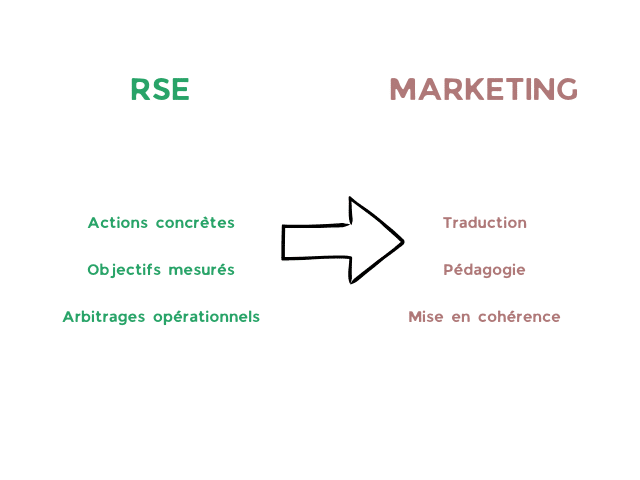
Marketing should not be looking for «value-adding» angles, but rather be based on existing, verifiable actions.
Questions to ask yourself before communicating on a CSR issue :
- Is there a formal CSR objective in this area?
- Is it monitored by a measurable indicator?
- Are there any results, even partial ones?
- Which internal department is really responsible for this action?
- What happens if you don't communicate about it?
Example :
When rethinking its marketing strategy, an industrial company realised that most of its environmental impact came from transporting its products. In two years, it had reduced the number of kilometres travelled by 18 % by reorganising its supply chain.
Rather than communicating about peripheral initiatives, marketing has chosen to explain this concrete transformation: optimising flows, reducing the number of journeys and relocating certain suppliers.
The result is a less «spectacular» approach, but one that is seen as more credible by B-to-B customers, with fewer requests for clarification of environmental commitments and a better understanding of the actions taken.
Clarify the stakeholders involved
CSR is not aimed at a single audience. Marketing must distinguish between what :
- directly concerns the customer (product, service, use)
- falls under internal practices (working conditions, organisation)
- concerns partners and suppliers
A single message dilutes meaning.
A targeted message improves understanding and ownership of the CSR strategy.
Communicate only about what is already real
A future objective is not a result.
An experiment is not a commitment kept.
Simple principle : communicate only on what is already in place, measurable or observable, and be transparent about future actions.
This rule protects the company from accusations of greenwashing, often linked to over-hasty communication.
Communication angle vs. real transformation
| Classical logic | Aligned CSR logic |
| Look for a positive message | Based on real practices |
| Generic slogan | Factual explanation |
| Promise | Proof |
| Announcement effect | Progressive transformation |
Testimonial :
«We tended to communicate very early on about our environmental ambitions. Working with the CSR team, we decided to talk only about what was already being measured. As a result, we're less vocal, but our messages are much more solid. And, paradoxically, more trust from our customers. Marketing manager of an industrial SME
Evolving marketing, not just words
Adapting your positioning and offering
Aligning marketing and CSR starts with a central question: what are we selling and what impact will it have?
Before adjusting messages or campaigns, marketing needs to question the product or service itself: its design, its real usefulness, its lifespan, its effects on usage.
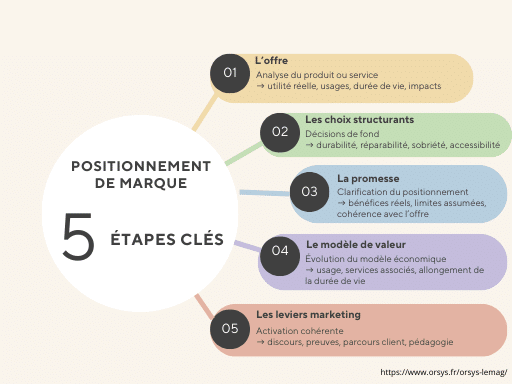
Brand positioning is built on these structuring choices. It is then translated into coherent marketing decisions, in particular :
- the evolution of the product or service (durability, reparability, accessibility, functional simplicity)
- clarification of the promise (what the product can actually do, without over-promising)
- adapting the value model (pay-per-use, associated services, longer life)
Marketing levers (promotion, message, customer journey) only support these choices. They cannot compensate for them.
Example :
When redesigning its product range, a retail chain committed to sustainability identified that a significant proportion of its sales came from short-life products. Rather than compensate with CSR rhetoric, it decided to reduce the number of such products and develop repairable ranges, with in-store repair services.
Marketing then adjusted its positioning: fewer messages encouraging immediate purchase, more educational content on use, reparability and cost over time.
In the space of a year, the proportion of sales accounted for by repairable products has risen, while customer satisfaction with the perceived durability of the range has improved.
Eco-socio-design of routes and marketing materials
Consistency between marketing and CSR is not only a question of messages, but also of the way in which the product or service is offered, distributed and activated. This is where commitments become tangible.
In practical terms, this means reviewing a number of operational levers:
● Bringing the product or service to market
Choosing really useful functions, limiting superfluous options, taking into account lifespan, maintenance and support over time.
● Distribution and access arrangements
Simplification of offers, limiting complex pathways or incentives to over-consumption, consistency between the channels used and environmental or social commitments.
● Marketing tools associated with the product
Selecting communication formats proportionate to the issue at stake, prioritising explanatory rather than promotional content. In a CSR-oriented approach, the question is no longer simply: «What device generates the most conversions? but rather: »Is this device proportionate to the issue? Does it provide real information value? Is it consistent with our environmental and social commitments?«
A product launch, for example, can be based either on a massive multi-channel campaign with strong advertising pressure, or on a more targeted approach: educational content, explanatory webinars, qualified e-mail campaigns, specialised press relations.
These marketing tools are the resources deployed For publicising, explaining, promoting and supporting a product or service once the offering has been structured. In concrete terms, this means :
- advertising formats (display, social ads, e-mailing, print, events, etc.)
- messages and content produced (landing pages, videos, brochures, case studies, technical data sheets)
- activation path (automation, reminders, retargeting)
- promotional mechanisms (limited offers, discounts, incentives to buy now)
- sales aids (sales literature, distributor kits)
● Long-term customer relations
The approach is one of support, use and understanding of the product, rather than one of permanent activation or systematic relaunch.
These choices have a direct impact on the marketing load produced, on the customer experience and on the overall footprint of the actions taken.
Example :
A training organisation committed to a CSR approach quickly realised that the reduction in printed material, although necessary, was marginal in relation to the real impact of its activity.
It has therefore embarked on a more structured project, clarifying its catalogue, eliminating redundant modules, simplifying registration procedures and developing more sustainable teaching formats that are better adapted to learners' needs.
Marketing has accompanied this development by reducing the volume of promotional campaigns in favour of content that explains the practical usefulness of training courses, their teaching methods and their value over time.
The result: clearer pathways, fewer drop-outs before enrolment and positive feedback on the clarity of the offer and the coherence of the message.
Moving from promise-based marketing to proof-based marketing
Communication aligned with CSR rests on 3 pillars:
- facts actions actually implemented on the product, service or organisation
- evidence figures, indicators, precise scope, measurable results
- clear, contextualised explanations What has been done, why, with what impact and what limitations.
No vague slogans. No undefined terms.
Example :
Take the case of an SME in the food industry that communicates its commitment to the environment. Rather than stating that it is «committed to the planet», it specifies :
What has been improved, for example:
- 22 % reduction in energy consumption at the main site in 3 years
- elimination of secondary plastic packaging on 80 % references
- 15 % reduction in transport-related emissions thanks to the relocation of two suppliers
- implementation of a waste reduction plan with 70 % of recovery
On what perimeters :
- main site only (subsidiaries not yet integrated)
- core market range, excluding seasonal products
- carbon balance covering scopes 1 and 2, partial scope 3
- comparison based on a clearly indicated reference year
What remains to be done:
- primary packaging that is still partially non-recyclable
- full scope 3 (raw materials) to be consolidated
- 2030 target still requiring investment
- partial dependence on imported raw materials
It's about showing a different approach with: a trajectory, measured progress and accepted limits. And to show that it may be less spectacular, but it is clearly more credible.
Managing alignment over time
Working cross-functionally
Marketing-CSR alignment cannot be based on marketing alone.
It requires regular exchanges with CSR teams, management and business units.
Without this coordination, marketing moves faster than the actual transformation, creating a time lag.
Monitor consistent indicators
KPIs need to evolve. In addition to business indicators, it is becoming necessary to monitor the following indicators:
- sober marketing strategies
- quality of commitment rather than volume
- real contribution to CSR objectives
Here are a few examples of indicators:
- CO₂ emissions generated by marketing actions (per campaign/per channel/per euro invested)
- Carbon intensity of media mix (kg eq CO₂/1,000 impressions)
- Share of marketing budget allocated to reduced-impact offers
- Share of sales generated by products or services aligned with CSR strategy
- Contribution of campaigns to the evolution of the product mix towards more sustainable offers
- Rate of orientation towards repair, reuse or use rather than replacement
- Rate of reduction in returns due to misunderstanding of the offer
- Index of clarity and understanding of CSR commitments (measured by customer survey)
- Change in perception of the brand's CSR credibility
- Rate of customer exposure to educational vs. promotional content
- Ratio of explanatory content to purely promotional content
- Annual reduction in the volume of marketing solicitations per customer
- Percentage of marketing materials that are eco-designed or optimised (weight, formats, responsible printing)
Avoiding excesses
There are three major risks:
● Greenwashing
Communicating intentions, objectives or marginal actions without addressing the main impacts of the product or service.
● Unclear promises
Use generic terms («responsible», «sustainable», «committed») without specifying what is actually changing, within what scope and with what results.
● Isolated actions with no overall vision
Multiplying marketing initiatives with no link to CSR priorities and no continuity or management over time.
Read also : Sustainable and responsible marketing: 5 key steps to build your strategy
Get trained!
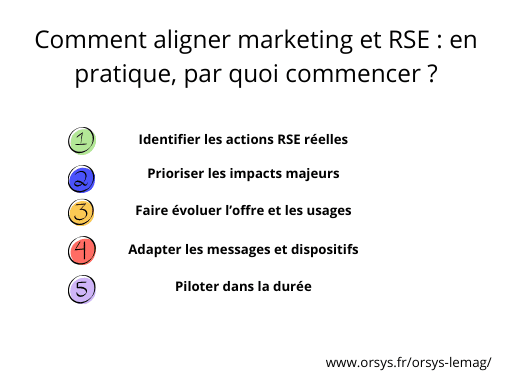
In conclusion, aligning your marketing strategy with your CSR strategy means changing the way you design, produce and manage marketing. Aligned marketing is more sober, clearer and more credible. And, in the long term, more effective..