ITIL®, ITIL®, the internationally recognised reference framework for digital service management, has just been updated. With ITIL® 5, this best practice framework is evolving to better respond to product challenges, automation and artificial intelligence. What does ITIL® really offer? 5 compared to ITIL® 4? Find out what's changing, what's staying the same, and which ITIL® training course is right for you.® Choose according to your profession, your level and your objectives.
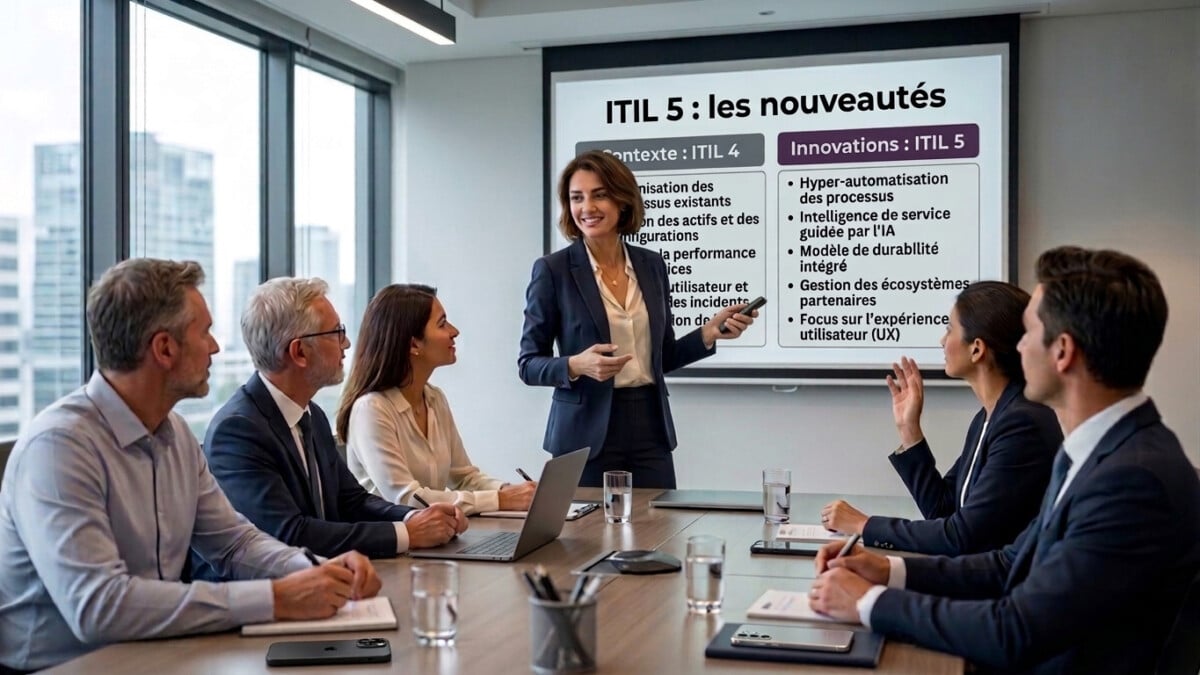
Before we look at ITIL®, we need to understand ITSM. ITSM stands for IT Service Management. In practical terms, it means organising everything that enables a digital service to function properly on a daily basis: user support, incidents, changes, quality, availability, coordination between teams, continuous improvement.
Let's take a very simple example. In a company, email, VPN, HR software, sales tools and e-commerce applications are all digital services. ITSM involves answering some very concrete questions: what do you do when something breaks down? Who decides on a change? How can recurring incidents be avoided? How can we improve the user experience? How can we get support, operations, development and business units to work together?
In other words, ITSM is about avoiding disorder. Without a common framework, each team works with its own rules, priorities conflict, incidents recur, and users have the impression that nobody is really in charge.
ITIL, the ITSM reference framework
ITIL (Information Technology Infrastructure Library) is one of the best-known frameworks for organising IT service management.. It can be seen as a best practice toolkit It provides a common language, principles, models and benchmarks for better managing services and aligning them with business objectives.
From 2019, ITIL® 4 is the reference version created by PeopleCert. This version marked an important evolution: it enabled us to move away from an overly rigid vision of processes towards a more flexible approach, more focused on value, collaboration and continuous improvement.
However, since 2019, IT services have changed considerably with digital transformation, the adoption of the cloud and the boom in artificial intelligence. Hence the move to ITIL® 5.
What is ITIL 5?
Announced in January 2026 by PeopleCert, ITIL® 5 marks a major evolution. The new standard is no longer limited to good service management: it focuses more on the management of digital products and services as a whole.
This is changing a lot of things. We're talking more about lifecycle, experience, cross-functionality between business and IT, governance, automation and AI. In other words, ITIL® 5 is more in tune with today's business reality, where IT is no longer just a support, but a direct driver of the business.
What is the main objective of ITIL 5?
ITIL® 5 aims to unify the management of digital products and services within a single framework. unique life cycle. It helps organisations manage their end-to-end digital operations while integrating AI governance, automation and sustainability issues. The result: faster delivery and better results.
Does ITIL 5 replace ITIL 4?
ITIL® 5 is not a sudden replacement for ITIL® 4, but rather an evolution. The idea is not to throw out what already exists, but to adapt the repository to a context where organizations are no longer just managing IT services, but also digital products and services increasingly complex, cross-functional and often enhanced by automation and artificial intelligence.
The two versions will coexist until 31 December 2027., ITIL® 4 modules will be discontinued by PeopleCert.
What are the major differences between ITIL 4 and ITIL 5?
From an IT services model to a value creation platform
ITIL® 4 focused on the co-creation of value through IT services, whereas’ITIL® 5 extends to the entire digital enterprise (products, platforms, data).
Example A bank moves from an IS supporting its branches (ITIL® 4) to a digital platform offering real-time financial services (ITIL® 5).
From management to anticipation thanks to AI
ITIL® 4 effectively structures operations (incidents, changes).
ITIL® 5 introduces AIOps and automation Incidents are detected and resolved before impact.
Example E-commerce: an e-commerce company uses predictive analysis to anticipate breakdowns and avoid lost sales.
From a project organisation to a product organisation
ITIL® 4 integrates agile and DevOps.
ITIL® 5 takes integration even further: autonomous, product-oriented teams, responsible from end to end.
Example The IT department replaces its annual projects with product teams delivering new functions on a continuous basis.
Experience as a strategic differentiator
ITIL® 4 measures customer satisfaction.
ITIL® 5 pilots the global experience (customer + employee) in real time.
Example A company continuously adjusts its services according to the actual usage observed.
Integrating CSR issues
ITIL® 4 does not deal with these subjects to any great extent.
ITIL® 5 integrates digital sobriety and CSR objectives into IT decisions.
Example A company optimises its cloud infrastructures to reduce its carbon footprint and its costs.
Extended governance
ITIL® 4 aligns IT and business.
ITIL® 5 includes partners, platforms and APIs in its extended governance.
Example A company pilots its services by integrating cloud providers, fintechs and digital partners.
ITIL 4 vs. ITIL 5
| Features | ITIL®4 | ITIL®5 |
| Main focus | Management of IT services (ITSM) and value co-creation. | Unified management of digital products and services. |
| Artificial intelligence | Evoked indirectly or via extension modules. | AI-Native AI is at the heart of the framework, including governance and AIOps. |
| Operational model | Services value chain (SVC) with 6 activities. | Unified product and service lifecycle with 8 activities. |
| Lifecycle Activities | Plan, Improve, Engage, Design & Transition, Procure/Build, Deliver & Support. | Discover, Design, Acquire, Build, Transition, Operate, Deliver, Support. |
| Experience | Focus on customer satisfaction, stakeholders and perceived value. | Extended focus on’overall experience (UX, CX, EX) |
| Sustainability (CSR) | Little discussed in the base plinth. | Natively integrated (ESG objectives, Green IT, digital sobriety). |
| Governance | Strategic alignment between IT and the business. | Governance extended to ecosystems, partners, cloud platforms and AI. |
| Agile approach | Integration of agile and DevOps, but sometimes perceived as abstract. | Explicit roles for Product Owners, Scrum Masters and UX Designers in the value chain. |
What hasn't changed since ITIL 4?
The fundamental pillars remain intact:
- The 7 guiding principles.
- The 4 dimensions service management.
- Le Service Value System (SVS).
- The 34 ITIL practices, although they are subject to minor terminology updates.
| Aspect |
What's new (ITIL® 5) |
What doesn't change (identical to ITIL® 4) |
| Global vision | Moving from service management to management of digital products and services. | The objective remains value co-creation between the supplier and the consumer. |
| Technologies | Approach «AI-native» with explicit integration of AI, AIOps and AI governance. | The approach remains technologically agnostic but now includes modern tools. |
| Operational model | Replacement of the value chain (6 activities) by a unified life cycle (8 activities). | The concept of Service Value System (SVS) remains the central structural framework. |
| Indicators | Focus on’overall experience (UX, CX, EX) via experience level agreements (XLA). | The utility and guarantee dimensions (Utility & Warranty) are retained. |
| Durability | Native integration of issues CSR/ESG and digital sobriety in all decisions. | The holistic approach to service management is maintained. |
| Foundation exam | Removal of questions on detailed practices (0 % compared with 42.5 %) in favour of strategy and terminology. | ITIL Foundation remains the compulsory entry point for the entire certification process. |
| Working methods | Agile roles (Product Owner, Scrum Master) explicitly integrated into the lifecycle. | Integrating concepts Agile, Lean and DevOps remains a fundamental pillar. |
| Fundamental structure | Introduction of new terms (SRE, Observability, Generative AI). | The 7 guiding principles and 4 dimensions remain unchanged. |
How does AI fit into ITIL 5?
AI is central. ITIL® 5 introduces concepts such as Generative AI, Intelligent Agents, AI Maturity Models and the ITIL® AI Capability Model. Artificial intelligence now represents 2.5 % of Foundation exam score.
The framework focuses on’AIOps and advanced automation. The aim is to move away from reactive incident management towards predictive anticipation, where problems are solved by AI before they have any impact on users.
Why is user experience so important in ITIL 5?
ITIL® 5 makes experience (UX, CX and EX - Employee Experience) a strategic differentiator. It introduces specific metrics such as Experience Level Agreements (XLA) to measure the real value experienced by the user, over and above mere technical performance.
Is ITIL useful? For which business lines?
The value of ITIL extends far beyond support teams. The repository is useful to anyone who needs to understand how an organisation designs, delivers, improves and governs digital services or products.
For the support, operations, production or delivery professions, An ITIL® 4 foundation is still very useful for gaining a better understanding of service mechanisms, operational quality, interactions between practices and service continuity.
For a product owner or a digital product manager, ITIL® 5 (ITIL® 5 Foundation, then ITIL® 5 Product) is clearly more natural.
Example: on a mobile customer application, the issue is not just the availability of the service, but also the consistency of the path, the speed of development, the data, the support and the governance.
For a service owner, ITIL® 5 (ITIL® 5 Foundation, then ITIL® 5 Service) is often more interesting than ITIL® 4 on its own.
Example: a Microsoft 365 or CRM service owner needs to manage quality, adoption, user expectations, upgrades and supplier dependencies. ITIL® 5's lifecycle and value approach is more appropriate.
ITIL® 5 will also be useful for a manager which must integrate automation or AI without losing control of the service.
For a consultant, The choice depends on the assignment. If the mission is about traditional ITSM structuring, ITIL® 4 is still very useful. If they concern transformation, value streams, product organization or business-technology alignment, ITIL® 5 is more valuable.
For a CIO or transformation manager, ITIL® is not about reciting concepts, but about providing a framework for linking organisation, governance, value, performance and the evolution of digital services. In this case, ITIL® 5 often provides a more up-to-date perspective, particularly when it comes to managing digital customer journeys.
ITIL 5 courses by business and specialisation
| Business family | Job / Specific role | Advanced ITIL 5 module recommended | Target designation |
| Management & strategy | CIO, CDO, Transformation Manager, Enterprise Architect | ITIL Strategy (out on 09/04) |
Strategic Leader |
| Support | Agile Coach, Release Train Engineer (RTE) | ITIL Transformation (out on 09/04) |
(Common module) |
| Product team (agile) | Product Owner, Product Manager, Scrum Master | ITIL Product | Managing Professional |
| Experience & design | UX Designer, CX Manager, Scrum Master | ITIL Experience | Managing Professional |
| Development & Ops | Dev Team, DevOps Engineer, Scrum Master | ITIL Service | Managing Professional |
| Operations (support) | Incident manager, Service Desk, problem management, request management | Monitor, Support and Fulfill (MSF) | Practice Manager |
| Operations (control) | Change, Deployment, Release and Asset Management Manager (ITAM) | Plan, Implement and Control (PIC) | Practice Manager |
| Governance & Quality | SLM manager (service levels), continuous improvement, safety, suppliers | Collaborate, Assure and Improve (CAI) | Practice Manager |
I'm a Scrum Master or Product Owner, does ITIL 5 offer me anything?
Absolutely. ITIL® 5 gives an explicit role to agile profiles (Product Owners, Scrum Masters, UX Designers) without asking them to change their methods. Publications such as ITIL Product or ITIL Experience use tools that are familiar to agile profiles, such as backlogs, user journeys and OKR (objectives and key results).
How does ITIL 5 integrate with other frameworks?
ITIL® 5 is designed to be fully integrated with methodologies such as DevOps, PRINCE2 and Lean. The Foundation exam explicitly tests the ability of the repository to work in synergy with these approaches.
What are the changes in the ITIL 5 Foundation exam?
The exam format remains unchanged This is a MCQ of 40 questions, to be completed in a maximum of 60 minutes, in a closed book. To pass, candidates must obtain at least 65 % correct answers, i.e. 26 correct answers out of 40.
But its content and the weighting of its rating have changed radically :
| Examination category | ITIL 4 Foundation | ITIL 5 Foundation |
| Detailed practices (e.g. incidents, changes, etc.) | 42.5 % of the score | 0 % (practice details have been moved to the advanced levels) |
| Terminology and definitions | 12 % | 30 % (includes new terms: AI, XLA, SRE, observability, etc.) |
| Value system (SVS, governance, principles) | 15 % | 40 % |
| Artificial intelligence | Not tested | 2,5 % |
| Flow of value | Little tested (included in Other concept) | 5 % |
| Integration of frameworks (DevOps, PRINCE2®...) | Little tested (included in Other concepts) | 2,5 % |
| Strategy, change and other concepts | 30,5 % | 20 % |
| TOTAL | 100 % | 100 % |
I am already ITIL 4 Foundation certified. Will my certification be lost?
No, you don't have to start from scratch. ITIL® 5 is backwards compatible: your ITIL® 4 Foundation qualification remains valid and you can go directly to the advanced modules in version 5. To sum up: ITIL® 5 Foundation is not mandatory.
Is the certification process changing?
Yes, the ITIL® 5 certification pathway is evolving significantly.
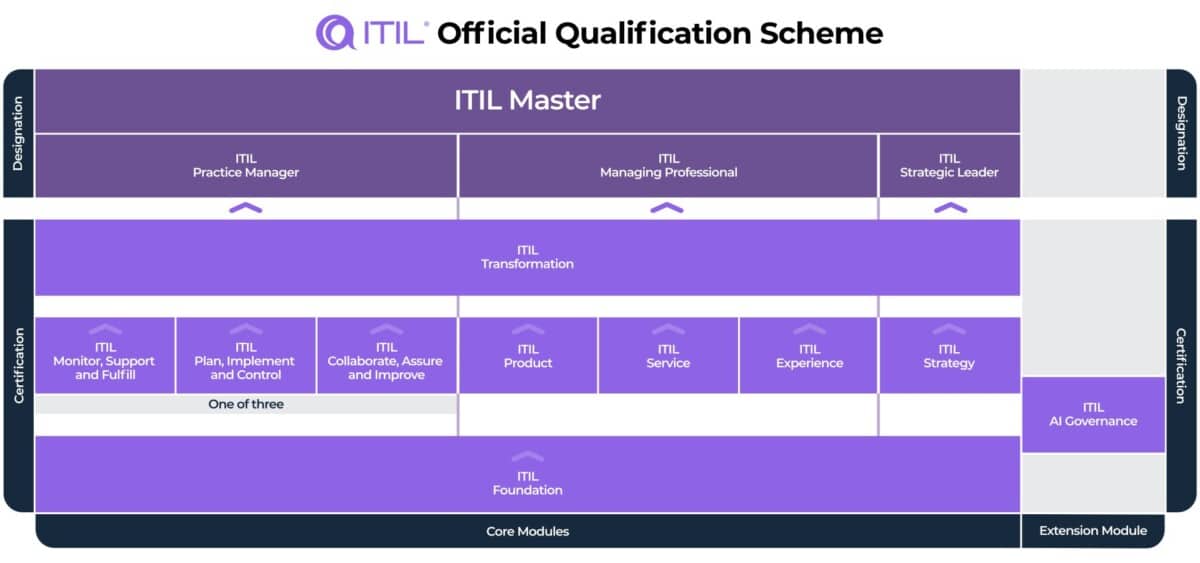
ITIL certification® Foundation (4 or 5) remains the compulsory entry point for all courses and for access to advanced modules.
This course is designed to give you the basics: understanding what a service is, what we call value, how responsibilities are organised, and why some companies perform better than others when it comes to digital services.
The Practitioner modules of version 4 no longer exist as stand-alone certifications: they are now included in each certification ITIL® Practice Manager (ITIL Monitor Support and Fulfill, ITIL Plan, Implement and Control, ITIL Collaborate, Assure and Improve).
The modules ITIL Product, ITIL Service and ITIL Experience lead to the ITIL Managing Professional designation.
A major new feature is the introduction of the ITIL Transformation module. This is now the only module common to all courses. It must be taken only once to obtain any of the three qualifications:
- ITIL Practice Manager (now including Practitioner modules).
- ITIL Managing Professional (via the Product, Service and Experience modules).
- ITIL Strategic Leader (via the Strategy module)
ITIL Master (Version 5) remains the highest level of certification.
Is the exam in French?
As with ITIL® 4, the ITIL Foundation (Version 5) exam is in English. The good news is that non-English-speaking candidates have access to 15 extra minutes, 75 minutes in total. At ORSYS, we already offer, with the support of our partners, Foundation training (Version 5) with a course material in French, in addition to the official PeopleCert support in English. A fully French-language version, including support and examination, is planned for autumn 2026.
I'm just starting out in service management, should I go for ITIL 4 or ITIL 5?
We strongly recommend that you directly to ITIL® 5. The frameworks are sufficiently different that learning ITIL® 4 will only give you some of the material you need for version 5. By choosing ITIL® 5, you will immediately learn the concepts of digital products and artificial intelligence that are the reality of business today.
Is the ITIL 5 exam more difficult than the ITIL 4 exam?
The approach has changed radically. Where ITIL® 4 required you to memorize specific practice steps (such as Incident Management), ITIL® 5 tests your strategic and global understanding. As a result, technical memory of practices only counts for 0 % in the Foundation exam for version 5, compared with 42.5 % previously.
How long is my voucher valid for?
The examination voucher is generally valid for 12 months from the date of issue.
How long is my ITIL certification valid for?
The PeopleCert rule has not changed: ITIL® certifications have a validity of 3 years. Re-certifying to ITIL® 5 renews your previous qualifications for a period of 3 years.