Soft skills, or behavioural skills, differentiate a savvy marketer from a mere technical executor. Among them, three skills stand out and paint a picture of the marketer of tomorrow: creativity, agility and critical thinking. These are three deeply human qualities, three essential levers for standing out in a world saturated with messages, constantly changing and sometimes chaotic. Clarisse Popower, an expert in digital marketing, gives us an overview of these key skills.

How can you capture the attention of a consumer who switches channels in less than two seconds? How can you remain relevant when artificial intelligence can produce content non-stop, without ever tiring? Marketing is currently undergoing a profound transformation.
Data explosion, the rise of generative AI, consumers who are more demanding and volatile than ever... The rules of the game are changing every day, and what worked yesterday may already seem obsolete today.
No matter how powerful they may be, tools are no longer enough. Software cannot invent a story that moves people. An algorithm cannot navigate an unexpected crisis. A raw database will never make a strategic decision on its own.
This is where soft skills come into play. Here are 3 essential skills to develop in order to make a difference.
Creativity to stand out
Open your smartphone: within seconds, you are bombarded with adverts, short videos and sponsored posts all vying for your attention. In this digital hubbub, one weapon remains indispensable: creativity.
But creativity in marketing is not what it used to be. It is no longer just about finding the perfect slogan or eye-catching visual. Today, creativity is the ability to:
- turn a TikTok trend into a viral campaign that truly engages
- create an immersive experience that combines digital and physical elements
- imagine storytelling that will leave a lasting impression on customers long after a video or event has ended
Example
The Patagonia brand perfectly illustrates the power of committed storytelling. With its campaign «Don't Buy This Jacket», it deliberately encouraged its customers to think before buying, highlighting the environmental impact of overconsumption. Far from being a conventional message, this responsible narrative made a lasting impression. It sparked a global debate on sustainability, while strengthening the brand's credibility and customer loyalty.
Read also : Marketers, how can you develop your creativity?
Training
Marketers: developing creativity
Unleash your creativity in marketing: learn how to generate original ideas and leverage AI to enrich your campaigns, while staying true to your brand identity.
Why is this vital? Because modern consumers no longer want to just buy. They want to have an experience, to feel emotions, to identify with a brand's values. Companies that understand this make a lasting impression. From Nike with its inspiring stories, to Netflix with its hyper-targeted and creative campaigns, to bold start-ups that are reinventing the rules.
The good news is that creativity is not a gift reserved for a select few. It can be cultivated on a daily basis.
How can you develop your creativity on a daily basis?
Vary your sources of inspiration: art, design, music, travel, social interactions.
Engage in collective brainstorming where every idea, even the most outlandish, is welcome.
Allow yourself to make mistakes and consider them part of the process.
Experimenting with new tools that broaden the scope of possibilities: mind mapping, generative AI such as ChatGPT or Midjourney.
Read also : How can AI boost marketers' creativity?
All in all, Creativity is an attitude.. It involves placing imagination at the heart of everyday life, surprising people and creating a strong emotional connection.
Testimonial
«In my team, I have established a weekly ritual where everyone has to share a creative idea inspired by a sector that is completely different from ours. This has enabled us, for example, to launch a campaign inspired by culinary design, even though we work in technology. This shift has generated record engagement on our social media channels.» Marketing and Communications Director, Retail Sector
Agility to adapt to constant change
Yesterday's marketing was like a well-marked motorway, with media plans defined months in advance. Today's marketing – marked by the immediacy of social media, the proliferation of channels and the arrival of AI – is more like a mountain road. Sharp turns, changing weather, constant surprises. In this context, it is not the fastest marketers who succeed, but the most agile.
Examples of changes
A reputation crisis erupts on social media.
New GDPR regulations are changing how data is used.
A Google algorithm update that reshuffles the SEO deck can happen overnight.
In such situations, following a rigid or overly linear plan is not enough.
What makes the difference is the ability to pivot quickly and adjust strategy without losing sight of the ultimate goal.
More and more marketing teams are adopting agile methods inspired by IT: short sprints, retrospectives, «test & learn» cycles. We experiment quickly, measure, correct, and relaunch. Failure becomes a learning springboard.
But agility goes beyond internal processes. It also relies on:
- cross-functional collaboration (data analysts, designers, sales representatives, community managers)
- actively listening to customer feedback
- the ability to integrate weak market signals (society, CSR, emerging trends)
Example: Some retail brands adjust their strategy in real time based on feedback collected on their mobile apps. This enables them to launch new offers tailored to detected behaviours within a matter of weeks.
Training
Agile methods: developing products and services in project mode
Far from being reserved for IT projects, agility is opening up to business projects: a new approach, values and tools for developing your products and services with creativity and pragmatism.
Agility is therefore a state of mind., a way of embracing change. Not as a threat, but as an opportunity for innovation.
The agile marketer is someone who knows how to bounce back and turn uncertainty into a competitive advantage.
Critical thinking to make sense of things and make better decisions
It is often said that data is the «new black gold». But what is a mine worth if no one knows how to exploit it? Raw data is a vast ocean. Without critical thinking, the marketer gets lost.
Developing critical thinking skills means first and foremost knowing how to:
- distinguish between a passing trend and an underlying trend
- question the figures instead of accepting them blindly
- avoid cognitive biases that distort decision-making
- ask the right questions before launching a new project
When faced with the arrival of a new «miracle» AI or automation tool, critical thinking acts as a filter. It allows us to ask ourselves:
- Is it really necessary to invest in this technology?
- Which KPI is truly relevant to my objective?
- Does this trend align with our brand identity, or is it merely a passing fad?
Testimonial
«When generative AI became a hot topic, we tested several tools. Rather than automating everything, we chose to use AI only to speed up certain searches and leave the strategic parts to humans. This choice allowed us to maintain our brand tone while increasing productivity.» Marketing Director, Retail Sector
But critical thinking is not just about performance. It also ensures credibility. Too many campaigns get lost in excess, overpromising or greenwashing. Consumers, who are better informed than ever, expect transparency, authenticity and consistency.
Tip: Before making any strategic decision, formulate three possible counterarguments and check whether your response to these objections is sound.
Developing a critical eye therefore also means building solid, trustworthy communication that stands the test of time.
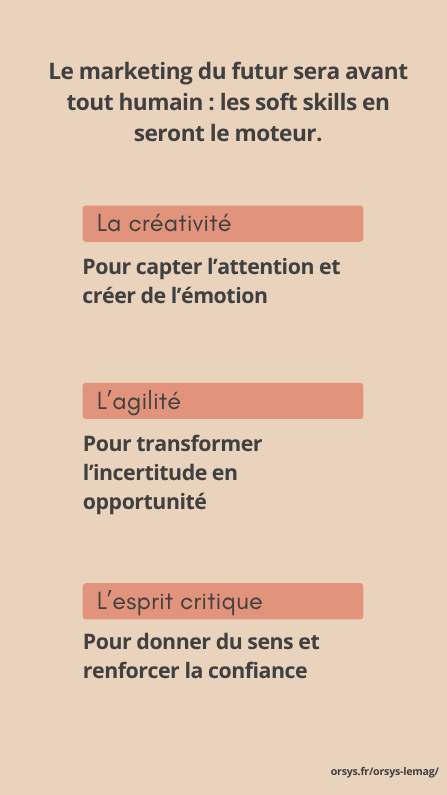
Ultimately, these three skills are much more than an asset. They represent the core of tomorrow's marketing performance. Marketers who develop these skills will not only be competitive, but indispensable. They will be able to create value, build lasting relationships and, above all, embody a smarter, more responsible and more human approach to marketing. So, which soft skill will you choose to develop today?