[For further information]
Hanging up politely on the telephone is not always easy, especially in professional English where the codes of courtesy differ significantly from French. How do you end a conversation without appearing abrupt, rushed or impolite? This practical information sheet provides you with effective and elegant ways of ending a call in English, while maintaining the quality of the professional relationship.
In a professional context, the telephone remains a key communication tool, but it is also a frequent source of misunderstanding, particularly when it comes to ending a conversation. In English, the difficulty is twofold: you have to be clear about your unavailability and at the same time respect codes of politeness that are often more indirect than those used in French. Too direct a formulation can be perceived as abrupt. This practical information sheet will help you find the right balance by suggesting some common expressions, adapted to different contexts.
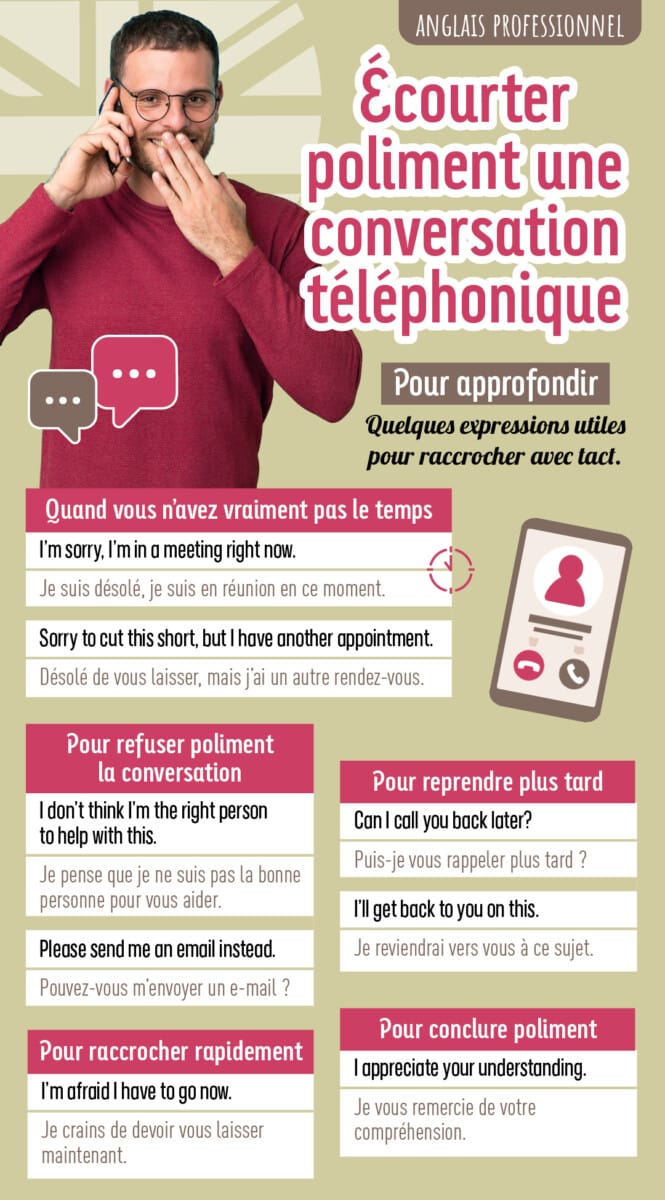
When you really don't have time
I'm sorry, I'm in a meeting right now.
I'm sorry, I'm in a meeting at the moment.
This isn't a good time to talk.
It's not the right time to talk.
Sorry to cut this short, but I have another appointment.
Sorry to leave you, but I have another appointment.
To politely decline conversation
I'm afraid I can't discuss this right now.
I'm afraid I can't discuss that now.
I don't think I'm the right person to help with this.
I don't think I'm the right person to help you.
Please send me an email instead.
Can you send me an e-mail?
To hang up without offending, learn to master the art of tactfully cutting short your calls in English.
To hang up quickly
I'm afraid I have to go now.
I'm afraid I have to leave you now.
I'm running out of time, could we continue another time?
I'm running out of time, can we continue this another time?
I'll let you go now.
I'll leave you to it.
I need to wrap this up now.
I must conclude now.
[Also read]
Taking a call in English can quickly lead to stress... especially when you're just starting out! Here are some useful phrases to help you be clear, polite and effective from the very first seconds of the conversation.
[Also read]
When the conversation gets off to a fast start or when the other person's accent is unfamiliar, a few key expressions and a bit of practice will help you to remain fluent and professional, even from a distance.
To resume later
I have to go now, let's talk later.
I've got to go now, so I'll talk to you later.
Let's continue this another time.
We'll pick this up another time.
Can I call you back later?
Can I call you back later?
Can we pick this up later?
Can we pick this up later?
I'll get back to you on this.
I'll get back to you on this.
To conclude politely
I appreciate your understanding.
Thank you for your understanding.
Have a great day!
Have a wonderful day!
💡 Advice and points to watch out for
This is a notable cultural difference, as English more often uses indirect forms of address. And British English even more so.
For example:
“Would you mind if we picked this up later?”
«Could we pick this up later?»
The wording can be misinterpreted by French speakers. They may think it is a question and not a request.
There is also frequent use of : “I was wondering if...”
For example:
“I was wondering if we could continue this conversation at a later time.”
«I was wondering if we could continue this conversation at another time.»
In a way, the more indirect and nuanced you are, the more professional you are perceived to be.
On the other side of the Atlantic, politeness is still the order of the day, but the American style is more pragmatic. Simple formulas are well accepted if the tone is cordial.
For example:
“I'll have to jump to another call.”
“Let's reconnect later.”
Too many detours can sometimes seem artificial. In this case, courtesy is above all clarity, synonymous with efficiency.