Artificial intelligence (AI) seems to be gradually gaining ground in the field of healthcare. Long associated with technology, it is beginning to find its place in clinical, educational and organisational environments. Conversational tools, decision support solutions, automated management systems: its uses are tending to diversify. This development is raising both expectations and questions among professionals. Against this backdrop, Lilia Campagna, a nurse, trainer and health executive, conducted an exploratory survey of a sample of healthcare professionals to gather their perceptions and experiences of AI in healthcare practices.

Understanding how healthcare workers and students perceive the transformations linked to AI in the field of healthcare is an essential challenge if we are to envisage its future deployment. AI is not just a powerful tool. It calls into question the place of clinical judgement, the nature of the therapeutic relationship, the protection of sensitive data and, more broadly, the ethical foundations of healthcare.
With this in mind, in June 2025 Lilia Campagna conducted an exploratory survey of forty-five participants using an online questionnaire.
Although the results are not sufficiently representative, they nevertheless provide an interesting insight into the current perceptions of healthcare professionals. In other words, their practices, the benefits they perceive, but also the fears they express.
Methodology
The questionnaire was distributed anonymously to healthcare students and practising professionals. It provides an overview of the profiles questioned, the AI tools used and their main areas of application. The responses also shed light on the perceived benefits, identified risks and level of confidence expressed in these technologies.
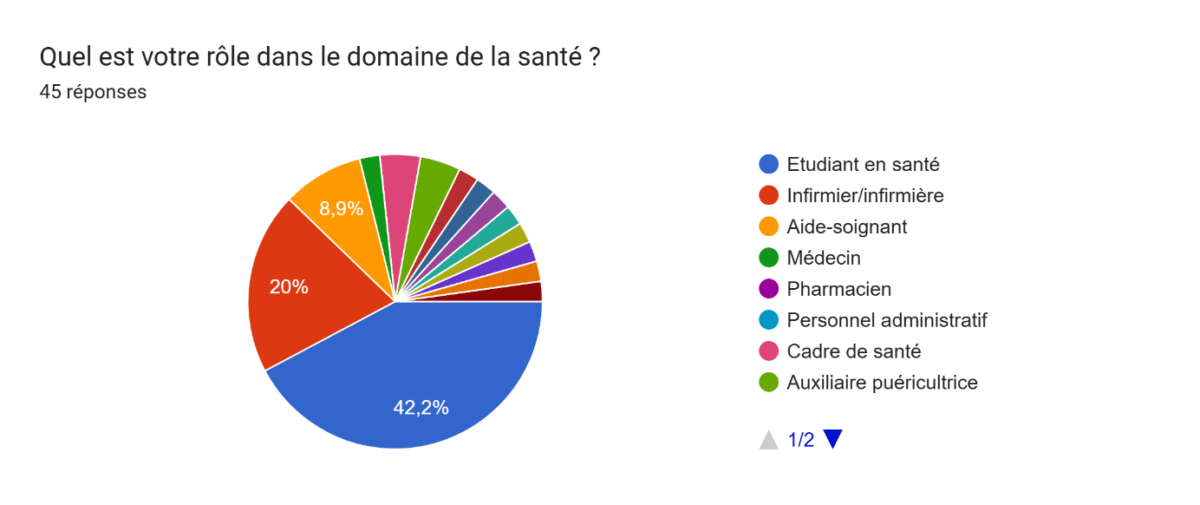
The majority of respondents were health students (42.2 %) and nurses (20 %), to which various other professions were added.
How can AI be used?
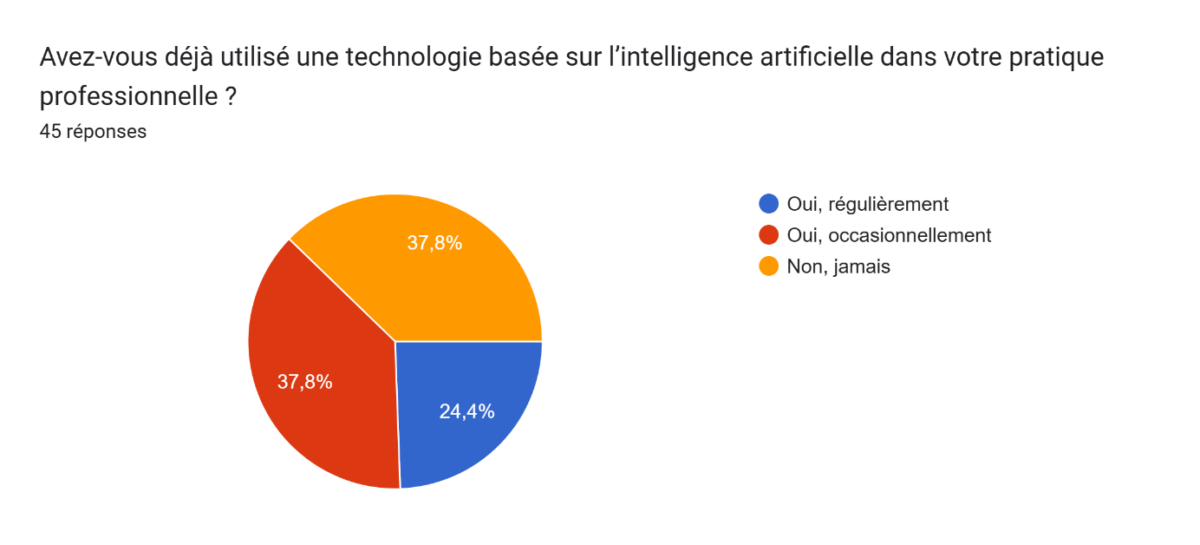
Overall, respondents express an interest in AI. As for their use, 24.4 % say they use them regularly, while 37.8 % have not yet experimented with these tools.
ChatGPT topped the list, followed by Copilot, Mistral AI and Gemini. Participants also mentioned diagnostic assistance software surgical robots as well as applications for drafting and managing files.
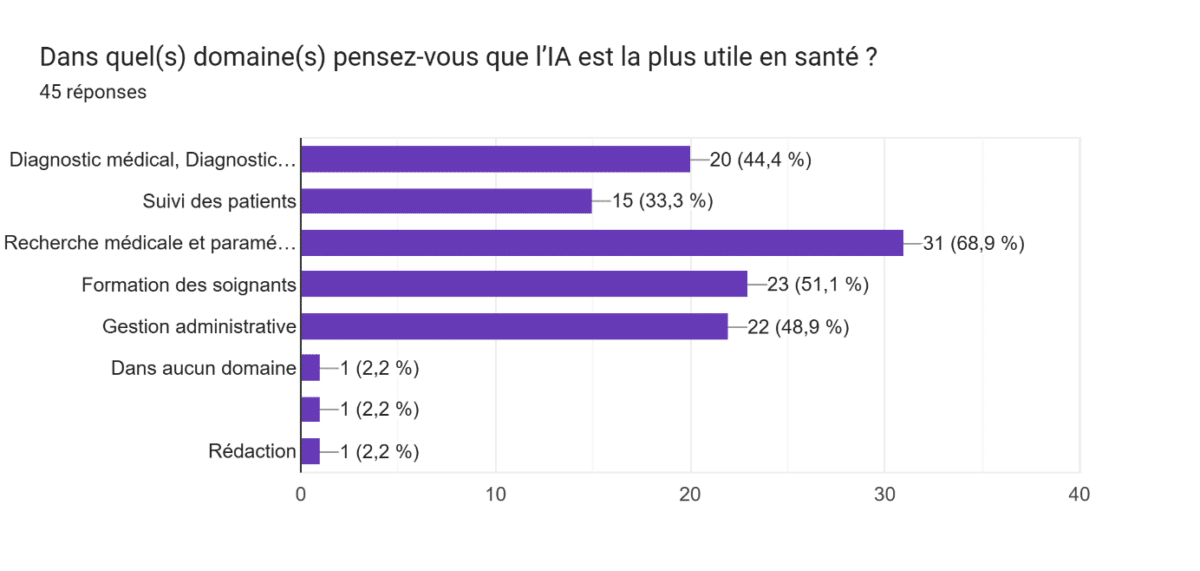
The areas considered most relevant by respondents for the integration of AI are medical research (68.9 %), training (51.1 %), Administrative management (48.9 %) and diagnosis (44.4 %). Patient follow-up (33.3 %) also appears to a lesser extent.
What are the benefits?
The 45 respondents to the study identified a number of potential benefits linked to the use of artificial intelligence in healthcare. One of the most frequently cited benefits was the time saving. This is thanks in particular to software capable of automatically analysing the results of medical imaging (MRI, scans), thereby reducing diagnosis times.
AI is also perceived as a invaluable editorial assistance. Digital assistants generate reports from voice notes or key words. This reduces the administrative burden on professionals.
It also makes it easier to access to information. Healthcare professionals can quickly find clinical recommendations or data on drug interactions.
Respondents also pointed to a improving the quality of diagnoses. There are tools that can cross-reference symptoms, history and test results to suggest hypotheses, even for rare diseases.
AI also makes it possible to automate repetitive tasks. For example, scheduling appointments or checking vitals, freeing up time for direct care.
Finally, it offers the possibility of individualising certain aspects of treatment, This is the case in oncology, where algorithms can propose protocols tailored to the patient's genetic and clinical profile.
Limits, risks and future prospects
The rise of AI in the field of healthcare is giving rise to both hopes and reservations. Participants identified a number of limitations and risks. The dehumanisation of care appears to be a recurring concern, combined with the fear of an impoverishment of the therapeutic relationship due to a reduction in human contact. Other concerns relate to the reliability of data, the risk of diagnostic errors with sometimes serious consequences, and cyber-security threats.
Testimonial
So, when asked «What do you see as the main risks or limitations of using AI in healthcare?», one participant shared the following concerns:
«In my opinion, the main risks associated with the use of artificial intelligence in healthcare relate first and foremost to the reliability of the data and the potential medical errors that may result. The absence of human judgement in certain clinical decisions raises major ethical questions, particularly in terms of liability in the event of a malfunction. Data security is also a crucial issue, especially given the risk of cyber attacks that could compromise sensitive information. Finally, I am concerned about the loss of human contact in the relationship between carer and patient, which could affect the quality of care and the well-being of patients. Over-reliance on technology could undermine the role of the healthcare professional and impoverish the overall approach to care.»
Another point of concern is the risk of excessive dependence on technology, which could lead to an erosion of clinical skills or standardisation of practices. When it comes to automating tasks, the activities perceived as most amenable to automation concern taking vital signs, drafting and managing documents, traceability and diagnostic assistance.
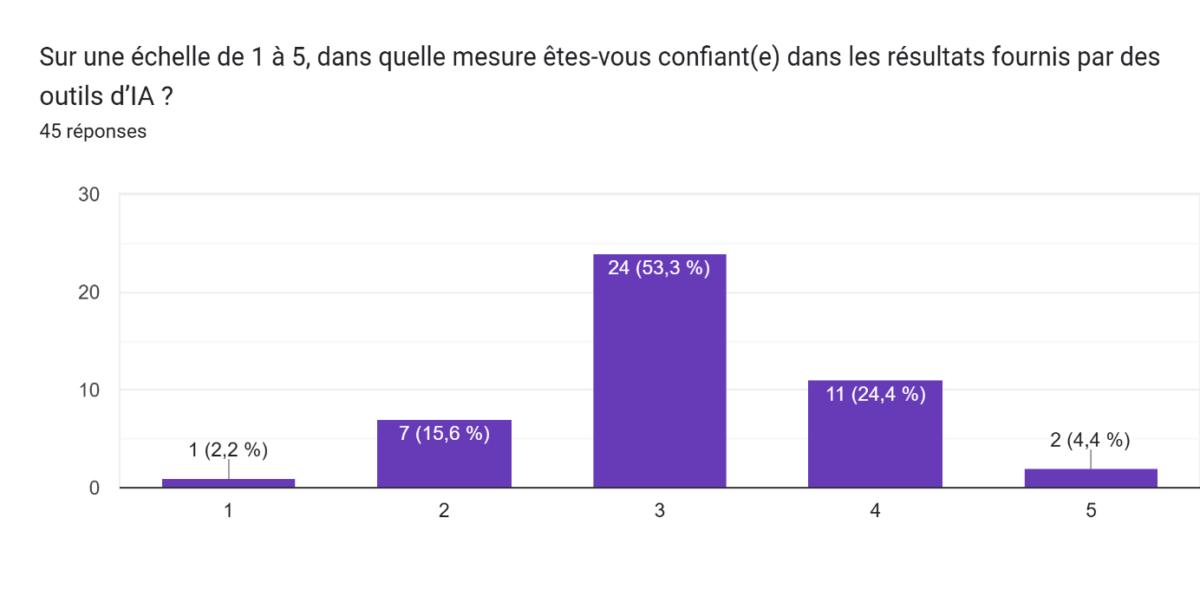
These reservations are accompanied by a still measured level of confidence. More than half of respondents (53.3 %) give AI an average rating of 3/5.
One participant shared her opinion on the matter: «AI can help with research, but it cannot replace humans. Similarly, we mustn't depend on AI, because we run the risk of no longer making an effort to communicate».
Respondents' emotions and perceptions
For many of the carers who took part in the study, AI is seen as an opportunity to simplify administrative workloads and reduce the burden of repetitive tasks.
«I use it to write interviews, which saves me time and gives me a better structure.»
The automation of certain stages and the provision of decision-making assistance offer the prospect of significant time savings, likely to encourage a refocusing on human support and a close relationship with the patient.
«As a result, I spend less time on the computer and more time with patients.»
However, this perspective is accompanied by a central concern: preserving the human dimension of care. Several respondents pointed out that complex situations, such as support at the end of life or mental health care, require above all empathy, listening and presence. In the absence of a clear educational framework, many professionals are still struggling to get to grips with these tools, which can lead to frustration and reluctance to deploy them.
«I discovered AI very recently and am still reluctant to use it, for fear of losing my free will.»
Towards a reasoned appropriation of AI in healthcare
A trend is emerging: the gradual adoption of AI, driven in particular by the strong presence of conversational tools. Respondents perceive a concrete contribution in terms of efficiency, particularly in the fields of research, training and administrative management. However, the results of the study highlight a shared concern about ethical issues, data security and the preservation of human relations. With this in mind, it would seem a priority to strengthen training systems. This would enable professionals and future users to adopt these technologies in a carefully considered, supervised and secure manner. This presupposes the implementation of a clear regulatory framework, ongoing performance evaluation and constant dialogue with stakeholders in the field.
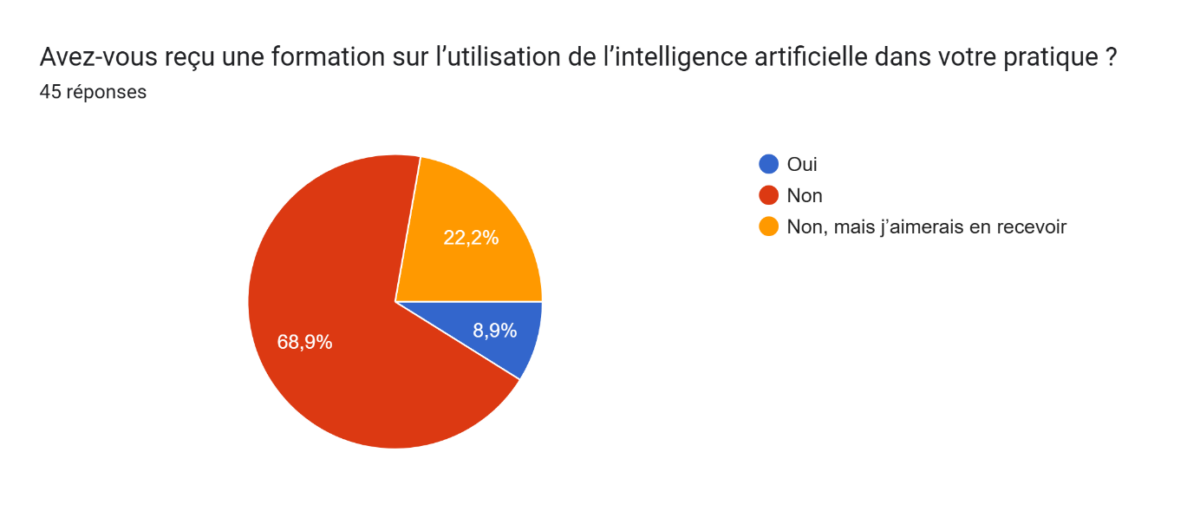
Only 8.9 % of respondents say they have already received an introduction to AI, while 68.9 % express a desire for training in order to better understand its uses and master the tools.
Get trained!
Improving professional efficiency with AI
Advanced prompting techniques, task automation, how AI agents work... Find out how to integrate AI into your professional practice to improve efficiency and responsiveness.
Examples of practical work :
- Analyse and identify time-consuming tasks using AI. In sub-groups, in an emergency context, choose the appropriate tools to process requests more quickly.
- Create your AI action plan and an AI Bot tailored to your business.
According to the results of this exploratory study of 45 healthcare professionals, AI appears to be a tool with interesting potential for healthcare. Its integration could help to improve the quality of practices, support professionals and encourage more efficient organisation. However, the respondents stressed the importance of maintaining a solid ethical framework, maintaining human skills and remaining alert to the limits of these technologies. All in all, a trend is emerging: AI will not replace the care-giver-patient relationship, but if used wisely, it could become a complementary ally in the service of more personalised, more human care.