Advertising saturation, falling attention spans, pressure on budgets... Marketing departments are looking for the best strategy to generate qualified leads despite the constraints. Inbound marketing is the answer. Brigitte Neveu-Dérotrie explains, an expert in digital marketing.
Inbound marketing is a marketing strategy that aims to attract customers naturally through useful content and experiences, rather than using more traditional, intrusive canvassing methods.
According to HubSpot, Over 90 % of companies that have adopted this strategy have seen a significant improvement in their lead generation. Nearly 50 % have increased their sales in seven months. But in 2026, the 2015 version of inbound is no longer enough. Search is changing (AI responses, zero clicks), buying paths are less and less observable for traditional marketing tools (“dark funnel”), and measurement is more fragile than before. The good news is that inbound marketing is still a powerful lever... as long as you use it methodically.
A tense marketing environment
Advertising everywhere, attention nowhere. In the B-to-B sector, buyers are over-solicited, budgets are scrutinised, and «cold» prospecting tires everyone out - including sales teams. As a result, companies are looking for a more profitable, more sustainable mechanism that feeds the pipeline without draining resources. This is exactly the promise of inbound marketing: to attract, qualify and convert, rather than chasing after lukewarm contacts.
Traditional or outbound prospecting methods (cold calls, non-segmented e-mail campaigns, standardised advertising messages) are showing their limits. Prospects either don't see them or avoid them, and don't respond.
| Criteria | Inbound marketing | Outbound marketing |
| Principle | Attracting prospects with useful content | Find prospects through direct prospecting |
| Acquisition cost | Weaker over time | Often higher |
| Conversion rate | Higher (prospects already interested) | Weaker |
| Length of sales cycle | Often shorter (better informed prospects) | Often longer |
| Relationship with the prospect | Based on trust and expertise | Based on interruption or solicitation |
| Examples of levers | SEO, articles, white papers, webinars, social networks | Cold e-mailing, cold calls, advertising, trade fairs |
Inbound marketing provides a strategic and structured response. This approach is based on the creation of useful content and the ability to bring prospects to you.
Added to this is the phenomenon of the «dark funnel». A growing proportion of purchasing decisions are made outside traditional measurement tools, through recommendations, community exchanges, private messages or comparisons consulted without direct interaction. Prospects therefore often arrive already informed, or even convinced, without their entire journey being fully visible.
In this context, the challenge of inbound marketing is no longer just to feed the pipeline, but to link content actions more closely to business results, by combining a structured approach, qualitative signals (self-reporting, feedback from the field) and more global performance indicators.
Inbound marketing responds effectively to the new expectations of users and the constraints of marketing and sales teams.
Why opt for inbound marketing in B-to-B?
In B-to-B, decision-making cycles are long, complex and involve several stakeholders.
Inbound marketing reduces the time spent prospecting by attracting prospects who have already shown an interest in your offer. It's no longer a question of cold calling, but of capturing an existing need and then nurturing it with high added-value content.
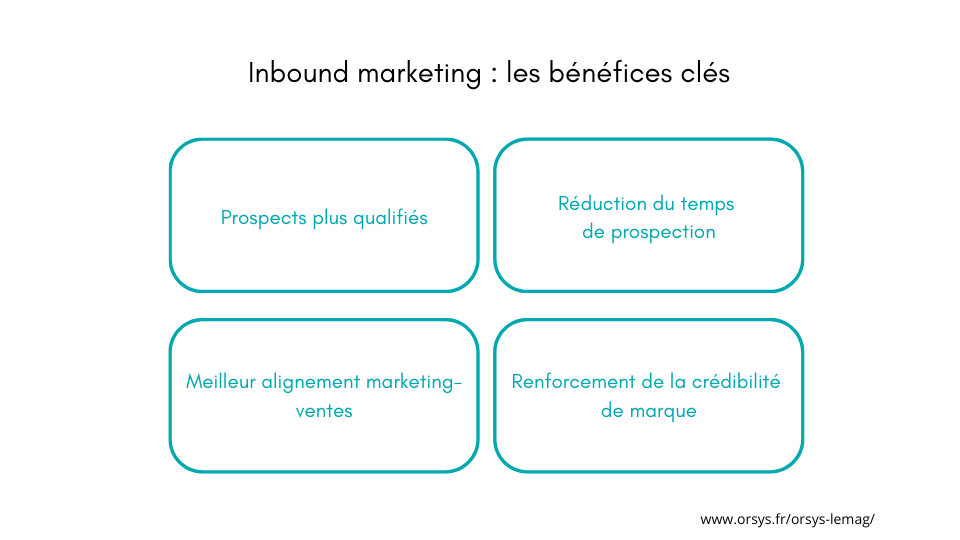
This approach represents a decisive advantage. A well-designed white paper, a sector-specific infographic or an expert webinar can generate far more qualified leads than untargeted e-mail campaigns.
Inbound marketing also improves collaboration between marketing and sales. The content produced serves as a prospecting tool, a sales argument and an educational resource. It enables sales reps to approach prospects with a tangible value proposition, rather than a generic sales pitch.
Examples
- HubSpot, an inbound pioneer, has built its global growth on an ecosystem of free content (certifications, checklists, guides and annual reports).
- LinkedIn relies on trend reports (Workplace Learning, Future of Work...) to attract and retain a massive professional audience.
- Salesforce uses expert content (State of Sales, State of Marketing, and events such as Dreamforce to generate qualified leads and reinforce its position as a CRM leader.
Testimonial
«Our inbound content has become a real sales tool. They help our sales teams to explain our software solutions and managed services. It's a way of engaging prospects with their business issues, rather than just a sales promise. Marketing Director, B-to-B software and IT services publisher
Get trained!
Would you like to develop your skills and boost your company's visibility on the web? Discover the training programme Webmarketing, the basics.
The 3 stages of effective inbound marketing
A successful inbound strategy is based on three key levers: attract, convert and close/loyalise.
1. Attract
The first step is to produce useful, educational content designed to address specific issues.
Key formats :
- SEO-optimised blog posts
- white papers and sector studies (authoritative content)
- infographics and checklists
- expert webinars and online eventsLinkIn posts, instructional videos, customer case studies
The aim is to publicise the company's expertise, build trust and attract targeted traffic.
The fundamentals of SEO in the age of AI
- Choose key words with strong intent (problems, uses, business issues)
- Produce expert, structured and educational content (readable by humans and AI)
- Structuring content for semantic understanding (headings, hierarchy, clarity)
- Strengthen editorial consistency with internal links
- Optimising the user experience (mobile, speed, readability)
- Measuring performance beyond the click (visibility, awareness, engagement signals)
2. Convert
Once a prospect has been attracted, they need to be directed towards a conversion process. The aim is not to sell a product or service, but to generate a lead.
Examples of tools :
- dedicated landing pages
- intelligent forms, tailored to the profile of the web user
- visible, contextualised calls to action
- free trials, demonstrations
In a context marked by the development of generative AI queries such as ChatGPT and zero-clicks, certain structured content (reference pages, FAQs, comparisons, figures) also plays an important role in reinforcing the credibility of the offer, understanding and decision-making, upstream of or in addition to conversion systems.
The key is fluidity: each piece of content should lead naturally to the next stage.
3. Close the deal and build loyalty
Lead generation is only one stage. An effective strategy is based on :
- a CRM to track and qualify contacts
- nurturing scenarios adapted to the level of interest (automated e-mail sequences triggered according to the prospect's behaviour and level of maturity, to help them reach a decision)
- scoring to prioritise the most advanced prospects
- dedicated customer content to strengthen the relationship
Building customer loyalty is often less costly than winning them over. Inbound also makes it possible to extend the relationship, generate recommendations and position the brand or company as a reliable partner.
It's not necessarily a question of building complex conversion tunnels, but of offering useful, targeted and coherent content that provides concrete support for prospects at every stage of their thinking process.
Examples of tools
- Newsletters help to engage, convert and retain leads with relevant content that adds real value. Customers can receive exclusive information, an invitation to an event or a promotion.
- HubSpot offers personalised communications and content throughout the customer cycle. Newsletters, content recommendations and in-app messages are tailored to the company's profile, level of maturity and functionalities used.
This personalisation helps you to get to grips with the tools, encourage their adoption and strengthen customer loyalty. - Salesforce customises its customer communications according to the company's profile, the modules used and the level of maturity of its teams.
Customers receive targeted content (user guides, feature recommendations, sector-specific webinars) tailored to their business challenges.
This approach encourages the adoption of solutions, the development of user skills and long-term loyalty. - Deloitte offers its customers targeted content (sector analyses, benchmarks, regulatory developments), depending on their business and priorities.
This content nurtures the relationship over time and makes it easier to renew assignments.
Get trained!
Developing an effective editorial strategy: from concept to the creation of engaging content
Key points:
- Design a clear editorial strategy tailored to your target audience
- Creating engaging content for the web and social networks
- Plan and measure the impact of your actions using practical tools
Who leads the implementation of an inbound strategy?
Inbound marketing is not just a marketing issue. A cross-functional approach is needed, with marketing-sales departments aligned from the design phase onwards.
Three examples of possible organisations:
- Marketing management with sales contribution Marketing produces the content, while the sales people identify the useful subjects and use these resources in their canvassing.
- Communication/marketing co-steering useful for companies where content is strategic (B to B, tech, industry).
- Sales enablement A model in which sales staff are equipped, trained and supported to integrate content into their approach.
Without cooperation and clear governance, content remains under-exploited and leads poorly followed up.
What tools do you need to succeed with your inbound strategy?
Implementing an inbound strategy need not be complex. The key is to choose solutions that are simple, scalable and tailored to the company's level of maturity.
Marketing automation
- HubSpot (market benchmark)
- Plezi (French solution for B-to-B)
- ActiveCampaign (flexible and accessible)
CRM
- Salesforce for large organisations
- HubSpot CRM for SMEs
- Zoho for SMEs with flexible needs
Analytics and data
- GA4
- Matomo (RGPD compliance)
- Hotjar (behavioural analysis)
Content and SEO
- Semrush, Ahrefs
- ChatGPT for structuring, reformulating or generating ideas
- Notion or Trello for organising content production
Sales engagement (reminders and sales activation)
- HubSpot Sales Hub for structuring follow-ups and tracking qualified leads
- Outreach or Salesloft to orchestrate multi-channel relaunch sequences in more mature organisations
What budget do you need?
Above all, inbound marketing requires consistency across the three levers:
- Human time for regular content production, lead tracking and management
- Tools From €100 to €1,000 per month, depending on the solution, the volume of contacts and the level of automation.
- Training : an essential initial investment to internalise best practice
Tip: start with the minimum viable product (MVP) technique. This is a targeted sequence based on an offer, a persona and a single channel, which allows you to start with a limited investment, test and adjust your strategy.
Measuring the performance of your strategy
Before launching a campaign, it is essential to think about how to measure its effectiveness.
Key B-to-B indicators :
- cost per lead (CPL)
- rate of qualified leads
- transformation rate
- length of sales cycle
To be completed by commitment indicators :
- time spent on content, clicks, bounces
- progress through the conversion tunnel
- attribution via dashboards (HubSpot, Plezi, Salesforce)
A well-managed inbound strategy can be seen in the figures: more qualified leads, less time wasted prospecting, better quality sales exchanges.
Read also : The key stages in building an effective marketing dashboard
Get trained!
Inbound marketing, converting prospects into customers
Do you want to turn your website visitors into qualified prospects and then loyal customers? This course will give you the keys to :
- Understand the new levers of inbound marketing and their practical benefits
- Generate more traffic and captivate your audience with high-value content
- Optimise your digital strategy to convert more effectively
- Measure and manage your actions using relevant indicators
Participants speak out:
«Very interesting subject, well covered. Comprehensive training. The exercises are very instructive as they enable us to put the theory into practice in our own field and therefore leave with good ideas to implement.»
Testimonial
«We structured our inbound strategy gradually, starting by clarifying our targets, our messages and our key content. Initially, the main challenge was to reconcile content production with internal operational constraints. After a few months, we noticed a clear improvement in the quality of leads and sales exchanges: prospects arrive better informed and sales cycles are smoother. Today, almost a third of the leads we generate come from inbound marketing, and the qualification rate is rising. The key lesson: inbound works when it's managed over the long term, with method and alignment between marketing and sales. Marketing Manager, ESN B to B (SME)
Inbound marketing is a profitable, sustainable lever that complements traditional sales initiatives. It enables companies to attract qualified prospects, improve sales performance and strengthen their expert positioning. The challenge is no longer to produce more content, but to produce the right content, for the right targets, at the right time, in a controlled, coherent and measurable way. Set up your inbound marketing strategy now. Create three buyer personas in collaboration with your sales team, carry out a quick SEO/UX audit of existing content and define a 6-month inbound plan, with one targeted action per month.