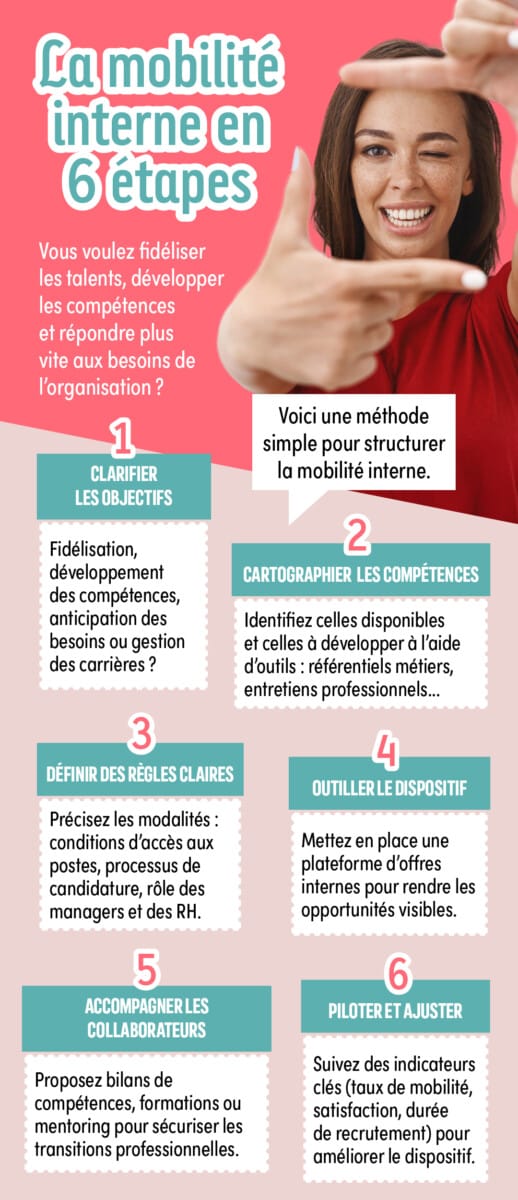
Internal mobility helps to retain talent, develop skills and respond more quickly to organisational needs. But in practical terms, how do you go about it?

With little structure, internal mobility remains an under-exploited lever in organisations. Between stated intentions and actual practices, the transition to action can be complex without a clear framework. However, if it is well thought through, it can become a strategic tool serving both employees and overall performance. Do you want to move from an opportunistic approach to a truly organised dynamic? Here's a simple method in 6 steps to structuring internal mobility.
1. Clarify the objectives of internal mobility
Building loyalty, developing skills, anticipating needs or managing careers?
First, formalise 2 to 3 clear priorities. For example: reduce staff turnover, fill key positions more quickly. Then translate them into concrete criteria. What types of mobility? For which audiences? With what expected results? Then, share these priorities and criteria with your managers to align your decisions.
2. Mapping skills
Identify what is available and what needs to be developed using tools such as job descriptions, professional interviews, etc.
First phase: Use professional interviews to identify current skills, development aspirations and potential.
Second phase: centralise this data (spreadsheet or HRIS).
Third phase: identify the gaps between future needs and available resources.
3. Define clear rules
Specify the procedures: conditions of access to positions, application process, role of managers and HR.
This is the basis: state the rules clearly of internal mobility! In other words: minimum seniority, application procedures, response times, the manager's role, etc.
Formalise a short process (application, interview, validation).
But above all, communicate widely to avoid informal practices!
4. Tools for internal mobility
Make opportunities visible!
Publish internal vacancies in a unique space (job exchange, intranet, career site, etc.).
Make sure it is easy to access, regularly updated and available to all.
Add alerts or notifications to encourage applications.
5. Supporting employees
Put forward concrete proposals!
Secure transitions with skills assessments, the mentoring or targeted training.
Raise managers' awareness so that they support mobility rather than hinder it.
6. Managing and adjusting internal mobility
Follow key indicators (mobility rates, satisfaction, recruitment times) to improve the system.
Analyse the obstacles (lack of applications, rejection by managers, etc.).
Finally, quickly adjust your practices.
[Also read] How can we maximise internal mobility processes?