[For further information]
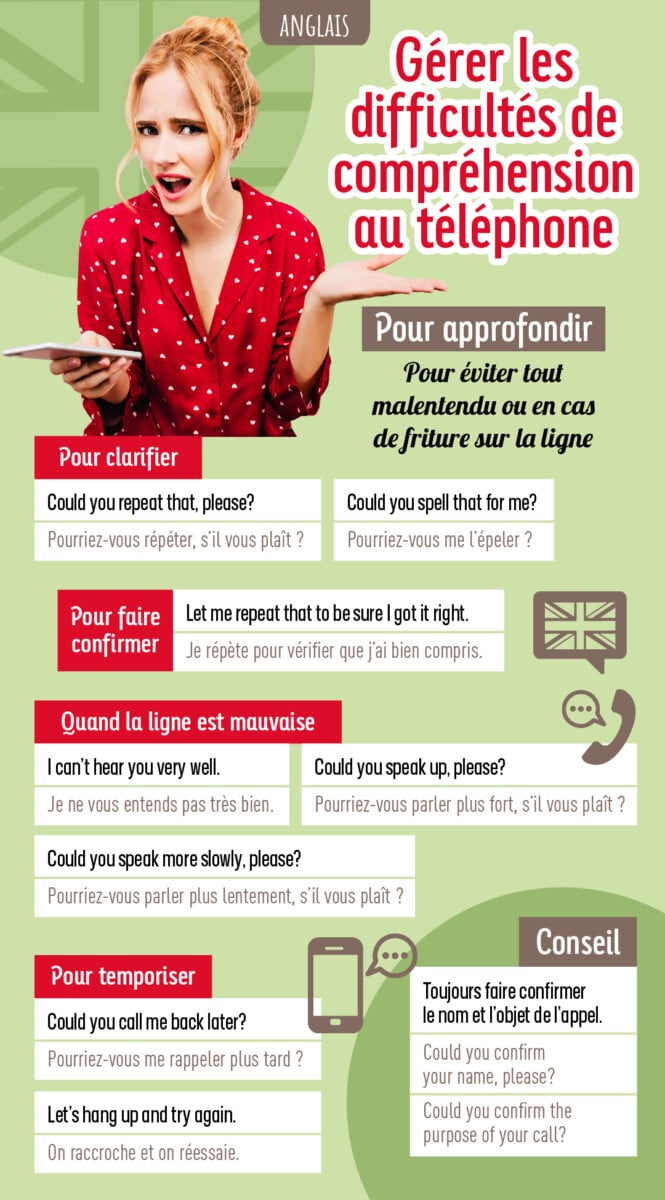
Difficulties in understanding on the telephone are common, especially when communicating in a foreign language. One misunderstood word... and there's a risk of misunderstanding that could be difficult to rectify afterwards. There may also be other factors affecting comprehension, such as a noisy environment or a lack of reception facilities. This practical information sheet contains key phrases and tips to help you make sure your message gets across.

To avoid any misunderstandings, or in the event of a fry-up on the line, here are a few key phrases.
Key phrases for dealing with comprehension difficulties on the telephone
🔁 To clarify / ask to repeat
“Sorry, I didn't catch that.”
«Sorry, I didn't understand.»
“Could you repeat that, please?”
«Could you repeat that, please?»
“Could you spell that for me? ”
«Could you spell it for me?»
✅ To confirm
“Let me repeat that to be sure I got it right.”
«I'm just repeating to make sure I've understood.»
🔊 When the line is bad
“I can't hear you very well.”
«I can't hear you very well.»
“You're breaking up.”
«The line is cutting.»
“Your voice is cutting out.”
«Your voice is choppy.»
“The connection is poor.”
«The connection is bad.»
🥁 When there's noise around
“There's a lot of background noise.”
«There's a lot of background noise.»
🛠️ To find a solution
“Could you speak up, please?”
«Could you speak up?»
“Could you speak more slowly, please?”
«Could you speak more slowly?»
“Could you call me back?”
«Could you call me back?»
“Let's hang up and try again.”
«Hang up and try again.»
[Also read]
Introducing yourself, asking for someone, closing politely... Make your English phone calls a success with these essential expressions!
[Also read]
Taking a call in English can quickly lead to stress... especially when you're just starting out! Here are some useful phrases to help you be clear, polite and effective from the very first seconds of the conversation.
[Also read]
When the conversation gets off to a fast start or when the other person's accent is unfamiliar, a few key expressions and a bit of practice will help you to remain fluent and professional, even from a distance.
A few tips to limit comprehension difficulties on the telephone
1/ Always confirm the name and purpose of the call
“Could you confirm your name, please?”
“Could you confirm the purpose of your call?”
2/ Figures
Numbers can be misunderstood. Example: thirty / thirteen. Don't hesitate to ask the person you are speaking to to repeat or even give an order of magnitude.
3/ Spelled words
Similarly, spelled names are often misunderstood. Here are some examples of the most common confusions when an English speaker spells out letters on the telephone.
The vowels A / E / I
- A → /eɪ/ → “é”
- E → /iː/ → “i”
- I → /aɪ/ → “aï”
When an English speaker says “e”, Some people can understand and write down «i».
Another common confusion : G / J
- G → /dʒiː/ → “dji”
- J → /dʒeɪ/ → “djeï”
Useful expressions to clarify :
- “Did you say A as in Alpha?”
- “Could you spell that using a word for each letter?”
To go further: contracted words
English speakers often speak faster than a beginner can process. They also use contracted words such as gonna, wanna, lemme.
For example : “lemma” is the oral (and sometimes written) contraction of “let me”.
🔎 More details
Complete form : Let me help you. → Here, let me help you.
Oral contraction : Lemma help you (often pronounced /ˈlɛmi/ or /ˈlɛmə/).
Usage : very common in telephone or informal conversations → “Lemme check that for you” (Let me check that for you). It is rarely used in written professional exchanges, but an English speaker can use it naturally in a business context.