Managing to keep to a date and a budget in a world where everything is constantly changing: this is perhaps the most paradoxical promise made to a project manager. What if the solution was neither 100 % predictive nor 100 % agile, but a hybrid? Project management expert Laurent Vandewalle explains how.
Delivering on time in a fast-moving world
" Keep to the date. Stick to the budget. And accept that needs will change. »
Behind this paradoxical injunction lies the daily reality of many project managers.
Accelerated digitisation, an explosion in technical dependencies, evolving regulatory constraints and changing user expectations: these days, a project rarely remains in a stable perimeter for more than a few weeks.
However, many organisations continue to think in terms of 100 % predictive approaches - reassuring, but quickly outdated - or, conversely, suddenly switch to 100 % agile - effective for building, but sometimes disconnected from the issues of deadlines and governance.
Between these two extremes, a solution is emerging: hybrid projects.
An approach that combines the predictability of the traditional with the flexibility of agile. And, above all, it is devilishly effective when it comes to delivering on time despite uncertainty.
What is a hybrid project?
Here's a simple definition. A hybrid project combine :
- a stable predictive framework target date, budget, milestones, regulatory constraints
- agile execution Adjustable scope, order of completion, short cycles, regular feedback.
To sum up:
– We protect the date and the budget.
– We make the content and the way we build the solution more flexible.
Three examples to help you understand
Project A: regulatory compliance (NIS 2 / RGPD)
The effective date is non-negotiable, but the detailed requirements evolve in line with exchanges with the regulator. The hybrid approach makes it possible to lock in the legal milestones while adjusting the content of the technical measures iteratively.
Project B: overhaul of a sensitive customer portal
The core transaction system cannot be changed lightly. Certain milestones have to remain fixed (security, load tests, audits), but user paths evolve after each demonstration of the mock-ups. Hybrid becomes the only way to move forward quickly without compromising safety.
Project C: modernisation of an internal ERP system
The company knows when it needs to migrate to the new version (end of publisher support). On the other hand, business needs become clearer as the workshops progress. The hybrid approach makes it possible to deliver a value-driven solution while respecting technical milestones.
When is a hybrid project the right answer?
A hybrid project becomes almost indispensable when several conditions are combined:
- A non-negotiable deadline
Examples: regulatory compliance, contractually agreed product launch, event. - Unclear or changing needs
Digital project where users “discover as they go”, technological innovation, high business complexity. - Strong safety, quality and image constraints
We can't afford to improvise: checks, tests and approvals remain fixed. - Many players need to be reassured
Management, business, IT, suppliers, DPO, RSSI... The hybrid facilitates dialogue between the executive and operational worlds.
Should your project become a hybrid?
- Have you at least one non-negotiable constraint (date, budget, compliance)?
- Le perimeter detailed is uncertain, incomplete or liable to change ?
- Are users likely to change their minds after seeing the first versions?
- Is there more than 3 major stakeholders to align?
- Is there a high risk of tunnel vision (seeing nothing until the end) or of a late surprise?
If you answer «yes» to 3 or more questions → hybrid is probably the optimal approach.
How to structure a hybrid project to deliver on time
Setting a realistic predictive framework
Even in hybrid mode, the fundamentals must be solid :
- Clarify objectives → why are we doing this project?
- Set a credible target date → neither optimistic nor too late.
- Define a budget including a reserve managed by the sponsor.
- Identify the major milestones → design, approval, testing, commissioning.
- List what is non-negotiable safety, legal constraints, quality standards.
For the project A (regulatory), The milestones correspond to the regulator's obligations (audits, declaration of conformity).
For the project C (ERP), The key milestone is the support end date.
Organising work in agile mode within the framework
Once the foundation has been laid, the execution can become more fluid:
- Set up a prioritised backlog (functionalities, requirements, risks).
- Working in iterations (sprints, 2-3 week cycles).
- Involving users in frequent demonstrations.
- Adjusting content along the way depending on value and risk.
In the project B (customer portal), Each sprint produces a functional model of the customer journey, which is immediately tested with a user panel.
Connecting the two worlds: synchronising agility and milestones
This is the heart of the hybrid model.
- Sprint reviews feed into project committees.
- The backlog is updated in line with steering decisions.
- The scope is adjusted to protect deadlines and the budget.
Case in point:
On the project C, Two initially planned functionalities (advanced export, custom reporting) have been postponed to version 2 in order to absorb unforeseen technical issues without affecting the migration date.
Hybrid roles, governance and tools
Who does what?
- Project manager Keeping an overview, securing the trajectory, managing risks and commitments.
- Product owner / business representative : prioritises value, arbitrates content.
- Sponsor supports the necessary trade-offs between scope, cost and deadline.
Appropriate governance
The hybrid doesn't multiply the number of meetings. clarifies them :
- Steering committees → structuring decisions, arbitration.
- Agile rituals → daily, sprint review, retrospective for team dynamics.
- Mixed reporting :
- traditional indicators (milestones, costs, risks),
- actual functional progress (burn-up, delivered value, % of the completed backlog).
Practical tools
The hybrid is based on complementary tools, not competitors:
- Planning for milestones (Microsoft Project, Excel, etc.).
- Operational management (Jira, Trello, Azure DevOps...) for tasks and the backlog.
- Living documentation (Confluence, SharePoint) to share decisions and specs.
On the project B, Jira manages user stories, while Project secures security and audit milestones.
Pitfalls to avoid
| The trap | Consequences | Good practice |
|---|---|---|
| The «false hybrid» |
Doing «a bit of both», agile without a framework (we keep to the schedule, add sprints and hope for the best) Confusion, unclear decisions, scope creep |
Clearly define from the outset what is fixed (non-negotiable base) and what is flexible. |
| Bureaucracy |
Adding agility on top of cumbersome governance Team burnout (meeting fatigue). More time is spent reporting on work than actually doing it. |
Streamline governance (committees, meetings, reports) and retain essential ceremonies. |
| Never referee |
Wanting to deliver the entire perimeter on a fixed date A collapse in quality. To meet deadlines, tests or security are sacrificed, creating a major technical debt. |
Practise active scope management and take responsibility for priorities. If one priority goes up, another must go down or be postponed. |
| Remaining opaque about actual progress |
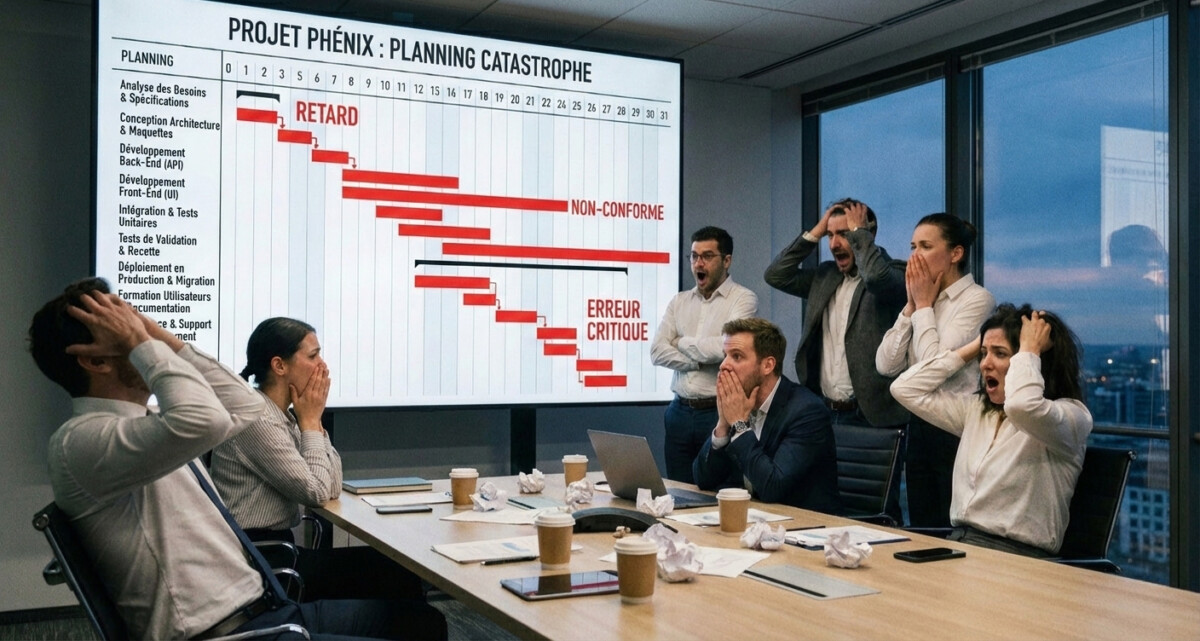
Hiding progress under an overly «green» Gantt chart» The problems come to light in the final phase, when it's too late. |
Share regular reviews, demonstrate results. Respect critical milestones and the team's actual speed. |
Change your attitude to better meet your commitments
The hybrid approach is not a soft compromise: it is an intelligent framework capable of reconciling control and flexibility in an unstable world.
The role of the project manager is changing: he or she is becoming negotiator of priorities, translator between needs and methods, guardian of a clear framework. The PO delivers the value. Together, they create the conditions for delivering on time and on course. even in the face of the storms of change.
For many teams, hybrids are no longer an option. It's a the most realistic route to make a success of modern projects (regulatory, digital, technical) without sacrificing quality or deadlines.
Try it out on your next project. No need to revolutionise everything, just hybridize gradually.