In 2025, it will become risky to rush headlong into prospecting without taking the time to target your audience, at the risk of annoying them when they are already being bombarded by massive email and telephone campaigns. Furthermore, your time, like that of your prospects, is a precious resource. The most effective methods are often the best prepared. So, what strategy should you adopt for prospecting? An overview of best practices with Yohan Boilleaut, an expert in B2B sales.

Back to basics: ICP, persona and USP at the heart of your prospecting strategy
The ideal customer profile
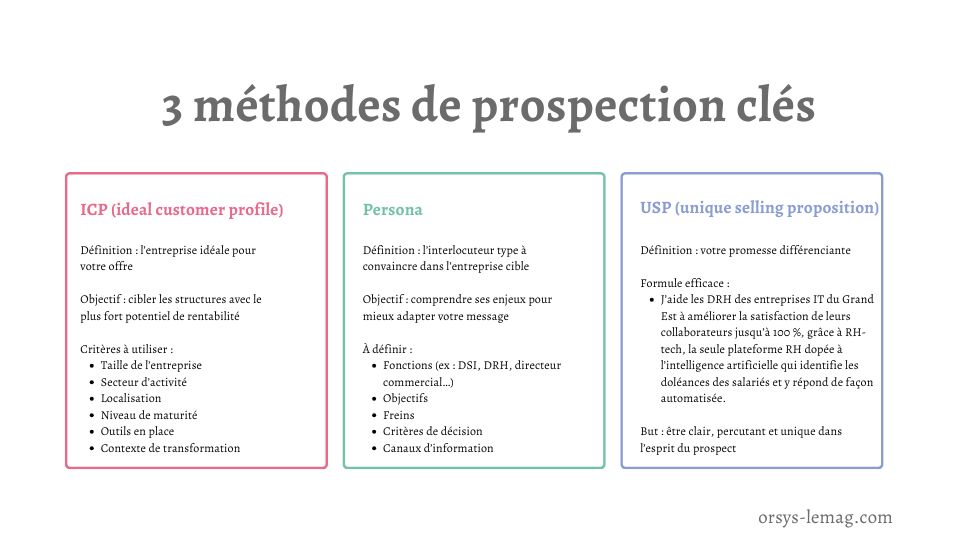
L'ICP or ideal customer profile is the representation of the ideal type of company for your business. It helps answer a key question: what does the organisation that is most likely to derive value from my offering, purchase it quickly and be a profitable customer over time look like?
To answer this question, rely on objective criteria: company size, industry, location, maturity level of your type of offering, tools already in place, or even the context of transformation. The ICP is a sorting tool. It allows you to rule out what is not relevant so you can focus your efforts where the impact will be greatest.
For example: «Target SMEs in the PACA region with fewer than 50 employees, specialising in IT and with a sales director.» is a relevant ICP for your offering.
In prospecting, generating volume without precise targeting is exhausting. Precision, on the other hand, generates value.
The persona
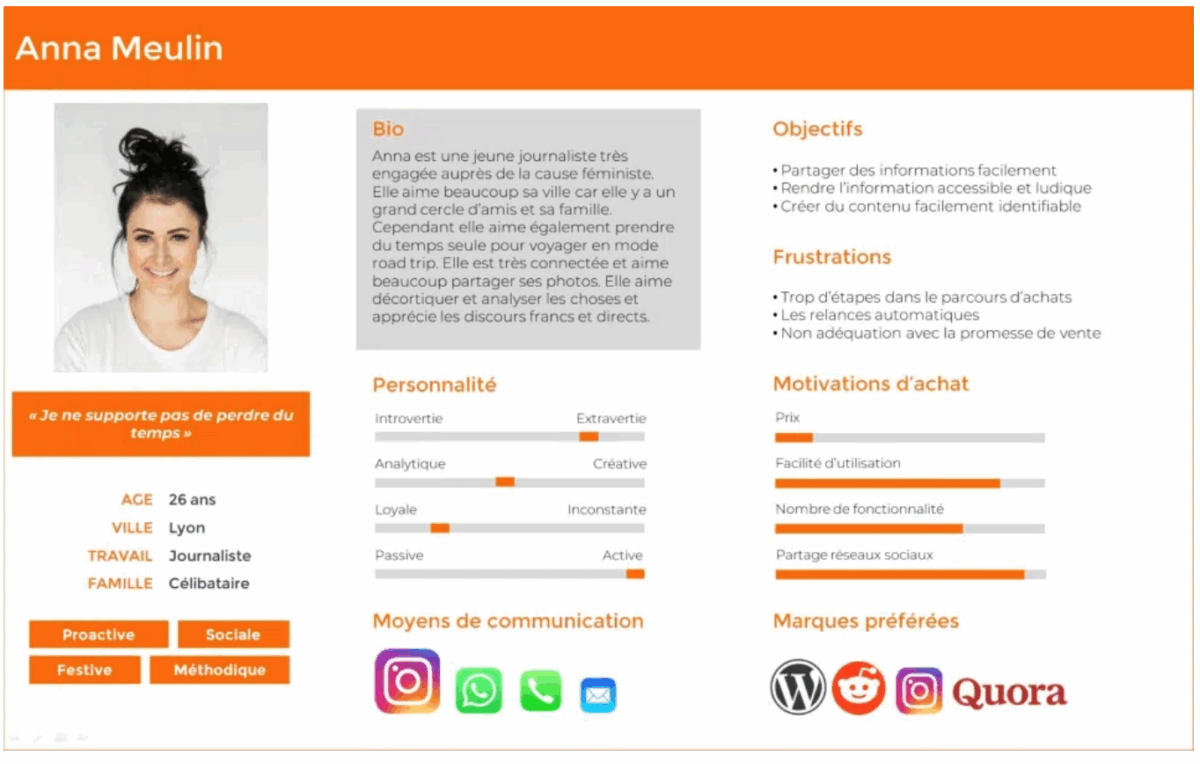
Once the target company has been identified, you still need to know who to contact. This is where the persona. Unlike the ICP, which describes a structure, the persona represents the typical contact person you want to convince within that company: a CIO, HR director, sales director or accountant, for example.
Defining a persona means putting yourself in that person's shoes to better understand their challenges, goals, pain points, decision-making criteria, and information consumption habits. This allows you to finely tune your message, your channels, and your approach. You don't address a strategic decision-maker in the same way you address an operational user. The persona helps you make this distinction accurately.
To create your persona, feel free to use the free tools offered by Semrush, HubSpot, or Canva.
The unique selling proposition
One last pillar remains: the’USP or uunique selling proposition. This is the promise you make to your prospective customer. It summarises what you offer, to whom, for what purpose, and therefore why it sets you apart in the market.
An effective USP can be summed up in one sentence, often phrased as follows: I help (your target audience) solve (their problem) using (your unique method/resources).
For example: « I help HR directors at IT companies in the Grand Est region improve employee satisfaction by up to 100%, thanks to RH-tech, the only AI-powered HR platform that identifies employee grievances and responds to them automatically.»
This type of message is your business compass. It allows your prospects to quickly understand what you offer, why it matters to them, and what makes you unique.
ICP, persona, USP: this trio is not reserved for large corporations or well-equipped start-ups. It forms the basis of any structured prospecting. And in 2025, structuring your approach is no longer a luxury: it is a condition for commercial survival.
A key concept: A/B testing, at the heart of your prospecting strategy
Looking for the perfect prospecting email? The foolproof telephone script? The bad news is, there isn't one.
The good news is that you can create your own winning version. Provided you adopt a reflex that has become essential in modern business strategies: A/B testing.
The principle is simple. It involves testing two versions of the same marketing message – an email, a telephone pitch, a LinkedIn message – on two similar groups of prospects, in order to objectively identify which one works best.
Here is an example: you send a campaign of 200 emails to decision-makers.
You split your file into two groups of 100.
- In version A, you focus on a value-oriented hook:
«How can you reduce your logistics costs by 20% in three months?»
- In version B, you opt for a more conversational and personalised tone:
«A quick idea for your logistics, Mr Dupont.»
After sending, you analyse the results:
- Which item generated the highest open rate?
- Which content generated the most clicks, responses, or appointments?
The most effective version is retained, reworked... and then compared with a new variant. The selected version is compared with version C, then D, and so on. The aim is to gradually refine the message until you have the best possible version to convince your target audience.
This iterative process is not limited to email marketing. It applies equally to your telephone scripts, your LinkedIn messages, your Instagram posts, and even your pitches at business clubs. Every channel deserves to be tested, adjusted, and optimised.
A/B testing is much more than a tool: it is a continuous improvement process that enhances the effectiveness of your prospecting activities.
Expert opinion – Yohan Boilleaut
During my prospecting classes at business school, I have my students work in teams of five on email/LinkedIn campaigns with Human Linker. Each team has a database built from an identical ICP and then creates its personas. However, the students write their scripts individually. At the end of the campaign, they see that their results differ depending on what they wrote, even though the target audience was similar. They then identify the most effective script to use in the future: the one with the best open, click and/or response rates.
Manage your time and effort so you don't run out of steam
Prospecting is demanding. It requires stamina, consistency and the ability to handle rejection. That's why it's important to manage your time and energy well so you don't run out of steam.
Step one: set realistic, quantified targets
Before deciding how many actions you need to take each day, start by asking yourself a simple question: «How many new customers do I need to reach my goals?».
An example
Your average basket value is €5,000. Your monthly target is to achieve €10,000 in additional revenue compared to the previous year. This means you need two new customers per month.
If your conversion rate (signature rate) is 1 customer out of 2 at the end of an appointment, you will need 4 qualified appointments.
Your preferred medium is the telephone, mainly the cold call. This is a call to a prospect with whom you have not had any previous contact. This is in contrast to a warm call, which involves calling back a prospect who has shown interest in your offer (response to an email, meeting at a trade show, etc.).
So, if you get an average of 1 appointment for every 10 telephone calls made, then 40 well-targeted calls are enough to achieve your goal.
By considering these figures, you can adapt your schedule. Forty well-targeted calls per month should be easier to fit into your schedule than 35 hours of cold call, isn't it?
Step two: plan your efforts wisely
Setting aside an entire day just for cold calling may seem productive... in theory. In practice, after two hours, you're exhausted.
It is better to spread your efforts throughout the week with several short but regular slots. Dedicated 1-2 hour sessions, with a clear intention for each call, will be much more effective than a 7-hour marathon.
Step three: adapt your schedule to the pace of your prospects
Not all slots are equal.
- Monday mornings are often a false start: full inboxes, internal meetings... little real availability.
- Some profiles are more reachable in the middle or late morning. Others are more likely to pick up in the middle of the afternoon.
- And some simply do not work on Wednesdays.
A word of advice: take the time to analyse your target audience's habits... and tailor your prospecting slots to the times when your prospects are most likely to be available.
Read also : Sales representatives, optimise your time management to improve efficiency
Get trained!
Professional effectiveness for sales staff
How can you implement good organisational practices to manage pressure and keep negative stress at bay? Discover which tools to use to optimise the management of your priorities and your commercial performance.
Sorting through databases
One last point. When you have a well-stocked database, it is tempting to want to contact everyone. However, not all prospects are equal in terms of potential... or accessibility.
The relevant question is: who should you contact first to maximise your chances of securing a qualified appointment?
While there are several tools available for assigning ratings to prospects (the scoring), the IPO-IPA matrix is also relevant.
IPO
Probable potential index
IPA
Probable accessibility index
Start with the IPO, i.e. by assessing the potential of each company in your database according to specific criteria, applying three categories: high, medium or low potential. Potential criteria could include:
- Company size
- Observed or expected growth
- Estimated budget
- Identified projects (site opening, fundraising, etc.)
- Alignment with your ICP, etc.
Once you have completed this initial sorting, move on to the second dimension: the IPA.
Here, the aim is to assess your ability to connect with the right person in the company:
- Do you have any contacts within the organisation?
- Do you have any references in the same sector?
- Can you benefit from a recommendation or a shared link?
- Is the decision-maker reachable and responsive on LinkedIn?
Then assign each prospect an accessibility level: high, medium or low.
From now on, your priority is as follows: first target companies with high IPO and high IPA. These are your “quick wins.
Good potential, a promising start: this is where your prospecting efforts will yield the best return on investment.
Prospects with high potential but low accessibility deserve to be nurtured over time through nurturing or targeted visibility actions. Nurturing consists of supporting a prospect who is not yet ready to buy by regularly providing them with value (content, advice, interactions) to maintain the relationship without being intrusive.
Those with a strong IPA but low potential can be useful for fine-tuning your messages... but be careful not to spread yourself too thin.
Working methodically also means knowing how to say no to the wrong priorities.
Get trained!
Would you like to know how to implement your prospecting strategy and what pragmatic approach to adopt? Discover the training programme. Prospect and win new customers.
Key points:
- Mastering useful methods for preparing and organising your prospecting
- Capturing your audience's attention through rapid communication techniques
- Prepare your scenarios and optimise each contact
Manage and measure your prospecting activities over time
Read also
The most effective prospecting methods
Recommendations, multi-channel, AI... Have you adapted your prospecting methods to the reality of 2025? Prospecting is not (yet) selling. Prospecting is about getting an appointment. No more, no less. But in a world saturated with offers and messages, the rules of the prospecting game have changed.
In conclusion, the key to successful prospecting is not to do more, but to do better. By defining your ICP, personas and USP, you can sharpen your targeting. By structuring your campaigns, testing your messages, managing your time intelligently and qualifying your databases, you can make your sales activities more effective by focusing your efforts where they have a real impact. What if preparation was the real superpower of the modern salesperson?