Social media is evolving at breakneck speed. Between the emergence of new formats, audience fragmentation and growing demands for authenticity and engagement, brands must adapt their digital presence to remain effective. Choosing the right channels, setting clear objectives and aligning your strategy with your audience's expectations is becoming crucial. What are the major trends for 2026? What are the best practices to consider when building a relevant and distinctive social media strategy? We take a look at the big picture with Brigitte Neveu-Dérotrie, an expert in digital marketing.

According to a Hootsuite 2025 study, 82% of French companies plan to increase their social media budget in 2026. Social media has become essential for recruiting, selling and building customer loyalty.
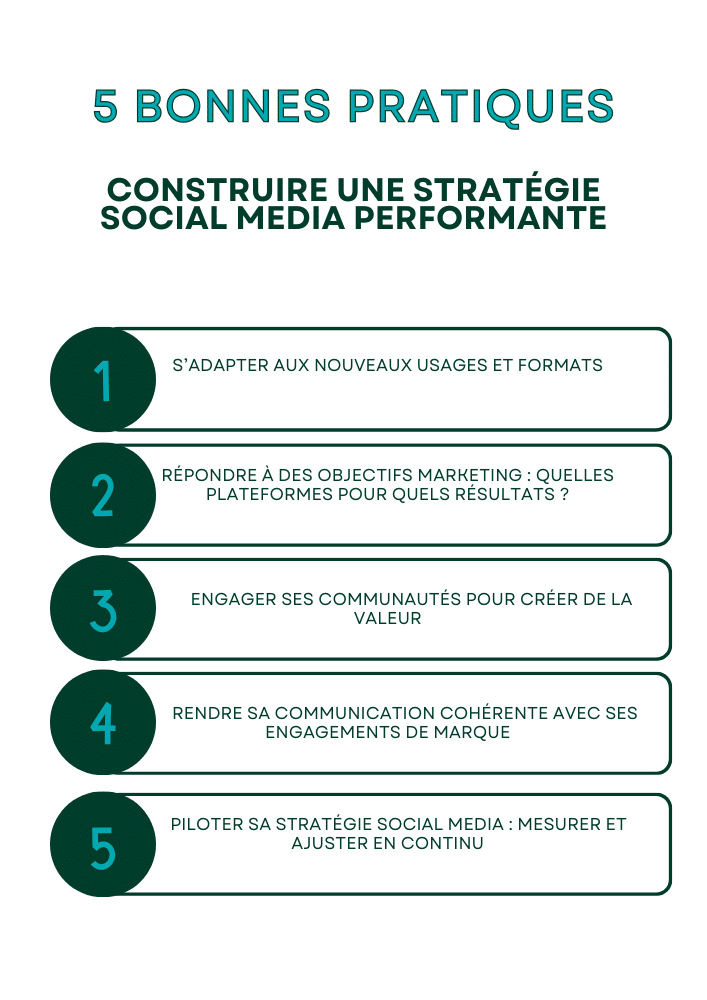
Here are five best practices to adopt in order to build an effective social media strategy in 2026.
1 – Adapting to new uses and formats
2 – Meeting marketing objectives: which platforms for which results?
3 – Engaging communities to create value
4 – Ensure that your communication is consistent with your brand commitments
5 – Managing your social media strategy: continuous measurement and adjustment
1 – Adapting to new uses and formats
Platforms and algorithms now favour short, immersive and interactive formats.
- Short videos, in vertical format: TikTok, Instagram Reels, YouTube Shorts
Algorithms favour content viewing time and engagement: private message sharing and comments. To capture attention, you need to hook internet users from the very first seconds with a striking visual, a question or a clear promise. To maintain a dynamic pace, use subtitles and visual cues.
- Carousels LinkedIn, Instagram
They are very useful for explaining a message, educational content, comparisons or structured arguments. On LinkedIn, this format helps readers to remember information better and highlights B2B expertise. Use clear titles, one idea per slide and a final call to action.
- UGC (user-generated content) and native content Authenticity is paramount. Users consider spontaneous content to be more credible.
- Collaborations and live performances Webinars with Q&A sessions, interviews, and co-creations strengthen engagement and organic visibility.
How can you capture attention in just a few seconds?
- Start with your value proposition : announce the benefit in one sentence. Examples: «How to halve...», «Three mistakes to avoid...».
- Anchor visually Close-up shot of face/product, text on screen, elements moving every 1 or 2 seconds.
- Write a script : structure problem → solution → proof → call to action.
- Take care of the audio videos: clear voice, high-quality microphone, light sound effects, discreet music.
- Optimise for retention : teasers, visual chaptering, call to action and promise at the end (reward, bonus, summary).
- Recycle wisely : the same angle can be used in Shorts, Reels, TikTok and carousel.
Growing networks to watch
| Platforms | Community | Target/Interest |
| 33 to 34 million of members in 2025 Steady growth | Preferred for promoting the company's expertise, employee engagement, recruitment and B2B lead generation. | |
| TikTok | 27.8 million monthly active users in France in 2025 It is one of the most widely used social networks. | For a young and mainstream audience |
| YouTube | More than 46 million unique monthly users in 2025 The second most widely used platform in France after Facebook | Appeals to all generations, but mainly to 18-34 year olds |
| Threads | 400 million monthly active users worldwide in 2025 | Useful for monitoring and organic reach on current affairs topics |
| Twitch | Booming, 105 million monthly active users worldwide in 2025 | A predominantly male community, aged 15 to 24 Opportunity for brands that want to test a product, sponsor a streamer or a tournament... |
| Bluesky | A tens of millions registered The number of daily users remains modest. | Relevant for tech or media communities and experimentation |
| BeReal | 40 million monthly users in 2025 | Used mainly by Generation Z with a focus on authenticity To be treated as a one-off activation rather than a pillar |
Get trained!
Webmarketing, the basics
A training course to understand all the components of digital marketing, measure the impact of its various levers on business performance, and learn how to create and manage effective cross-channel strategies.
2 – Meeting marketing objectives: which platforms for which results?
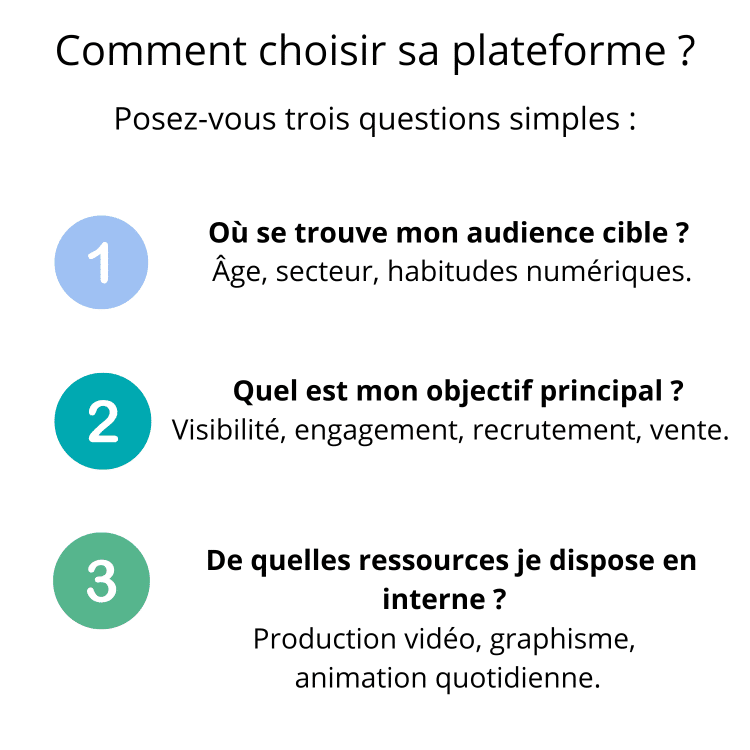
Each network has its strengths, limitations and uses. Rather than being «everywhere», it is better to prioritise according to your targets and objectives: brand awareness, engagement, lead generation, conversion.
B2B: visibility and professional credibility
- LinkedIn : to develop your professional network, publish expert content, generate qualified leads, and recruit.
- YouTube : to build lasting brand awareness through long-form videos, tutorials, interviews, and demonstrations of expertise.
- X : remains a channel of influence and monitoring in certain sectors (technology, media, politics, sport). Useful for responsiveness (e.g. in the event of a crisis) and sharing news.
Testimonial :
«LinkedIn has become our number one channel for recruitment, and 40% of our qualified leads come from this network.» – B2B Marketing Manager, Industrial SME.
B2C: awareness, engagement and conversion
- Facebook : broad audience, aged 30-60. Interesting for its targeted advertising and community engagement via groups.
- Instagram (27 million users in France): essential for brand image, lifestyle, and visual sectors (fashion, food, tourism, sport). Reels are currently the preferred format.
- TikTok : effective for reaching younger generations and generating virality via short videos. Also interesting for e-commerce via «social shopping».
- YouTube : is essential for both long videos (tutorials, interviews, testimonials, which tend to be viewed on large screens) and short formats with Shorts.
- Snapchat (approximately 22 million users in France in 2025): mainly for Generation Z, useful for one-off campaigns, filters and immersive content.
Get trained!
Designing and managing your digital marketing plan
This operational training course will enable you to implement best practices for building a coherent and effective digital marketing plan, while taking into account new trends and innovations in the field.
3 – Engaging communities to create value
MFocusing on raw reach (number of views, likes and followers) is no longer enough. Algorithms now favour content that generates engagement. real interactions: comments, discussions, private sharing.
It is these exchanges that create the concrete value For the company: loyalty, recommendation and, ultimately, conversion into customers.
Focusing on ambassadors and micro-influencers
Campaigns with mega-influencers reach a wide audience but sometimes lack authenticity. Conversely, micro-influencers (from a few thousand to tens of thousands of subscribers) often have higher engagement rates because their more targeted community trusts them.
A campaign involving several micro-influencers can therefore generate more impact than a single message delivered to a mass audience.
Encourage co-creation with customers and partners
Internet users like to feel involved. Encourage them to generate content (UGC) is an effective way to amplify its reach: customer comments, creative competitions, shared stories, etc. This type of content has two strengths: authenticity and virality.
Leading a niche community
Some brands find more value in a small, highly engaged group than in a large, passive audience. This can be achieved through private Facebook groupsand LinkedIn communitiesand Discord servers, or even interactive newsletters. These types of spaces enable richer exchanges and build long-term loyalty.
Humanising communication through storytelling
Content that highlights true storiesand faces (employees, customers, partners) or backstage is more likely to create an emotional attachment. The public is less interested in marketing speeches than in human evidence Who are you, why do you do what you do, what values do you hold?
Read also : Brand storytelling: how emotion strengthens consumer engagement
Get trained!
Social networks, organize community management
This training course provides you with all the keys to effectively structure and manage your social media presence in order to enhance your visibility, engage your communities and optimise your brand's marketing impact.
4 – Ensure that your communication is consistent with your brand commitments
Today, a presence on social media cannot be limited to institutional, promotional or unrealistic content. Audiences expect brands to be transparent and consistent.
Employer brand: putting people first
Both candidates and clients want to know who works in the company and under what conditions. Sharing employee testimonials, behind-the-scenes project insights, and internal initiatives helps to strengthen the employer brand's appeal and credibility with the public.
CSR, inclusion, transparency: real drivers of trust
In 2025, more than half of consumers in France say they prefer to buy from companies that demonstrate a clear commitment (Sustainability Sector Index report, 2025 edition).
On social media, this translates to:
- content that highlights your concrete actions (reducing your carbon footprint, social commitments, sustainable partnerships)
- coherent statements, without exaggeration or greenwashing
- special attention to representation (diversity, accessibility)
Examples of best practices
Patagonia highlights its environmental actions while communicating about its difficulties. This transparency builds trust.
L'Oréal promotes diversity and inclusion, with campaigns shared on LinkedIn and Instagram.
local SMEs Some rely on their CSR commitments or their regional roots to create genuine proximity with their community (Armor Lux, Gendreau Group, Horïzons, etc.).
Developing a consistent editorial line
Consistency requires clear editorial policy : tone, key messages, recurring themes.
Every publication must answer one simple question: is it in line with our values and commitments?
This discipline avoids discrepancies and builds a strong, distinctive and credible image.
Get trained!
Developing an effective editorial strategy: from concept to the creation of engaging content
This training course teaches you how to design and implement a multi-channel editorial strategy — combining compelling content, rigorous planning and the use of AI — to captivate your audience, maximise engagement and measure the impact of your publications.
5 – Managing your social media strategy: continuous measurement and adjustment
A social media strategy is not set in stone. It must evolve based on the results obtained and the target audience. It is therefore a matter of implementing a regular monitoring, with relevant indicators.
Defining the right key performance indicators (KPIs)
The figures to be monitored depend on the objectives set.
- Notoriety : reach, number of impressions, subscriber growth
- Commitment : likes, comments, public and private shares, outgoing clicks
- Conversion : website traffic, leads generated, sales attributed to social campaigns
A common mistake is to limit oneself to vanity metrics (e.g., number of followers), which are flattering but do not indicate actual performance.
Measuring return on investment (ROI)
Several tools enable you to go beyond the internal metrics of platforms:
- Google Analytics or equivalents to measure web traffic generated by networks
- Specialised tools (Hootsuite, Sprout Social, Agorapulse, etc.) to centralise data and compare campaign effectiveness
- Integrated advertising reports (Meta Ads Manager, LinkedIn Campaign Manager, TikTok Ads) to track cost per click, cost per lead, or ROAS (return on ad spend)
Adjust your strategy regularly
- Identify what worked well (formats, themes, channels)
- Identify content that has not generated the expected interest
- Reorient the editorial line, budget or publication frequency accordingly.
This gradual steering prevents you from persisting too long in the wrong direction or, conversely, from changing strategy at the slightest weak signal.
Ultimately, social media is evolving extremely quickly and playing an increasingly important role in communication. This means that teams need to undergo continuous training in order to adapt their practices, remain relevant and effectively support their company's visibility.