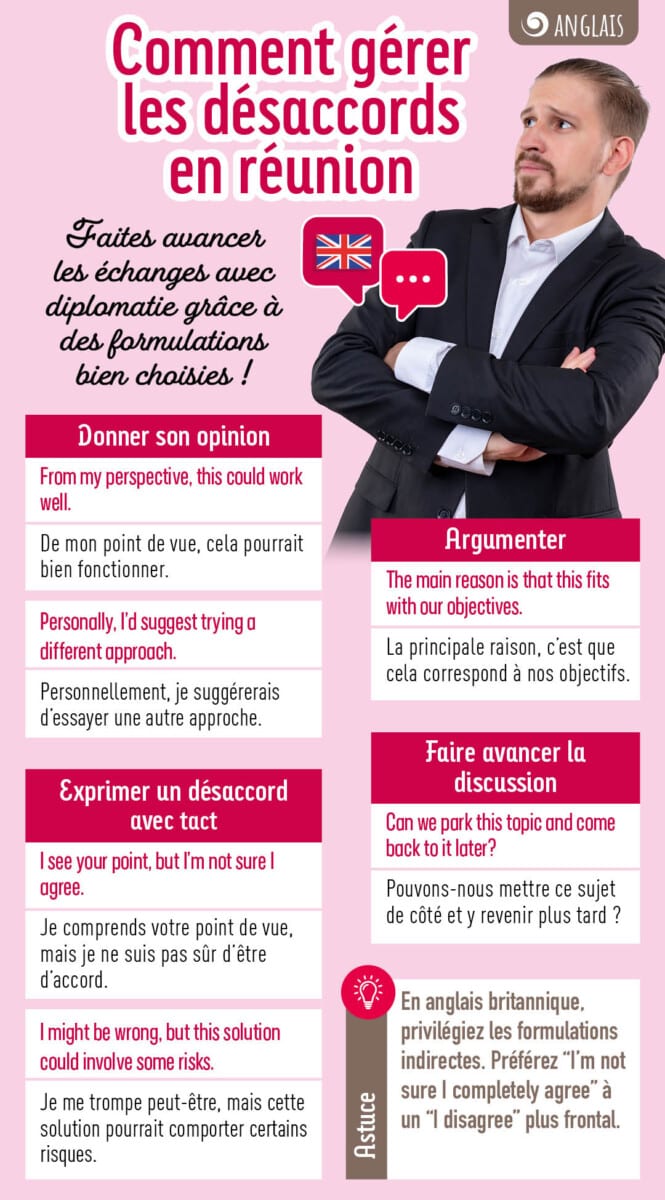
Managing disagreements in meetings in English requires the right balance between clarity and diplomacy. So, how can you defend your point of view without alienating those you’re speaking to? Discover the key phrases for presenting your arguments, qualifying your comments and maintaining a constructive discussion.

In a professional context, a disagreement can quickly become awkward when it has to be expressed in another language. In English, however, there are certain ways of phrasing things that allow you to state your position whilst maintaining the quality of the conversation. The aim is not to avoid disagreement, but to know how to express it tactfully so as to move the discussion forward.
Giving your opinion
From my point of view, this could work well.
The way I see it, it could well work.
Personally, I’d suggest trying a different approach.
Personally, I would suggest trying a different approach.
In my view, we should consider another option.
In my view, we should consider another option.
Expressing disagreement tactfully
I see your point, but I’m not sure I agree.
I understand your point of view, but I’m not sure I agree.
I may be wrong, but this solution could involve some risks.
I may be wrong, but this solution could involve certain risks.
Argue
The main reason is that this fits with our objectives.
The main reason is that it matches our objectives.
One of the key benefits is that it would save us time.
One of the main advantages is that it would save us time.
Moving the discussion forward
Can we put this topic to one side and come back to it later?
Can we put this topic aside for now and come back to it later?
Shall we focus on what we can agree on first?
What if we started by focusing on the points we agree on?
[Training] Meetings in English (A2 level)
[Tip]
In British English, disagreement is often expressed indirectly. For example, it is better to say “I’m not sure I completely agree” rather than the more direct “I disagree”. Expressions such as “perhaps”, “I’m afraid” or “I see your point, but…” also allow you to qualify your message without compromising your position.