Prospecting, negotiating, building loyalty, managing performance... Today's sales profession covers a wide range of roles. At a time when purchasing cycles are becoming more complex and digital tools are transforming practices, the sales function is more than ever a genuine strategic lever for companies. What are the different sales professions? What skills make the difference in the field? And how are career paths changing? Here's the lowdown.

In France, commercial functions play a central role in the economy.
- There are around 245,000 sales staff in the Paris Region, more than a third of the national total.
- 51.4 % of managers say they are finding it difficult to recruit sales staff.
- In 2025, more than 38,000 job vacancies were for sales roles, making this one of the most sought-after profiles on the market (Le Figaro Professional employment).
According to'Apec (2025), the «sales and marketing» function comprises 73 professions divided into 22 families. This diversity reflects the transformation of sales organisations: digital prospecting, strategic account management, long-term customer relations and performance management.
Overview of commercial professions
Commercial professions can be grouped into several categories major families corresponding to the different stages in the sales cycle : winning new customers, complex sales, account management, building customer loyalty and strategic steering.
1. Pre-sales and opportunity generation
Even before the field salesperson is involved, certain functions prepare the prospecting work.
SDR / BDR (Sales Development Representative / Business Development Representative)
Their role is to qualify leads, identify opportunities and prepare sales meetings.
Missions prospect qualification, making appointments, feeding the sales pipeline
SKILLS communication, needs analysis, CRM and prospecting tools
These profiles now play a key role in sales organisations.
2. Commercial conquest
These businesses are dedicated to developing new customers and new markets.
Field sales representative
- Missions prospecting, customer visits, negotiating and concluding contracts.
- SKILLS customer relations, negotiation, autonomy.
Testimonial :
«When I started out, my role was mainly limited to prospecting. Today, I analyse customer data to anticipate their expectations and I use AI tools to prepare my meetings. The job has changed a lot in just a few years. Adrien, B-to-B sales representative, tech sector
Business developer
It works on the’opening up new markets and creating business opportunities.
- Missions strategic prospecting, pipeline generation.
- SKILLS business vision, commercial creativity, project management.
3. Complex and technical sales
Sales engineer / technical sales representative
With a strong presence in technical sectors (industry, IT, construction and public works), it combines product expertise with commercial skills.
- Missions technical advice, sales and customer support.
- SKILLS product expertise, negotiation.
These profiles often work in conjunction with pre-sales teams or technical experts.
4. Account management and loyalty
When the commercial relationship is long-term, other professions take over.
Account manager
It develops the value of an existing customer portfolio.
- Missions : building loyalty, managing and growing an existing portfolio.
- SKILLS Relationship management, needs analysis, internal coordination.
Customer success manager (CSM)
Positioned between sales and customer experience, It ensures that the customer benefits fully from the solution sold.
Objectives customer satisfaction, contract renewal, upsell
Key account manager (KAM)
The Key Account Manager manages the company's strategic customers.
- Missions negotiating complex contracts, managing long-term relationships and coordinating several teams.
- SKILLS Strategic planning, advanced negotiation.
Get trained!
Testimonial :
«The real turning point in my career was the transition from pure sales to strategic account management. I had to learn to negotiate differently, to work cross-functionally with marketing and customer services, and above all to adopt a partnering approach. Soft skills have become central: assertiveness, analytical skills, managing tense situations. Today, I'm not just selling an offer, I'm building a long-term relationship. Sébastien, account manager
5. Strategic management
At a higher level of responsibility, certain functions are responsible for management and organisation of sales performance.
Sales manager / sales director
- Missions defining sales strategy, managing sales teams and monitoring performance.
- SKILLS leadership, vision and performance management.
They work closely with the general management, marketing, finance and products.
To note remuneration ranges fixed + variable These vary considerably from job to job and from sector to sector, with increased responsibilities resulting in higher packages for strategic functions (e.g. sales manager, commercial director).
Key skills in the sales professions
As well as jobs, success in the sales professions depends on a combination of human, analytical and technological skills.
Essential soft skills
- Active listening and empathy - essential for understanding customer needs.
- Persuasion and negotiation - at the heart of every transaction.
- Resilience - to cope with uncertainty and often long sales cycles.
- Curiosity and market watch - pillar of strategic adaptation.
- Teamwork and cross-disciplinary work - an indispensable dimension in agile or project mode. A good sales person works with marketing, product development, finance, pre-sales, customer service and sometimes even compliance or CSR.
Discover our soft skills glossary
Examples
Active listening
A account manager exchange with a long-standing customer whose sales are stagnating.
Rather than immediately proposing a new offer, he rephrases the customer's comments, asks open-ended questions and identifies a previously unexpressed internal constraint (lack of resources, budgetary pressure). The result is an adjusted solution that is more readily accepted, and a stronger relationship.
Persuasion and negotiation
A B-to-B field sales representative is faced with a customer who systematically compares competing offers. Rather than getting involved in a price war, he highlights the tangible benefits of his support (after-sales service, responsiveness, business expertise) and demonstrates the medium-term financial impact. The customer accepts a slightly higher price, convinced by the overall value.
Hard skills and technology
AI tools integrated with business processes to automate tasks, generate insights and enrich the customer experience: a strong trend in 2026, with major investments in automation and hyper-personalisation.
Mastery of CRM tools (Salesforce, HubSpot, etc.) to monitor the pipeline.
Commercial data analysis and performance management.
Read also : The 10 must-have AI tools for salespeople
Focus on’ORSYS 2026 Skills Survey
AI optimises sales work by improving targeting, prioritising actions and preparing meetings, while helping to anticipate customer needs. However, differentiation is still based on the quality of the human relationship, creativity and argumentation. Salespeople must therefore master AI tools, predictive analysis and communication to transform these contributions into sustainable sales performance.
- 43 % of salespeople use AI in their daily work
- 2 hours a day are freed up by automating repetitive tasks (lead qualification, data entry, follow-ups)
Source: HubSpot, 2024
Use cases
- Task automation (lead qualification, data entry, follow-ups)
- Preparing appointments (personalised scripts)
- Automated prospecting and predictive lead scoring
- Customised offers
- Predictive analysis to identify high-risk customers or high-value opportunities
How is the sales function changing?
Digitalising sales
New digital uses, a proliferation of sales channels, more autonomous customers: the sales profession has never been in such a state of flux. This change is forcing sales teams to rethink their methods, strengthen their listening skills and build more lasting customer relationships to make a difference.
New economic and social challenges
Added to these changes are the challenges posed by the ecological transition. With a tougher regulatory framework, responsible stock management and growing ethical expectations on the part of consumers, retailers are having to integrate new parameters into their strategy. All of these challenges are reshaping the skills required in the sales professions.
Read also : CSR: what impact for the sales function?
The growing impact of artificial intelligence
AI is gradually transforming business practices.
In particular, it makes it possible to automate certain repetitive tasks, improve prospect targeting, anticipate customer needs and personalise offers.
However, technology does not replace the human relationship: listening, argumentation and creativity remain key factors in commercial performance.
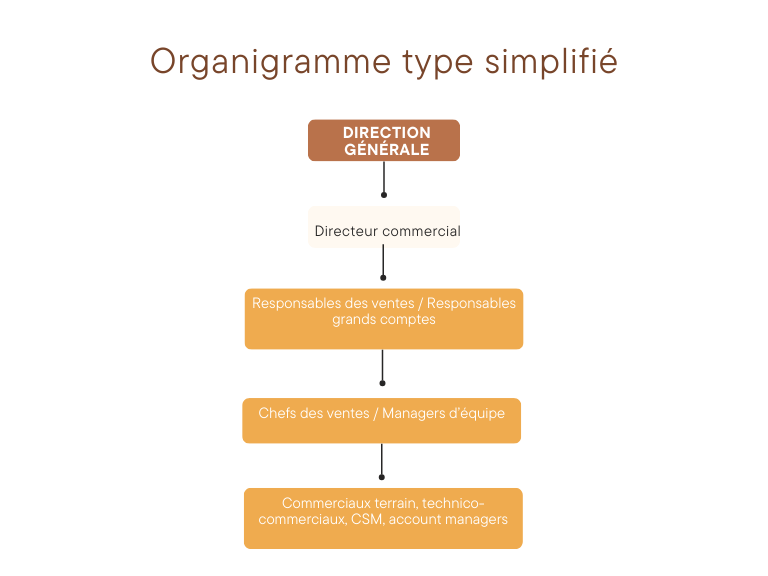
A typical hierarchy of commercial professions
To help you understand the possible routes, here is a simplified view of exercise levels :
Operational level - Execution and prospecting
Positions involved in the practical implementation of customer relations These include field sales staff, technical sales staff, business developers and CSMs. They generally report to a team manager or head of sales.
Intermediate level - Account management and supervision
Profiles that manage more complex relationships or teams account manager, KAM, sector or regional manager.
Strategic level - Steering and management
These functions define the objectives, sales strategies and sales force organisation They may be national sales managers, sales directors or commercial directors. They work closely with General Management and the marketing, finance or product departments.
Increasingly diversified career paths
Sales careers remain attractive because they offer numerous opportunities for development. However, today they are less linear than they used to be.
We can always evolve from from field sales to account management or management, But other trajectories have developed.
Examples of routes:
- Inside sales → account executive
- Account manager → key account manager
- Technical sales representative → pre-sales or market management
This diversification reflects an important development: sales performance is no longer based solely on «sales talent». It also depends on an understanding of the business environment, method and team coordination.
Testimonial :
«When I started out as a field salesman, I thought it was all about the sales pitch and the ability to convince. I very quickly realised that the key was elsewhere: really listening, understanding the customer's context and accepting rejection without taking it personally. I gradually built up my skills, through hands-on experience as well as training in communication and stress management. Today, I manage a customer portfolio independently and I feel legitimate in my dealings, even with very experienced people. Manon, B-to-B sales assistant, services sector
In 2026, sales professions will still be at the heart of business performance. But they are undergoing profound change. Companies value human skills (listening, negotiating, customer relations) as much as their ability to exploit modern technologies (CRM, AI). For professionals, this means adapting, learning continuously and knowing how to evolve in rewarding roles that enable them not only to close a sale, but also to build lasting relationships.