You see it every day: your newsletters fall flat, in-house events do little to mobilise people, collaborative platforms struggle to get off the ground... Many initiatives lose effectiveness because they are not properly designed. And yet, internal communication remains a key lever for engaging, uniting and supporting change. Here's an update from Aude Mioni, an expert in network communications and team management.

According to Willis Towers Watson (2024), companies without a solid internal communications strategy see their staff turnover increase by 33 %. In other words, communicating well also means retaining your talent.
Let's take the example of this organisation: during an internal seminar, co-construction workshops mobilised the teams around the problem areas and the concrete solutions to be deployed. It was a real success, with a high level of involvement, an exhaustive list of problems identified and a brainstorming session teeming with ideas! Twelve months later, another in-house seminar, using the same methods, was a complete failure! Demobilisation, negative feedback. The lack of strategy led to ineffective action! Here's an analysis of the common pitfalls of internal communication and practical alternatives for transforming your actions into levers of impact. This approach is structured in three stages:
- Clarify your issues before taking any action
- Use the COACH© method to structure your approach
- Choosing the right type of action at the right time
Set your course: choose the issue before taking action
Before thinking about formats, tools or messages, ask yourself a simple question: «What precise effect do I want to produce? Too often, internal communication fails because it tries to do everything at once. Each action must have a unique challenge and a precise objective. Setting a course is the first step towards avoiding fragmentation.
Three major issues need to be clarified:
- Team cohesion Strengthening the sense of belonging, reconnecting dispersed teams, recreating links around a common mission.
- Employee commitment Encourage participation, promote initiative and give a sense of community.
- Change communication explaining transitions, providing visibility, reducing resistance and uncertainty.
Common error: want to deal with all three at the same time. Effective action is always based on a single priority issue.
Examples:
At Alpha IT, customer projects involve several divisions, but the teams often work in silos. The main challenge for internal communication is therefore to strengthen team cohesion in order to facilitate collaboration and reduce friction.
At Omega IT, management is shifting its values towards greater flexibility. The priority is to support the change, to make it understandable, reassuring and in line with the day-to-day work of the teams.
What is your priority challenge today? Uniting teams, encouraging internal fluidity, developing collective intelligence, encouraging the sharing of experience, supporting organisational transitions...?
Read also : Internal communication: the levers to activate to improve collective performance
Apply the COACH© method: precision before action
To transform a challenge into effective action, you need to structure your internal communication tools correctly. The COACH© method gives you a simple, reproducible framework in five steps.
C - Target: who am I talking to? Who should receive and understand this message?
O - Objective: why am I taking action? What concrete effect do I want to produce?
A - Action: how do I go about it? What form of action is most appropriate?
C - Channel: where do I send my message? Which internal channels are the most relevant?
H - Story (message): what am I telling? How can I give meaning through internal storytelling?
The five stages of COACH© illustrated:
1) Target - Identify your targets and internal influencers precisely
At Alpha IT, The priority targets are the project teams and the technical/commercial divisions, which currently operate in silos. At Omega IT, The main target is all employees, with a specific focus on relay managers to ensure that they understand the new values and apply them on a day-to-day basis.
Do you segment your messages according to your internal audiences? Who are your final targets? Who are your intermediaries?
2) Objective - Clarify the expected result with internal communication performance indicators
The objective is the concrete manifestation of the challenge. This is what enables you to assess the effectiveness of your internal communication.
The five possible objectives of an internal communication campaign :
1. Go to visit To disseminate information, projects and news.
2. Go to understand explaining what is at stake and why a decision has been taken.
3. Go to love Creating support for a project or a value.
4. Go to prefer to generate commitment and change behaviour.
5. Go to act trigger participation, registration or contribution.
To note These five objectives are progressive. You can't hope to get people to act without first getting them to know and understand. At least, if you're looking for a lasting effect on your teams, and not just a flash in the pan.
Examples:
At Alpha IT, The aim is to promote cross-functional collaboration and an increase of 30 % in the number of employees who say they like to work in mixed teams.
At Omega IT, The aim is to make people understand the direction of the change in values, measured via an internal barometer (comprehension score above 75 %).
Objective OK or knockout?
K.-O.: employees read the «Live my life» article in the newsletter.
OK: By reading the «Vis ma vie» article, the teams identify new ways of working together between departments.
The aim is to change employees' behaviour; the action taken must be assessable in terms of its relevance to supporting this change.
3) Action - Choosing the right type to meet your objectives
Alpha IT focuses on equities cross-disciplinary and ascending sharing initiatives between departments, providing feedback and soliciting ideas.
Omega IT active in shares descending (meetings, managerial messages), complemented by spaces ascendants («Ask me anything» live chat with management) to answer questions and allay concerns.
4) Channel - Select the channel that conveys the message, as well as the message itself.
Alpha IT uses collaborative and dynamic channels: internal platform, micro-videos, short posts.
Omega IT is based on more structured and reassuring channels: meetings, fact sheets, FAQs, executive videos.
Three common mistakes:
- Use a single communication channel at the risk of saturating it with information.
- Do not take into account the technical constraints of field or full remote employees (e.g. videoconferencing for field technicians who are not equipped).
- Mixing communication styles on the same channel: formal and informal exchanges must be physically separated to avoid creating confusion.
5) History - Give meaning to the message by building on your HR brand platform
Alpha IT shows the impact of collaboration through concrete examples of customer improvement.
Omega IT builds a clear and reassuring narrative: «Greater flexibility to make our day-to-day work easier and serve our customers better».»
Five steps to storytelling
This writing technique is based on a real-life situation to raise employees' awareness by connecting the reader emotionally.
- What key message do you want to get across?
- Who will be the real hero?
- What is the initial problem situation?
- What decision did the hero take to change the situation?
- What decision are you inviting the reader to make?
Good storytelling doesn't stop at telling the story: it opens up a perspective and triggers action.
What story does your internal communication tell? Is it in line with your corporate culture?
Pitfalls to avoid:
- Communication that thinks «tool» before «objective».
- Systematic top-down communication.
- Overly institutional messages with no link to the HR brand platform.
Read also : Brand storytelling: how emotion strengthens consumer engagement
Once you have clarified your objectives, the final step is to choose the right internal communication tools, at the right time, depending on the type of action you are targeting.
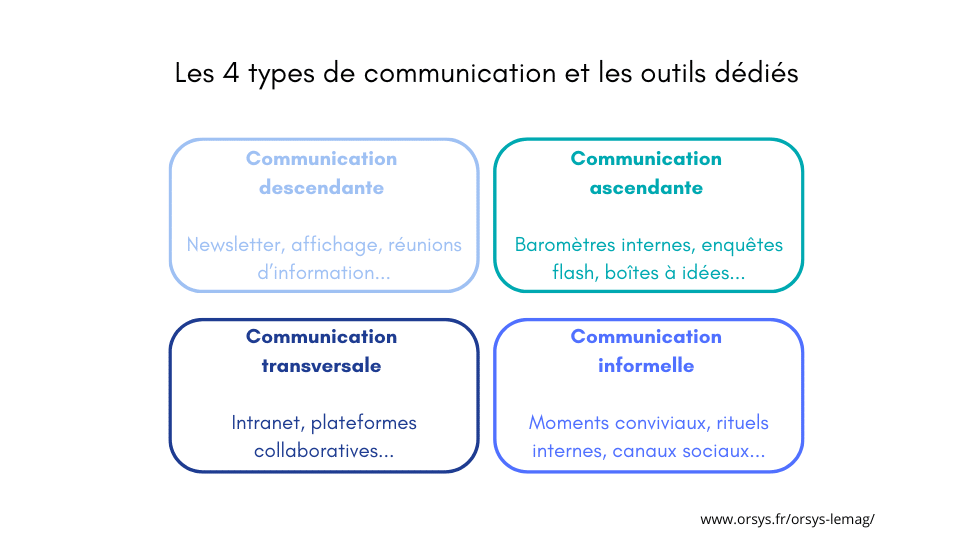
Types of internal communication initiatives: the right use of tools
Newsletter, intranet, team building, surveys... You've heard of them. But have you mastered them? Each tool has its own role, tone and timeframe. Used at the wrong time or for the wrong purpose, they lose their effectiveness.
Downstream communication: information without overload
Objective: to raise awareness and understanding.
Tools: newsletter, posters, managerial messages, information meetings.
❌ The trap: an overly dense and institutional flow of information, drowning out the essential messages.
✅ Best practice: prioritise information according to your objectives, embody your values and give rhythm to content by increasing the number of internal contributors.
Example :
At Omega IT, the monthly newsletter «Innovation utile» (Useful Innovation) highlights an improvement in cross-departmental project management, reported by an interdepartmental pair. The result: an increase in the open rate and a real sense of shared pride.
And you, how could you make your messages more concrete and closer to the field?
Upward communication: listening for adjustments
The aim is to get people to share their perceptions and ideas so that they like and prefer the brand better, without imposing a single vision, but by adapting the message to the concerns of the teams. This will be particularly useful in supporting change.
Tools: internal barometers, flash surveys, anonymous feedback, suggestion boxes.
❌ The pitfall: launching surveys without giving back the results and follow-up actions.
✅ Good practice: close the loop, i.e. share the results, explain the decisions and thank the participants.
Example :
At Alpha IT, a monthly mini-survey followed by a live managerial session enables teams to discuss matters directly with management. The result is greater participation and concrete improvements in the departments.
And what preconceived ideas do you want to change?
Cross-functional communication: connecting energies
Objective: decompartmentalise, share practices, strengthen inter-departmental collaboration (make things happen).
Tools: intranet, communities of practice, collaborative platforms, project groups, brainstorming workshops.
❌ The pitfall: actions frozen by too much formalism and a cumbersome managerial presence.
✅ Best practice: share confidence in the collective by encouraging individual initiative, and encourage open and respectful dialogue, with a common goal in mind.
Example :
At Alpha IT, the new intranet has become a hub for initiatives. At Omega IT, a community of business referrers relays important messages during informal moments between colleagues and facilitates exchanges.
Does your intranet really encourage the circulation of ideas and the sharing of solutions?
Informal communication: forging long-term links
Objective: to build confidence and foster a friendly atmosphere (to make people like you).
Tools: team cafés, social events, internal rituals, social channels.
❌ The trap: organising an isolated event with no follow-up.
✅ Best practice: set up regular rituals, capitalise on informal exchanges and encourage spontaneous initiatives.
Example :
At Omega IT, monthly «cafés croisés» bring together employees from different business lines to discuss their respective challenges. At Alpha IT, monthly project breakfasts provide an opportunity to present current innovations in a relaxed setting. These events strengthen team cohesion and foster a sense of belonging.
And you, how do you maintain cohesion beyond the official messages?
Summary of objectives and actions
| Communication objective | Definition | The most effective actions |
| Raising awareness | Inform about a project, a decision, a change or a news item | Descending newsletter, e-mail, Codir announcement, internal posting |
| Making people understand | Giving meaning, explaining why, clarifying impact | Descending + ascending management meetings, FAQs, Q&A sessions, explanatory videos |
| To make people love | Create buy-in, arouse interest, make people want to go further | Descending + informal internal storytelling, employee portraits, user-friendly events, testimonial capsules, etc. |
| Give preference | Encouraging preference for a particular behaviour, process or way of working | Transversal + bottom-up collaborative workshops, feedback, interdepartmental discussion forums, etc. |
| Taking action | Trigger a specific behaviour: sign up, contribute, test, participate, etc. | Ascending + descending calls for contributions, surveys, internal challenges, action forms, etc. |
Focus on one tool: the newsletter
A newsletter can do much more than provide information. When it is carefully thought out, it can combine several types of internal communication: top-down, bottom-up, cross-functional and even informal.
In the case of Omega IT, the newsletter has become a key tool for communicating the company's strategy and the reasons for the change in values (from an emphasis on processes to a focus on flexibility), with 4 key headings:
«Why in plain English (top-down)
A simple and regular explanation of an element of change: what is changing, why, and what it brings to the company.
«Your questions, our answers» (bottom-up)
Every month, a question is asked by an employee, and a transparent answer is given by a manager or the Executive Committee.
«Collaboration in action» (cross-disciplinary)
A concrete example of how a department has become more efficient thanks to a more flexible approach.
«They're talking about it» (informal/embodied)
A short testimonial from an employee explaining how the new flexibility value helps him on a daily basis. Visible micro-success stories.
Summary: comparison of the Alpha IT and Omega IT internal communication plans
| Alpha IT | Omega IT |
| Strengthen team cohesion around customer projects | Supporting the change in values (greater flexibility) |
| Project teams + technical and sales teams | Employees + relay managers |
| Prefer cross-functional collaboration +30 % of employees say they prefer to work cross-functionally | Communicating the vision and reasons for change 80 % employees capable of explaining the new vision |
| Cross-functional, bottom-up actions (ideation, feedback) | Top-down actions + Q/R sessions |
| Internal platform, micro-videos, collaborative posts | Management meetings, fact sheets, FAQs, videos |
| «Together, we're improving the customer experience.» | «More flexibility for better work and better service».» |
Internal communication is not an exact science, but a precise discipline. By mastering your internal communication tools and the COACH© method, you can create actions that are clearer, more human and, above all, more effective. The first simple step to making progress today: identify your priority issue, then apply the COACH© method to a single upcoming action. And you, what will be your next COACH© action to strengthen the collective energy of your teams?