With AIs, web users are increasingly able to get a direct answer to their questions without going through the classic Google search. To remain visible, a site must no longer just be well ranked: it must also be cited by AIs. This is what GEO, or Generative Engine Optimization, is all about, as it overturns the rules of traditional SEO. For web professionals, the challenge is concrete: structuring «AI-friendly» pages. Stéphane Brunet, trainer and web development expert, explains how to.
Generative artificial intelligence is redefining the online visibility of websites and businesses. For front-end developers and web professionals, this transformation is translating into a new discipline: GEO (Generative Engine Optimization). Behind this acronym lies a fundamental challenge: ensuring that content is cited and recommended by the response engines of generative AI.
Stéphane Brunet, trainer and developer, sums up the changeover in one sentence: «Before, you had to be found. Now you have to become a reference.»
There's a lot of talk about GEO. What exactly is GEO?
Generative Engine Optimization (GEO) covers practices aimed at optimising the visibility of content or a brand in responses generated by generative AIs., ChatGPT, Gemini, Copilot, Perplexity, etc.
GEO also applies to AI functionalities built into search engines, such as the AI mode of Google search, which provides the answer to a search directly without having to click on links. Launched around a year ago in certain countries, this mode is not yet available in France.
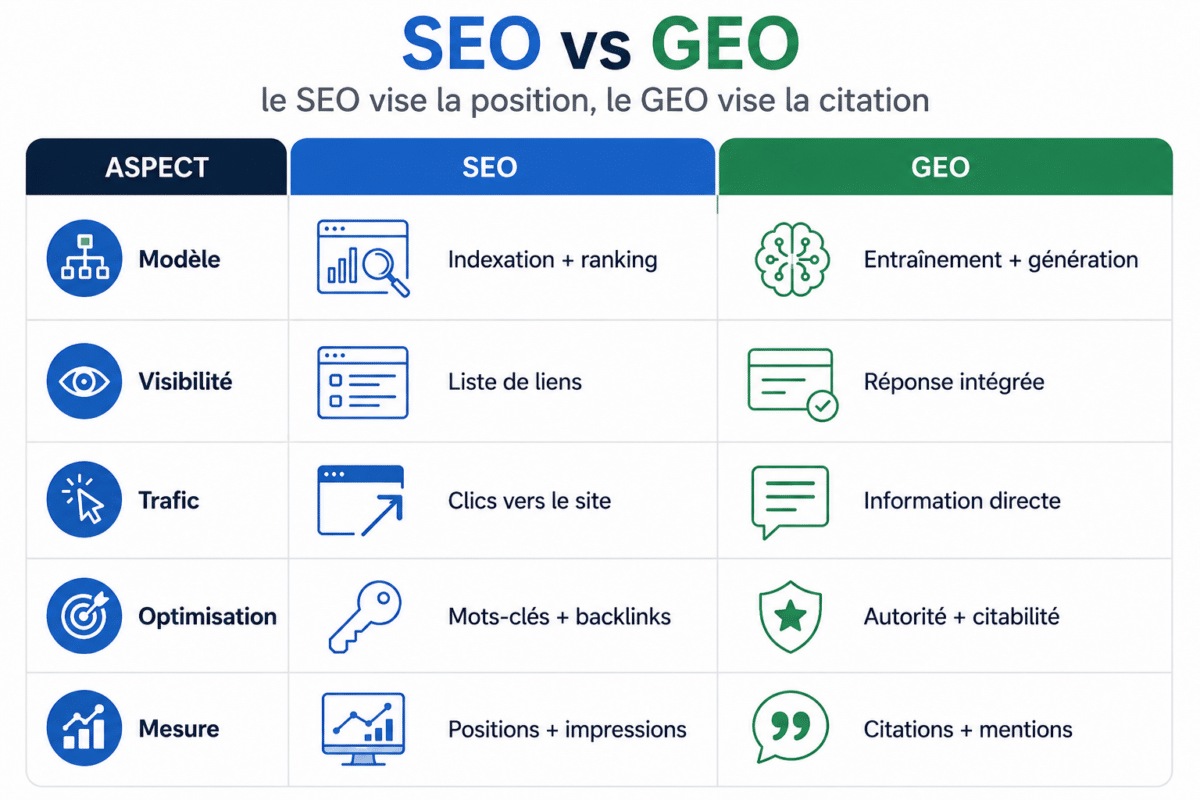
Unlike traditional SEO, which aims to position a page in the search results, GEO has a different objective. It seeks to make a source so reliable, structured and relevant that it is selected, summarised and cited by the AI in its response to a user's query.
The challenge is no longer simply to appear on a list, but to provide clear, structured and reliable information. As Stéphane Brunet explains: «We are now becoming more of a content provider than just a result in a search list.»
What are the practical implications for web professionals?
The first impact concerns the measurement of visibility. With AI, some visibility can exist without an immediate visit. Stéphane Brunet puts it clearly: «Your site can become an outstanding reference for half the internet users without you having a single click on your website.»
For web project managers, content managers, SEO consultants, webmasters and UX/UI designers, the value of a page also lies in its ability to provide a response.
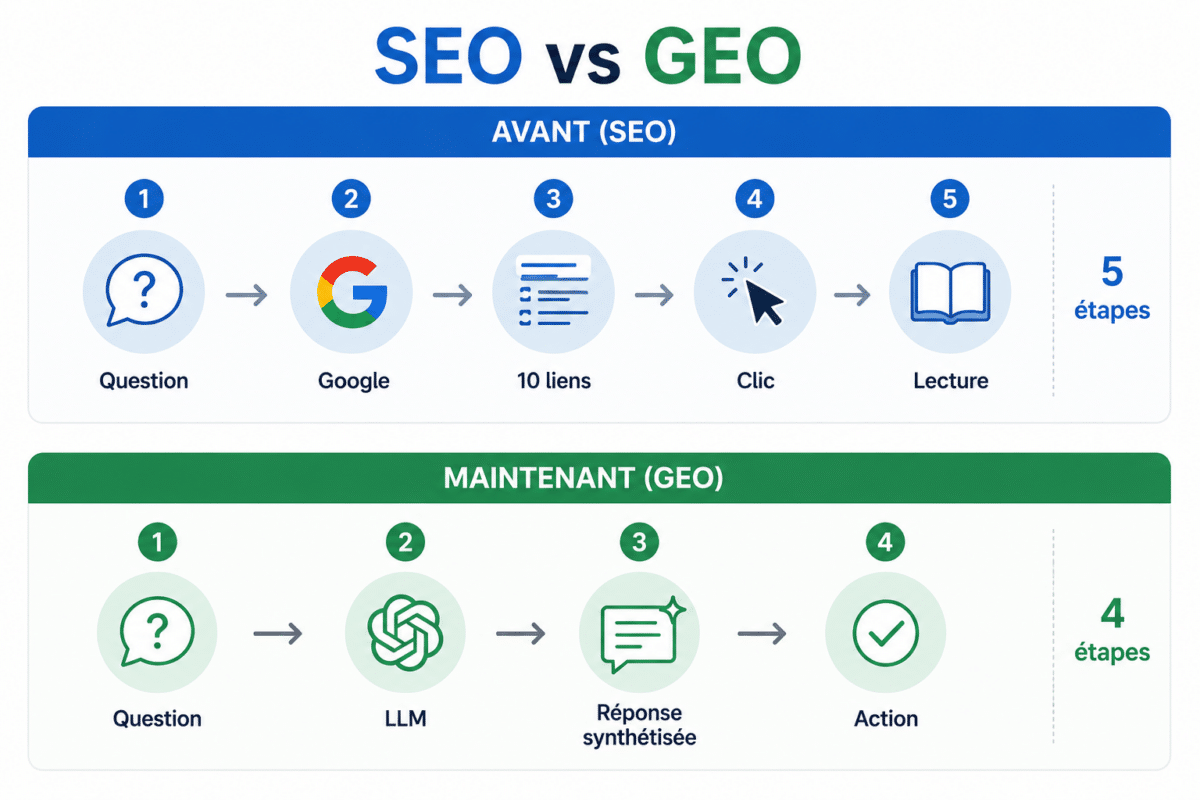
Conversational searches favour complex questions, serial searches and «zero-click» paths, where the user obtains an answer without immediately consulting a site.
The first impact of AI search engine optimisation is therefore almost counter-intuitive: a page can gain influence while losing clicks. In generative interfaces, the user asks a question, reads a summary and does not necessarily visit the source. For a classic SEO dashboard, this might seem like a drop in the bucket. For the brand, however, it can be exposure.
Stéphane Brunet insists on this development: « SEO should no longer be measured solely on traffic, but also on brand recall, cross-visibility and presence in different discovery platforms».»
Another consequence is that Google is no longer the only site to be monitored. Stéphane Brunet points out that ’ Today, one of the most important sources is Bing.» This is particularly true of the Microsoft ecosystem, Copilot and certain conversational uses. However, it is important to avoid the shortcut «Bing = all AI». The right approach is to check where your pages are indexed, how they are included and by which platforms.
How do AIs choose the content they use?
AIs don't just look for a keyword. They're looking for an answer. And, above all, an answer that makes sense.
Stéphane Brunet insists on content validation: « The idea is to have text, but also text that is validated. »This validation can take several forms: identifiable author or expert in a field, customer opinion, institutional source, proprietary data, methodology, date of update, expert quote, feedback, etc.
The notion of author becomes strategic: «If the person signs the article that is on your website, [...] the AI will consult the person's profile. this person and what credibility he or she has in the field concerned».»
This is a key idea for web professionals: average content, even when well optimised, is no longer enough. An AI that is already aggregating dozens of sources has no interest in picking up a page that repeats what everyone else is saying. Google also contrasts generic content with high added value content: content that is not interchangeable, that brings real experience, a unique angle or feedback from the field.
What's more, AIs no longer think in terms of keywords, but in terms of entities, associating the elements of a search.
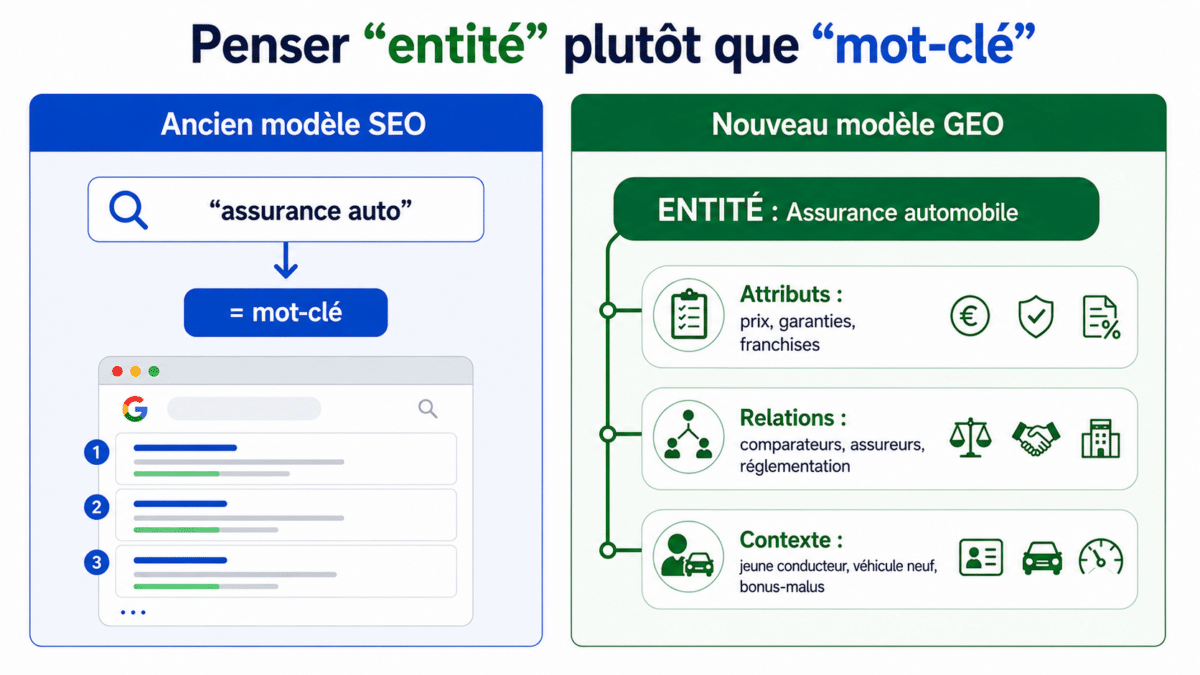
This entity logic helps AIs to understand not only the subject of a page, but also its context, relationships and credibility. Entities need to be reinforced with definitions, multiple contextualisations, explicit relationships and synonyms.
Is GEO mainly editorial or also technical?
GEO is both editorial and technical.
On the editorial side, content needs to be more comprehensive, more useful and less promotional. Stéphane Brunet describes the shift as follows: «We have gone from search engines that identify keywords on a page to AIs that read complete articles.»
On the technical side, structuring becomes even more important. «When we structure a page from an HTML point of view, we do everything we can to give it as much information as possible.» H1, JSON-LD, semantic HTML, useful structured data, metadata, accessibility, performance and indexability facilitate interpretation.
This example shows how to link a quotation to a person, a function, an organisation and a date. This is exactly the type of signal that is useful for clarifying the authority of content.
Code snippet - Enriching an expert quote with schema.org
<span itemscope itemtype="https://schema.org/Quotation">
  <blockquote itemprop="text">
    "73% of companies increase their AI budget in 2024"


    <span itemscope itemtype="https://schema.org/Person">
      <span itemprop="name">Marie Dupont,
      <span itemprop="jobTitle">Innovation Director
      at
      <span itemprop="worksFor" itemscope
            itemtype="https://schema.org/Organization">
        <span itemprop="name">TechCorp France


    -
    <time itemprop="datePublished" datetime="2024-01-15">
      15 January 2024
What is AI-optimised content?
AI-friendly content is content that can be understood, extracted and read by AIs. It answers a question clearly, is organised into logical sections and provides verifiable information.
Stéphane Brunet insists on the end of artificial practices: « We're not going to stuff it with keywords.» Keywords are still useful, but they need to be integrated into natural sentences and rich paragraphs. The new logic is to produce substantive content: « Today, we provide complete, high-quality paragraphs.»
The most effective formats are those that help an AI to construct an answer without inventing anything:
| Format | Why it works |
|---|---|
| Step-by-step guide | AI can take over a structured method |
| Expert FAQs | Questions correspond to conversational requests |
| Comparison | The criteria make it easier to summarise |
| Case study | Feedback from the field provides non-generic value |
| Glossary | Definitions strengthen entities |
| Detailed local page | Geographical data, timetables, notices and services are easy to use |
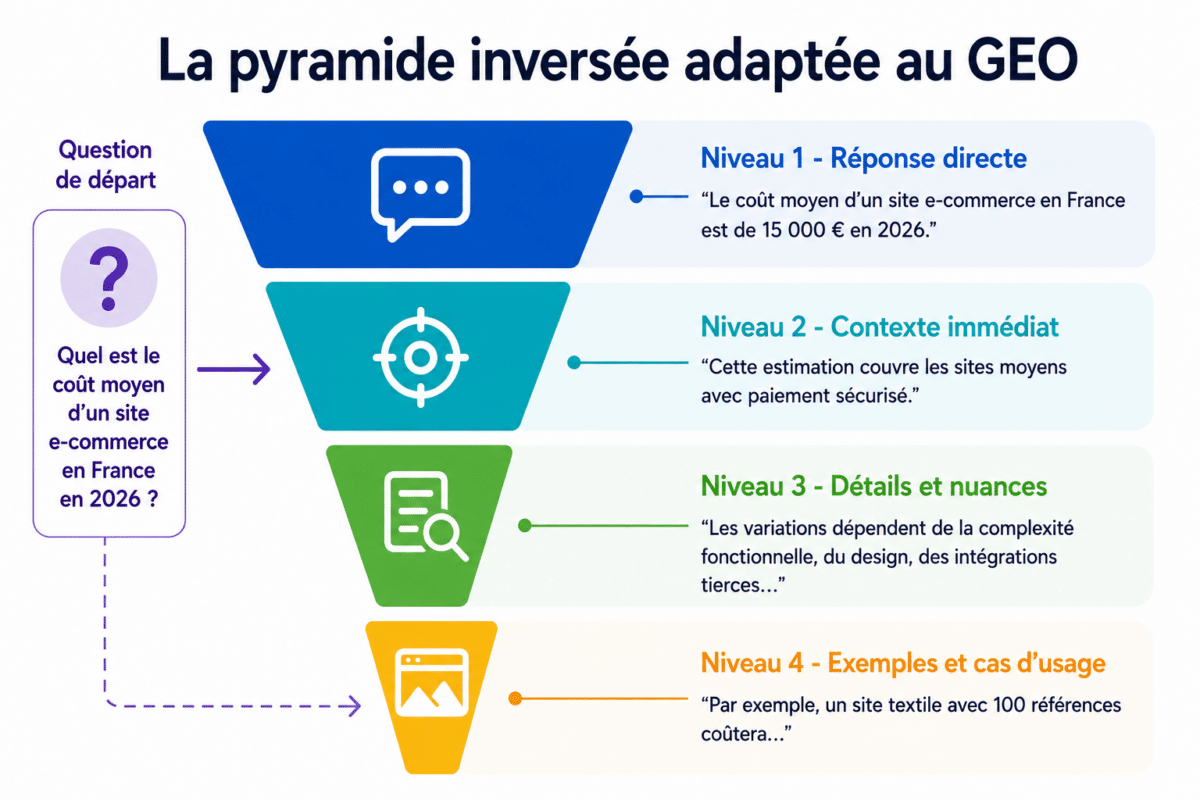
Stéphane Brunet also recommends putting the direct answer to a question first, then adding context, nuances and examples. This structure makes it easier for an AI to take up the question in a synthetic response.
Are traditional SEO levers still relevant?
Yes. SEO remains the foundation. Title tags, keywords, internal linking, backlinks, performance and indexability are still useful. But they need to be used in a more qualitative way.
Keywords should no longer be stacked on top of each other. Titles should not just contain a query: they should structure an answer. Backlinks don't just serve to transmit authority: they help to reinforce an entity's credibility.
Google explicitly states this in its official guide GEO on 15 May 2026: GEO is not a total breakthrough. For its AI features, such as AI Mode, SEO best practice remains relevant, These experiments are based on Google Search's ranking and quality systems. The guide cites two mechanisms in particular: the RAG (Retrieval-Augmented Generation), which uses indexed pages to anchor responses, and the query fan-out, which generates several related queries to answer a complex question.
This is where the subject gets interesting. GEO is not about «writing for robots». It's about producing content that AI systems will have an interest in using because it provides a point of view, an experience or information that can really be exploited.
Does GEO impose new performance indicators?
Yes, with traditional SEO, the indicators are well known: positions, impressions, clicks, CTR, organic traffic, conversions. With GEO, some of the visibility is not covered by these dashboards.
Stéphane Brunet talks about a profound change: «Even the method of calculation is completely different.» Commenting on the measure, he adds: «For everything that can be measured, it's a disaster.»
SEO KPI vs GEO KPI
| SEO KPIS | KPI GEO |
|---|---|
| Organic traffic | Citation rate |
| Positioning | Award score |
| CTR | Contextual relevance |
| Backlinks | GEO authority index |
| Conversion rate | Share of conversation |
| Indexed pages | IA Mentions |
The frequency of citation, attribution as source, accuracy of context, citation gap with competitors, recognition by experts and presence on several AIs should also be monitored.
The tools are still imperfect, but monitoring can be started simply by regularly testing key queries in several AIs, observing the sources cited, checking the wording of the brand, tracking branded searches and isolating referents from AI assistants in the analytics.
Where do you actually start?
The first step is to stop looking for “the secret GEO technique”. The most actionable point is more sober: choose ten strategic pages and turn them into sources.
For each page, ask five questions:
- Does the page clearly answer a real question?
- Does the content provide experience, data or an angle that others don't have?
- Are the author, date and sources visible?
- Is the main content accessible without technical friction?
- Is the page linked to a clear entity: brand, expert, product, location, service?
Next, prioritise pages with high conversational potential: guides, FAQs, comparisons, local pages, complex product pages, tutorials, case studies. These are the pages most likely to be included in summary responses.
For an e-commerce or local site, Google also points out that Merchant Center and Google Business Profile can feed AI responses with product, commercial or local information. This is a very concrete point: GEO is not just about blog articles. It's also a question of product feeds, store cards and your own sales data.
GEO checklist - Content, credibility, technique
| Area to be audited | Points to check |
|---|---|
| Content | Descriptive H2/H3 headings, integrated questions, definitions, examples |
| Credibility | Original data, sources cited, dates, methodology, identifiable author |
| Technical | Schema.org, JSON-LD, enriched meta-description, alt-text, clean URLs |
| Validation | LLM test, citation obtained, quality of attribution, freshness |
Do you have any examples of content that works well? ?
Effective content directly helps AI to build a reliable response: practical guides, tutorials, expert FAQs, comparisons, case studies, detailed local pages, customer reviews, testimonials and glossaries.
Examples of content that can be summarised and shared
Enhanced FAQs natural questions + full answers
Step-by-step guides detailed processes with checklists
Structured comparisons tables with objective criteria
Reference definitions Sector glossaries
Calculators ROI, simulators, configurators...
Stéphane Brunet also recommends conversational formats: interview, customer-advisor dialogue, structured debate or narrative case studies. These formats correspond well to the uses of generative engines, which often transform a complex question into a structured response.
How do you see SEO evolving over the next few years?
SEO will continue to exist, but it will be integrated into a wider system. Traditional search engines will continue to be used, but AI will become an important entry point for information, comparison and decision-making.
Web professionals will therefore have to work on several levels of visibility: being indexed, well classified, understood, quoted, associated with a reliable entity. Generic, anonymous content will lose value. Expert, structured, sourced and signed content will gain in importance.
The best GEO strategy is not to chase after every keyword or every tag. It's to produce pages that an AI would be reluctant to ignore: because they explain better than the others, prove more, cite their sources, accept their limitations and convey a real experience.
GEO is not the end of SEO. It extends its requirements.