Are you running out of time and unable to get organised? What if your tools don't fit in with the way you work? The solution: tailor-made efficiency. Communication expert Aude Mioni shares practical tips to help you regain clarity, fluidity and impact, even under pressure.

Eisenhower matrix, Pomodoro, SWOT, to-do lists: these are all methods that you may have already tried, often with little result. But what if, deep down, this is normal? You're probably confusing organisation and efficiency.
In trying to organise yourself better, you sometimes impose rigid processes on yourself, far removed from your natural way of working. And in a day-to-day working environment under stress, this can quickly become counter-productive. What are you really looking for? To be organised or to be efficient?
Get trained!
Would you like to move from a situation where you are forced to be efficient to one where you choose to be? Discover the training programme Improve your professional effectiveness. Being effective is not about doing more and more, but about concentrating your energy where it has the greatest impact. This course is designed to help you re-examine your priorities, decision-making methods and energy management so that you can achieve greater clarity and lasting effectiveness, even in demanding environments.
A tailor-made approach: regaining fluidity without exhausting yourself
You are an individual in your own right, with your own way of functioning, deciding and acting. So why continue to apply standard organisational methods, without ever adapting them to the way you work?
Here are some practical ways to :
- identify your areas of comfort and your talents, the levers that are often under-exploited
- activate them on a daily basis, even in stressful situations
- take on the main organisational methods in a flexible, tailored way
- put them into practice by drawing on the experience of two project managers, Marina and Vincent
The aim is to offer a sustainable, tailor-made approach so that you can rediscover greater fluidity, pleasure... and results, without always doing more.
Definition of efficiency
Understanding the levers of efficiency
Keeping control in stressful situations
Adopt the main organisational methods
Efficiency: less effort, more impact
Being efficient means producing maximum results with minimum effort or expense. And that's where everything hinges, because this minimum effort is profoundly important. staff. For some people, analysing a mass of information is easy and stimulating. For others, it's a nightmare. Public speaking can be fun or an insurmountable challenge. To each his own zones of ease and fragility.
And yet, from school onwards, you learnt to focus your energy on your weak points. That famous red pen in the margin of your papers is perhaps the most enduring symbol of this.
Pareto's law invites us to take a different look: 20 % of your efforts, when based on your strengths, can generate 80 % of your results.
Get trained!
Gain in performance and peace of mind. That's the aim of the Improve your personal organization. Organisational methods are useful, as long as they work for you. This course helps you to structure your work in a realistic and personalised way, based on your priorities, your pace and your constraints, so that you can work more smoothly every day.
Positive emotions: an efficiency booster
Neuroscience is now shedding light on this phenomenon: positive emotions (joy, fun, serenity, curiosity, gratitude, hope...) have a direct impact on your effectiveness. Three mechanisms come into play.
- dopamine, a motivational neurotransmitter, encourages you to persevere towards a goal, in a more fluid way. You act faster, for longer, with less internal resistance.
- Le prefrontal cortex, The central planning and prioritisation zone is mobilised. You make more accurate decisions, less subject to your impulsive emotions.
- Le cortisol, The brain switches from threat mode to exploration mode. You broaden your attention and improve your creativity.
So why not boost your positive mood on a daily basis? How about relearning to trust what's already there inside you?
Understanding your efficiency levers: areas of talent, where efficiency comes naturally
Think of your talents as a trampoline. If you want to reach for the sky, is it better to take advantage of the bounce of a soft surface or rest on a hard one? Efficiency works in exactly the same way. When you lean on your talent zones, energy circulates, effort is reduced and results increase.
The 34 Gallup talents, based on research by the Gallup Institute, defines natural capacities for excellence. They can be recognised in your experience through three simple criteria:
- feasibility: « it's something I've always been able to do. "
- the easy way: « it's something I do well and easily. »
- pleasure: « it's something that gives me energy.»
It's often these small everyday actions that you downplay: «Frankly, it's not that complicated. Everyone knows how to do it». All of them? No. YOU, Yes.
The Gallup Institute identifies 34 talents, including: focus, prudence, activation, harmony, learning, strategic sense...
There remains one essential question: how to identify your talents, and above all, how to activate them to improve your efficiency ?
Get trained!
Know yourself better to develop your potential
Getting to know yourself better means understanding what energises you, what holds you back and what enables you to give the best of yourself. This course provides a framework for identifying your talents, needs and driving forces, so that you can activate them more consciously in your professional life.
Spotting your talents: child's play
There isn't just one good method, but three. It's up to you to choose the one that suits you best:
- Option 1: Return to childhood
Think back to moments of simple joy. What exactly were you doing? What actions spontaneously energised you?
- Option 2: Talk to those around you
Family, friends, colleagues. What do they say about you? When do they see you galvanised, serene or glowing?
- Option 3: explore the Gallup grid
Read Gallup's 34 talents at your leisure and tick the ones you recognise yourself in.
This exercise alone can generate a positive emotion. Remember this feeling. It will be invaluable to you in the more demanding moments of everyday life.
Activating your talents : Marina and Vincent, two paths to the same efficiency
To understand how talent translates into concrete action at work, let's follow Marina and Vincent. Both are project managers. Both aim for efficiency. But not in the same way.
Marina is a natural connector. Even with strangers, the contact is immediate. Her first talent is harmony. With experience, it has also identified a strong capacity analysis. It only takes a few minutes for him to grasp what's at stake in a situation. And that excites him.
When a new project comes along, Marina draws on these two talents. She quickly contacts the stakeholders, asks questions and picks up on weak signals. Her fluid interpersonal skills enable her to gather a great deal of information, which she then analyses with finesse. In just a few hours, she can identify opportunities and points to watch out for.
Vincent works differently. Ever since he was a child, he's been sorting, arranging and structuring. By the age of three, he was already organising the vegetables at the market into categories. His talent for discipline is obvious. Those close to him have also revealed a second talent: his impressive ability to process and present his work. memorise a large volume of information. A real human «processor».Where Marina seeks information from people, Vincent delves into written documentation. He reads, sorts and categorises. And, without much effort, he too manages to identify the key issues in the project.
Two styles. Two paths. The same result. Each drawing on their own talents, Marina and Vincent carry out the same mission with maximum impact and minimum effort.
What are your talents? How can you make the most of them to achieve your goals more easily?
Staying in control even under stress
Stress, fear, fatigue, grief... These conditions have a direct impact on your emotional stability and your cognitive abilities. And that's normal. So the question is not to deny them, but to know how to remain effective in spite of them.
As a reminder, efficiency also means acting with a minimum of expenditure. But what costs you the most energy is acting in ways that run counter to your operating methods and values.
There are reading grids that help you identify what's costing you, so you can better adjust your working methods and get out of stressful situations more quickly.
Better understanding for better adjustment: the MBTI example
The MBTI can be one of these reading grids. It helps to clarify your fundamental needs in different areas.
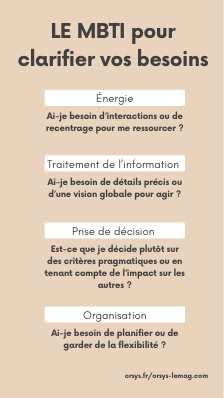
Taking the free MBTI test gives you a better understanding of your reactions in both effective and ineffective situations. Let's take a look at what this means in practice, going back to Marina and Vincent.
Marina: when organisation goes against needs
Marina has decided to set up her own business as a project management consultant. She's looking for more freedom and flexibility. Yet her MBTI profile highlights two key needs: external energy and planned organisation.
Finding yourself alone behind your desk, producing reports without any discussion or long-term vision, runs directly counter to these needs. The result: stress, demotivation and even a questioning of your own skills.
A few adjustments are all it takes, however, to put you back in the driver's seat when it comes to efficiency. Sharing a workspace, co-constructing certain assignments with her customers or integrating regular discussion time. It's not the skills that Marina lacked, it's the alignment between the way she works and the way she's organised.
Vincent: regaining your efficiency while respecting your rhythm
For Vincent, the stakes are different. He often compares himself to his colleagues, who systematically launch their projects with large group meetings. By mimicry, he imposes these kick-offs on himself even though he feels uncomfortable in them. As a result, he loses clarity and even discipline, which is one of his talents.
According to his MBTI profile, Vincent needs a lot of detailed information to build meaning and time to structure his thoughts before expressing himself. By imposing these meetings on himself, he is going against his needs and sabotaging his effectiveness.
For him, regaining control of his own organisation changes everything:
- Read all the useful documentation
- Sorting and connecting ideas, identifying grey areas
- Lead a targeted meeting with a clear objective
Same project. Different path. Efficiency restored.
Get trained!
Knowing yourself to avoid wear and tear
The MBTI is only one tool among others for understand each other and adjust better. There are, for example, Metaprograms, the Process Com, DISC.
But sometimes the problem isn't just misalignment. It comes from push too hard. Think of your brain as a powerful engine. If the vehicle is not maintained, the engine breaks down. If you press too hard for too long, the engine breaks down too. This is the principle of Illich's Law. Beyond a certain threshold of effort, performance no longer improves, it falls. To keep control of your efficiency, you sometimes have to change your posture, not push harder. This is where motor passions come in.
Driving passions: intelligently recharging your batteries
A driving passion is a chosen activity that mobilises your talents in a different way, and whose results reinforce your sense of competence.
For Marina, alternating between consultancy and project management training allows her to reactivate her talents for harmony and analysis. It's not so much in her expert posture that she regains energy, but in her ability to make things understandable to others. The more demanding moments are then counterbalanced by these rejuvenating spaces.
When Vincent feels his cognitive abilities slipping, he takes a few minutes to recharge his batteries by creating 3D puzzles. By focusing his thoughts on sorting a multitude of pieces and assembling them according to a step-by-step process, he mobilises his talents into motor passions.
Knowing yourself does not eliminate pressure or constraints. What it does do, however, is stop you fighting against yourself.
The next time the pressure mounts, resist the temptation to do more. Instead, ask yourself this question: What do I need, right now, to remain effective?
Adopt the main organisational methods
When you respect your talents, your needs and your rhythms, you expend less energy for the same result. You regain discernment where stress used to make you react. And above all, you regain control of your efficiency.
Then there's the key step of making organisational methods your own, rather than imposing them on yourself. Eisenhower's matrix, Pomodoro, to-do lists, retroplanning... can be extremely powerful, as long as they work for you and not the other way round.
In other words, the question is not : «What is the best method?. But rather: «How can this method support my talents, my needs and my energy?.
Eisenhower: clarifying what's really important
The Eisenhower matrix is based on two axes: urgency and importance, in order to prioritise actions and delegate. We often focus on urgency, but the real lever for efficiency lies on the importance axis. What is important? And more importantly, by what criteria?
This is where Pareto's law (20/80) comes in. What if you prioritised your actions on the basis of your talents and values? Could you delegate other tasks to those who have the talent? What if collective intelligence became the lever for your individual effectiveness?
Using the Eisenhower matrix effectively is not just about ranking tasks. It's about clarify what really deserves your energy, in terms of your talents.
Pomodoro: respecting your cognitive energy
The Pomodoro method involves working in short, rhythmic sequences. It is often presented as a universal solution to dispersion.
Here again, its effectiveness depends on the way it respects the way you work, in terms of energy management, information processing and the organisation of your thoughts. For some people, short, paced times support concentration; for others, they fragment thinking and cut off cognitive momentum.
Read also : 4 effective methods for prioritising your tasks
Here's how Marina and Vincent apply these methods to their project management:
| Marina | Vincent | |
| Talents | Harmony: creating a bond Analysis | Discipline: classifying/categorising Memory storage |
| MBTI* | External energy Global vision | Detailed information Planning |
| Eisenhower / Prioritisation | Analysis that brings clarity and meaning to the project Working together | Structuring information Project planning |
| Eisenhower / Delegation | Use of AI tools to gather technical information | Use of automation tools for things that do not require analysis |
| Pomodoro / Sequencing | Rather short sequences to avoid saturation. Active breaks (exchanges) that feed their energy and motor passions | Rather long sequences to maintain continuity of thought. Less frequent but restorative «off» breaks to avoid the Illich effect |
Lasting effectiveness is not about doing more, but about making a conscious choice: to act in line with the way we function rather than against it. This choice marks the transition from a logic of reaction to one of responsibility and self-direction. But this control cannot remain purely individual. It also means daring to express your needs and your levers of efficiency to others, to make collective work clearer and more fluid.
What if your next step was to share your way of being effective, in order to build fairer and more effective ways of working together with your colleagues?