Reorganisations, social tensions, disengagement, the circulation of alternative information… Internal crises never arise suddenly: they develop gradually through subtle warning signs that are often overlooked. How can we identify and interpret them, and take action before the situation reaches breaking point? Aude Mioni, a communications expert, sets out a practical methodology to help internal communications teams anticipate crises rather than simply reacting to them.

According to a Tryane survey, for 83 % of French companies, crisis management was a major internal communication challenge in 2024. And yet, corporate crises never arise out of the blue. They can be anticipated! Crises take hold quietly, in small ways: a meeting where nobody responds anymore, sarcastic WhatsApp messages, a deserted intranet, teams developing their own parallel communication channels. All of these are weak signals which, if underestimated or misinterpreted, can undermine team commitment and cohesion, and even destabilise an entire organisation.
Internal communication plays a key role in picking up on these early warning signs, assessing them and anticipating them, before crisis management becomes the only viable solution.
- Understanding the organisation as a dynamic system: why internal crises are almost always predictable
- Adopt an effective methodology: map, interpret and decide
- Preventing internal crises: structuring and equipping rather than reacting
The crisis: the predictable result of a gradual imbalance
A business functions like a living ecosystem. Every team, every manager and every communication channel contributes to its overall balance. When this balance is disrupted (by reorganisation, an overload of projects, pressure on resources or strategic uncertainty), the system does not collapse immediately. It adapts.
This is the principle of homeostasis: when faced with a disruption, the organisation restores a new balance. But this equilibrium is not always desirable. It can take the form of silent adaptations: individuals redefining their priorities, alternative organisational processes, or the dissemination of parallel information by certain influential actors.
The real risk in internal communications is not just the visible crisis, but the gradual acceptance by everyone of this new balance as the new normal.
Weak signals: subtle but valuable warnings
It is precisely at this point that the interpretation of weak signals – those early, partial and ambiguous indicators – becomes particularly significant. They enable us to anticipate an organisational and cultural shift before it becomes firmly established.
In this context, internal communication is not merely a channel for disseminating information, but a barometer of change. Silences, inaction or minor conflicts are all signs to be interpreted, just like HR indicators or clear-cut signals – obvious and visible manifestations of an ongoing dysfunction.
To move from intuition to analysis, an approach based on internal communication issues helps to structure the identification of weak signals.
Interpreting weak and strong signals in the context of internal communication
| Issues | Weak signals | Strong signals | Related HR KPIs |
| Raising awareness | Information that has not been read or has only been skimmed Repeated questions on topics that have already been communicated | Widespread rumours Criticism of the lack of transparency | Attendance at information meetings Usage rates for internal resources |
| Making people understand | Unconventional or off-topic questions Incorrect rephrasings | Open conflicts of meaning Operational bottlenecks caused by a lack of understanding | Misunderstandings reported to managers Increase in operational errors |
| Sign up | Cynicism, irony Gradual disengagement The emergence of critical informal leaders | Explicit rejection of the guidelines Open defiance towards management A breakdown in industrial relations | eNPS Response rate for internal surveys Turnover QVCT / RPS alerts |
| Taking action | Inertia Discreet workarounds Repeated lateness by staff members | Refusal to implement a decision Evident disorganisation Project cancellations Strikes, targeted resignations | Rate of implementation of action plans Absenteeism Involuntary internal mobility |
Be aware that corporate culture can mask underlying tensions
Not all weak signals are interpreted in the same way. Behaviour that is perceived as problematic in one organisation may be entirely acceptable in another.
At Omega IT, for example, the corporate culture encourages frequent, informal exchanges and the regular use of humour. When humour becomes the dominant form of communication, even on sensitive topics, it does not raise any alarm bells — as it is a shared code.
However, when humour consistently takes the place of clarification or confrontation, it can mask underlying unease and undermine team cohesion. Corporate culture therefore acts as a powerful filter, which can both highlight and conceal imbalances.
And what about you – what ‘weak signals’ are you noticing these days… without yet having a clear methodology for analysing them and taking action?
Adopt an effective methodology: map, interpret and decide
Identifying weak signals is a first step. But without a method, this observation remains subjective and is often insufficient to guide action. The challenge for internal communication is to structure the way the system is read in order to understand how information circulates, changes and influences collective behaviour.
This methodology is based on three key stages.
- Mapping flows and feedback loops: interpreting the system
- Identifying key influencers: the human impact
- Risk prioritisation: taking action
Step one: map out the flows and feedback loops to identify areas of tension
Start by understanding how information flows actually within the organisation, beyond formal procedures. It is not a question of auditing every tool, but of identifying where the flow breaks down. Nor is it a question of pointing the finger, but of understanding where and why meaning becomes distorted.
Map the flows:
- outputs (what is communicated, to whom, and through which channels)
- ancestors (what can be traced back, what cannot, and by what means)
- cross-cutting, often indicative of cooperation or, conversely, of circumvention
To this end, the creation of a dynamic mind mapping is particularly useful. This mind map helps to visualise the following:
- formal and informal channels
- quiet zones
- saturation zones
- discrepancies between the message sent and the message received
This mapping exercise helps to identify places where information gets stuck, is transformed or moves outside official channels — all of which are valuable clues to ‘weak signals’.
Reading the feedback loops is just as essential.
- Do the messages elicit the expected reactions?
- Are there any formal and informal channels for feedback?
- Do certain topics invariably lead to silence, sarcasm or side discussions?
To validate these findings, you can use a variety of methods: field observation, focused interviews with key stakeholders, or analysis of recurring situations using the ‘5 Whys’ method.
An example of how to apply the 5 Whys method
Weak signal observed : At several meetings, staff have asked very few questions about the reorganisation currently under way.
Why 1 : Why are there so few questions? > Because staff members think their questions won’t be addressed.
Why 2 : Why do they think that? > Because in previous announcements, some questions were not answered adequately.
Why 3 : Why were the answers deemed insufficient? > Because they explained the «how» but not the «why» of the reorganisation.
Why 4 : Why weren’t the objectives clarified? > Because the managers didn’t have the information.
Why 5 : Why weren’t the managers sufficiently equipped? > Because no specific time had been set aside to prepare them.
Conclusion : without analysis, the weak signal could be mistakenly interpreted as an indication that the teams understand the issues, when in fact it reveals a risk of disengagement.
Step two: identifying influencers, the human lever for weak signals
Weak signals do not spread on their own. They are carried out, amplified or neutralised by individuals. That is why the analysis of flows must be supplemented by a mapping of internal influencers.
An internal influencer is not necessarily a manager or a recognised expert. They are someone whose words and attitudes influence people’s behaviour, whether in line with or at odds with the official line.
Influence/Alignment Matrix is the key tool at this stage. For each unofficial influencer identified, assess their level of influence and how closely their views align with the official line. The matrix will then suggest an optimal internal communication strategy:
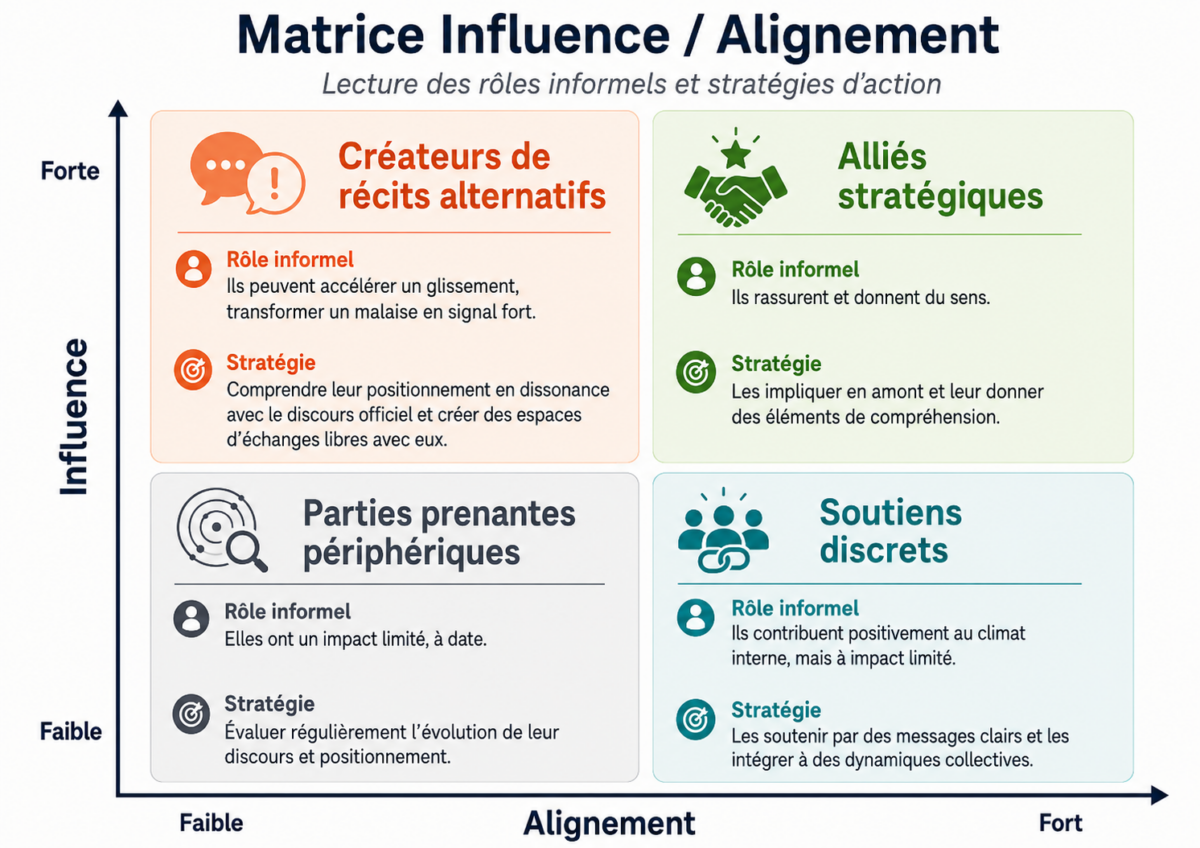
This matrix enables us to look beyond intuition and gain a deeper understanding where alternative narratives are created, how they flow and where the system is most vulnerable to imbalances.
You can include influencers in your mind map to gain an overview of the areas of risk in terms of internal communication.
Step 3: Prioritise risks and consider scenarios
An analytical methodology is only meaningful if it enables priorities to be set and action to be taken. Not every weak signal should trigger an immediate response, as this risks undermining the credibility of the internal communications function.
Identifying and assessing risks is the final step in analysing weak signals in order to make effective decisions regarding internal communication.
- What are the risks associated with these weak signals?
- How often do these weak signals occur? Are they becoming more frequent?
- What is the likelihood of them changing?
- How will mapping flows and influencers serve to dampen or, on the contrary, amplify these weak signals?
- What might be the potential impact on the organisation and its performance?
When discussing risks in internal communication, the following are typically listed: loss of trust, disengagement, a breakdown in cohesion, strategic misalignment, internal rumours, resistance to change, managerial conflict…
Set your alert threshold: based on which combination of indicators (weak, strong, HR KPIs) would you consider that the organisation has moved from a manageable risk to a crisis situation?
Depending on the severity of the risks, there are three strategies:
- monitor, when the signals are isolated or still unstable
- mitigate, through targeted measures to clarify, listen or make adjustments
- avoid, by putting preventive measures in place before the imbalance becomes entrenched
Example
At Omega IT, the systematic use of humour becomes a subtle signal of avoidance rather than simply a cultural trait. The risk is not immediate, but it is very real. Tensions are no longer voiced, and operational problems are swept under the carpet without being resolved, so as not to spoil the «good atmosphere».
To mitigate the effects without undermining the corporate culture, the internal communications team can organise a forum for the expression of views and collective wisdom. By enabling teams to understand one another better, the company fosters open dialogue without making the culture more rigid. Sensitive issues are then given an official forum for discussion, without being sidetracked by humour or brushed aside too quickly.
This ability to tailor the response enables internal communication to fulfil its role to the full: anticipating crises without slipping into a mindset of constant control.
But then, how can we put in place a sustainable prevention scheme that is embraced by the whole organisation?
Preventing internal crises: structuring and equipping rather than reacting
Preventing internal crises is not just about tracking down weak signals: it is about structure practices municipalities. In this context, internal communication plays a key role in’tools and framing, working closely with management and HR.
Training managers to identify and interpret weak signals
Front-line managers are the first to pick up on weak signals: unusual silences, recurring sarcasm, inaction, and underlying tensions. Yet these signals are often interpreted as individual behaviours, rather than as systemic indicators.
Internal communication can act as empowering managers : short training courses, practical workshops or methodological guides to teach them how to spot these signs, ask the right questions and report them in a structured way.
The aim is not to turn managers into crisis experts, but to provide them with a shared framework for interpreting the situation, so as to avoid trivialising it or reading too much into it.
Get trained!
Anticipating early warning signs is the first step. However, it is also essential to know how to organise an appropriate response when a crisis breaks out. The training Crisis communication, preparing and coping enables participants to acquire the essential methods and instincts needed to manage communication in sensitive situations, handle stakeholders and minimise the impact of a crisis on the organisation.
Structuring monitoring activities through bottom-up communication
Weak signals often emerge from feedback from the field. To pick up on them, internal communications can put in place upstream communication devices simple and regular.
Quick surveys, listening sessions, feedback and Q&A sessions enable you to gather people’s perceptions before they become set in stone. Ensure you collect a representative sample of responses so that you can analyse the results properly.
Please note that these measures are only effective if they are monitored and utilised, with clear feedback for the teams!
Support departments (IT, administration, office management, etc.) often act as effective channels for feedback from the front line.
Read also : Internal communication: how to make your actions effective
Provide clarity through the HR brand platform
Finally, crisis prevention in internal communications relies on a clear consistency between strategy, messages and behaviour. Where there is ambiguity, the system adapts automatically, often through parallel practices.
Internal communication draws on the HR brand platform to explain:
- what makes sense in collective action
- expected professional conduct
- communication guidelines during times of tension or change
Clear, shared guidelines are one of the most effective ways of preventing crises.
Example :
Omega IT: promoting humour and transparency via the HR brand platform
Internal communication can explicitly incorporate humour as explicit relational code within the HR brand platform, by translating it into the professional behaviours expected. In practical terms, this involves making it clear that humour is encouraged to build rapport, but that it must not replace the clarification of issues or the expression of disagreements.
Tools (such as a management charter and a guide to running meetings) and management training courses enable staff to explore the balance between humour, transparency and accountability through real-life examples.
This clarification provides a common framework, without stifling the culture, and limits personal interpretations, which can lead to imbalances.
Shaping, structuring, clarifying. It is by acting on these three levers that internal communication equips the organisation to address tensions before they escalate into breakdowns.
Checklist: Does your organisation pick up on weak signals?
| Questions | Yes | No |
| Do staff still respond to internal communications? | ☐ | ☐ |
| Do certain topics lead to silence, sarcasm or avoidance? | ☐ | ☐ |
| Are parallel information channels emerging? | ☐ | ☐ |
| Do managers have the answers their teams are looking for? | ☐ | ☐ |
| Is feedback from the field actually taken into account? | ☐ | ☐ |
| Are managers trained to identify weak signals? | ☐ | ☐ |
| Had the company set an alert threshold before the crisis? | ☐ | ☐ |
If you get a majority of «no» answers, it is probably time to put in place a strategy for preventing internal crises.
Ultimately, internal crises are generally preceded by weak, subtle and often ambiguous signals, which reflect the way in which the organisation adapts to tensions, changes or inconsistencies. These signals are not anomalies to be corrected, but genuine messages from the system, revealing a gradual shift in the collective balance. In this context, internal communication plays a strategic role. It is not limited to disseminating messages but helps to observe dynamics, interpret imbalances, prioritise risks and prevent crises. And what about you? How can internal communication today better structure the process of anticipation to avoid having to manage what could have been prevented?