With the challenges of cohesion, innovation and environmental responsibility on the rise, corporate seminars are being reinvented. The assistant, who is often at the heart of the process in VSEs and SMEs, is steering many aspects of the event to maximise its impact. More than just a coordinator, she becomes the conductor of these experiences, which are crucial to collective performance. A strategic role that reveals the full scope of the assistant's job. Élisabeth Duverney-Prêt, a specialist in assistants and secretarial work, explains.

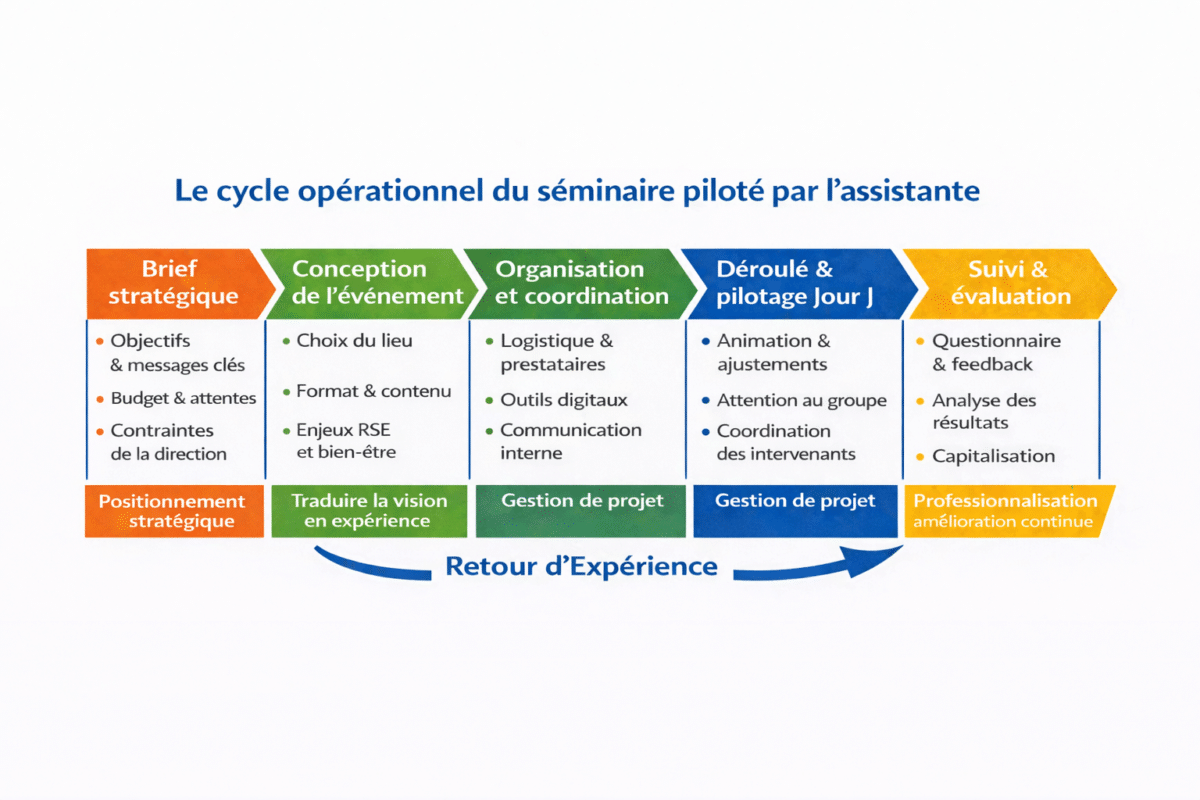
Corporate seminars have become key moments in the life of an organisation, providing an ideal opportunity to share a corporate vision, strengthen cohesion and open up new perspectives. Over the years, the role of the assistant has changed considerably. The assistant now plays a decisive role in the success of these collective events. These days, organising a seminar is no longer just about coordinating the logistical aspects. It's also about helping to define the main thrust of the event, ensuring that it runs smoothly and contributing directly to its impact. It's a responsibility that requires a broad range of expertise, constantly enriched by the new expectations of companies. A true orchestral conductor, the assistant can be involved at every stage of the seminar cycle. From strategic briefing to post-event evaluation.
Trends in 2026: the assistant as part of a new dynamic
Sustainability: making the event part of a meaningful approach
Today, more and more corporate events are integrating the environmental dimension into their design. Assistants are often the first to promote this more committed approach. The ecological impact is now taken into account in the organisation of events, in the same way as the quality of the experience or alignment with internal objectives. This is reflected in the choices made:
| Eco-responsible choice | Example of action / location | Impact |
| Hosting | Choose an ecolodge or low-carbon venue | Reducing our carbon footprint |
| Catering | Organise a lunch to promote local producers and short distribution channels | Supporting the local economy and minimising transport |
| Service providers | Select service providers with labels or CSR charters | Guaranteeing an ethical and responsible commitment |
| Activities | Workshops with craftspeople or team-building activities based on biodiversity | Transforming the seminar into a lasting adventure experienced as a group |
The assistant's role goes even further by opening up the teams to new and more responsible experiences. Workshops run by craftspeople, team-building activities focusing on biodiversity, meetings with local associations... These are just some of the ways in which the seminar can be transformed into a lasting, collective adventure. But the financial aspect undeniably weighs in the balance. Isabelle, an assistant in Savoie, recently found out: «When I suggested organising our seminar in an eco-responsible way, the first reaction was to fear that it would be more expensive and more complex to organise. So I started by comparing several concrete options: venue, catering, service providers, showing that certain responsible choices could still be compatible with the budget. I also explained the other benefits: greater consistency with our values, a better internal image and a more unifying experience for the teams. Management finally endorsed this approach and the feedback following the event was very positive.»
By instilling this new dynamic, the assistant is no longer simply organising an event. She is helping to anchor the company in an ethical and deeply meaningful approach.
Get trained!
Would you like to find out more? Discover the training programme Eco-responsible events.
Key points:
- Understand the concepts of sustainable development and climate issues as applied to events
- Identifying the requirements of an eco-responsible event
- Acquire a reliable methodology for designing zero-waste, low-carbon, inclusive and responsible events
Innovation: how to modernise the experience
Seminars are also being enriched with digital tools that increase participants' commitment and make the experience more fluid.
Dedicated applications
The assistant can, for example, put in place interactive solutions, such as dedicated applications that allow you to consult the programme, take part in live polls or ask questions without interrupting the proceedings.
Artificial intelligence
It also relies increasingly on AI tools to offer workshops or content tailored to the profile and interests of each participant.
Immersive virtual space
And when teams are spread over several sites, the assistant can create an immersive virtual space where remote employees follow the highlights, take part live and share the same information as those physically present.
These tools help to make the seminar more engaging and better adapted to today's ways of working.
Get trained!
AI at the service of event communication
Key points:
- Understanding AI, its potential, how it works and its limits for the events industry
- Automate repetitive, time-consuming or low value-added tasks
- Nurture your creativity and increase your sources of inspiration tenfold
- Knowing which tools to choose and how to get the best results from them
Well-being: putting people back at the heart of the event
Expectations in terms of well-being are also on the rise, requiring method and organisation.
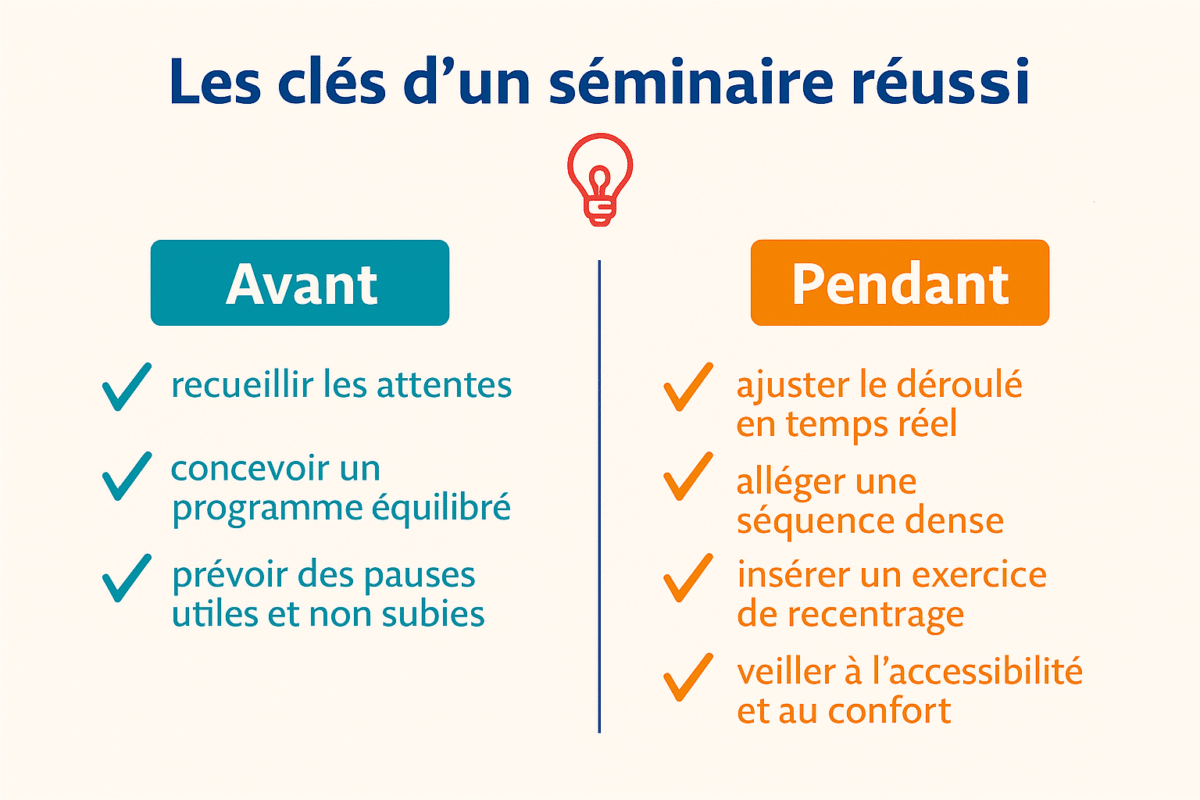
Right from the preparation stage, the assistant can gather participants' expectations to design a fluid programme, alternating short sessions, interactive workshops and breathing time to maintain continuous attention.
During the event, the assistant can also observe the energy of the group and adjust the sequence if necessary. For example: lighten a sequence that is too dense, add a brief refocusing exercise or arrange an extra break when the tension rises. She coordinates the speakers, ensures that the transitions are consistent and that each activity is accessible.
With her sense of anticipation and ability to regulate the pace of the group, the assistant creates a calming and effective framework, making the seminar a constructive and beneficial experience for everyone. By adapting the pace of the seminar and taking into account the well-being of the participants, the assistant contributes to a more positive atmosphere and better team cohesion.
Operational levers: the know-how that makes the difference
Choosing a location: a strategic lever in its own right
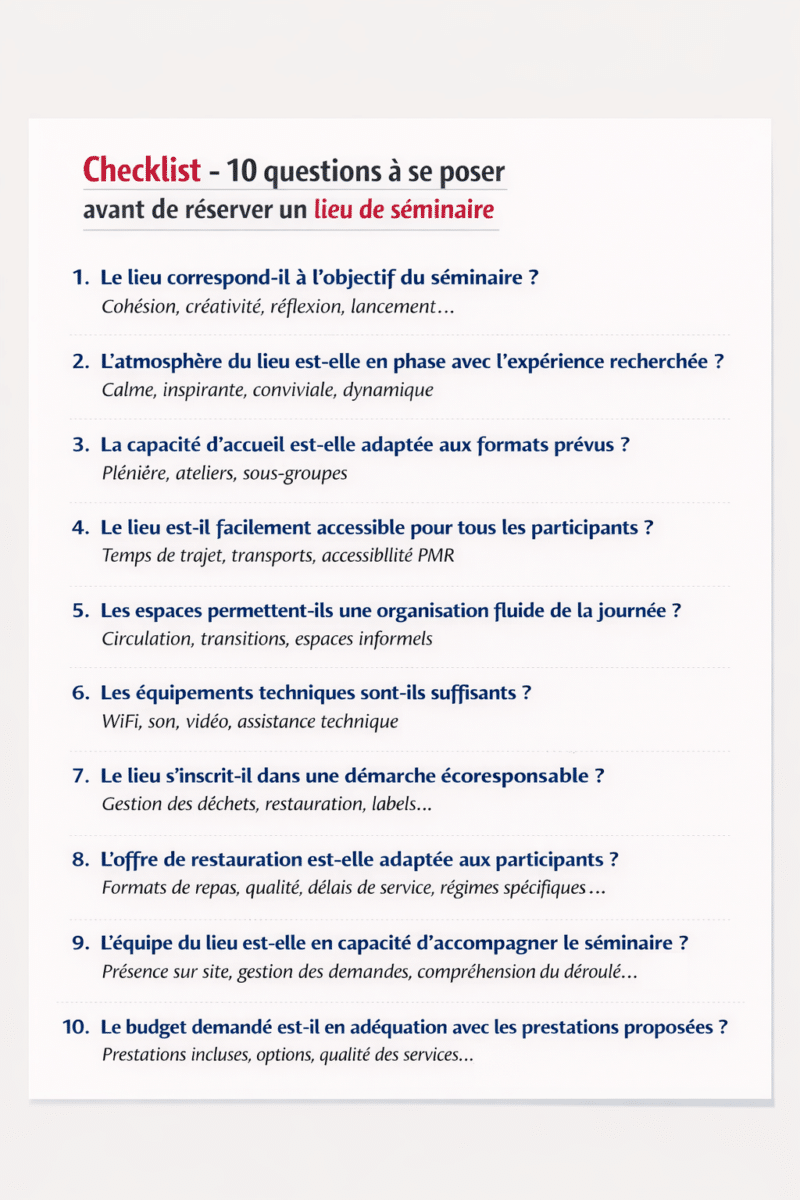
Well before the big day, the assistant can set the tone for the seminar by suggesting a venue that will create a favourable dynamic. The décor acts as a driving force. It can trigger emotions and stimulate discussion.
A few examples
For a convivial seminar, the assistant will choose a vineyard where conversations will naturally flow as the visit progresses.
For a fast-paced, active day, she'll opt for a barge that will get everyone on board for a programme in motion.
And if the aim is to unleash creativity, she'll dare to use an artistic third place or even a troglodyte space, perfect for sparking off new ideas.
In this way, the assistant builds a real story around the venue, giving coherence, inspiration and meaning to the whole experience.
Creating an engaging format
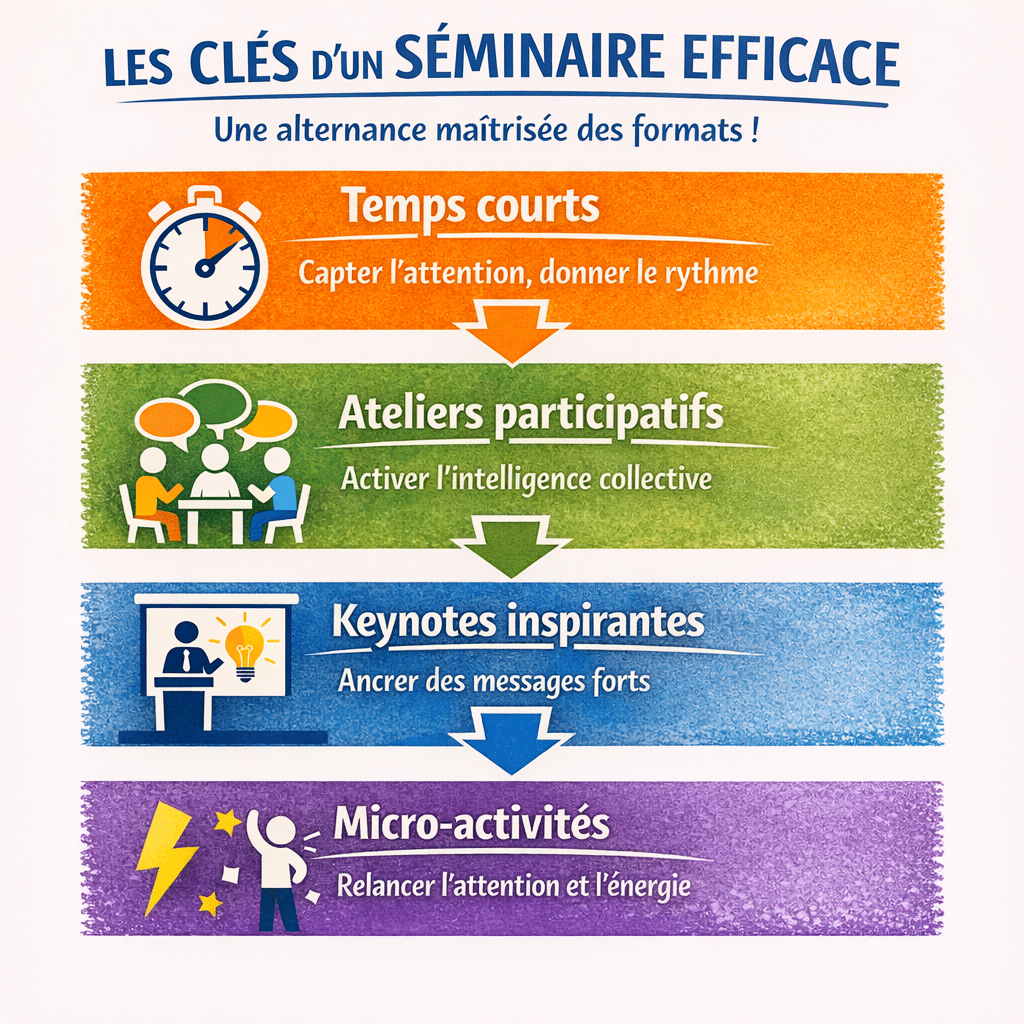
A successful seminar also relies on a precise balance between intensity, breaks and participation. The assistant plays a central role here. It is she who orchestrates the day's progress and creates a rhythm capable of maintaining the teams' attention. It's all about building an event that alternates short moments with more immersive sequences.
A round-table discussion can open the debate after a general presentation, before giving way to a participative workshop that will mobilise the collective intelligence. Later, a keynote speech can be positioned at the moment when attention is at its highest, to anchor a key message. Conversely, when attention is likely to wane, the assistant can insert an express activity or a collaborative exercise to get the momentum going again without overloading the timetable. But finding the right balance is not always easy, as Aurélie, an assistant in Val-de-Marne, explains: «A few days before a seminar I was organising, my manager expressed some reservations about the planned participative workshops. Rather than calling everything into question, I took the time to clarify his expectations and adapt the format. Shorter, highly structured sequences, with precise objectives for each workshop. On the day, these workshops generated real interest and gave rise to particularly rich and constructive discussions.»
Get trained!
Making a success of your events
Key points:
- Mastering the different stages of an event: design, organisation, results
- Integrating the challenges of digital technology and eco-responsibility
- Optimising the visibility of your event
- Measuring the results of your event for the company
Examples of practical work :
- Devising a global communications strategy including events
- Drawing up a promotional plan for a specific event
- Create an evaluation questionnaire for participants and prepare an action plan
Participants speak out:
«Interesting training which will enable me to organise events more methodically».»
«This course has made me want to continue in this direction and get started! There's nothing like hands-on experience in the events business!»
Follow-up to ensure the event is a lasting one
The value of a seminar doesn't only come into play on the day: it also reveals itself afterwards. This is when the assistant transforms the event into a real learning lever. By drawing up a clear, hard-hitting report, she can summarise the main points in just a few pages, with a return on images, and distribute it to participants and clients to give the seminar greater impact.
Read also : Optimising note-taking for greater efficiency
It will then send out an evaluation questionnaire to measure the success rate of the seminar: what worked and what didn't, what surprised, inspired or motivated.
On the basis of this feedback, the assistant can organise a follow-up meeting with management to identify areas for improvement and best practices to capitalise on.
Read also : Assistant jobs: how to position yourself in front of your manager?
A dashboard will also enable him to compare the planned budget with the final budget, analyse any discrepancies and optimise future events.
Often relegated to second place, this phase is nevertheless decisive. It is this phase that professionalises the entire process and transforms a simple seminar into a genuine strategic tool for the company.
The assistant: a strengthened and recognised role
By orchestrating these new-generation seminars, the assistant develops skills that go far beyond the purely event-related. Project management, cross-functional coordination, communication, understanding of human and technological issues... She becomes a point of reference for teams, a valuable contact for management and a discreet but essential driving force behind internal transformation.
And this evolution does not stop there. It also affects other areas that shape the profession. For example: mastering digital tools, managing priorities, supporting managers and internal communication. At the heart of organisations, the assistant is no longer simply the guarantor of smooth administrative operations. She is becoming a trusted partner and a pillar of cohesion. These new demands open up a host of new avenues to explore: how can we strengthen our operational leadership? What AI tools can be used to improve efficiency? How can you develop soft skills that enhance your posture?
Read also : Assertiveness: the essential quality of the assistant
In conclusion, the job of assistant is constantly evolving and gaining in strategic scope. The organisation of seminars is a concrete example of this, and is part of a wider range of tasks that now position the assistant as a structuring element in the company. At the interface between teams, managers and projects, she now plays a key role in coordination and makes a significant contribution to the company's overall performance.