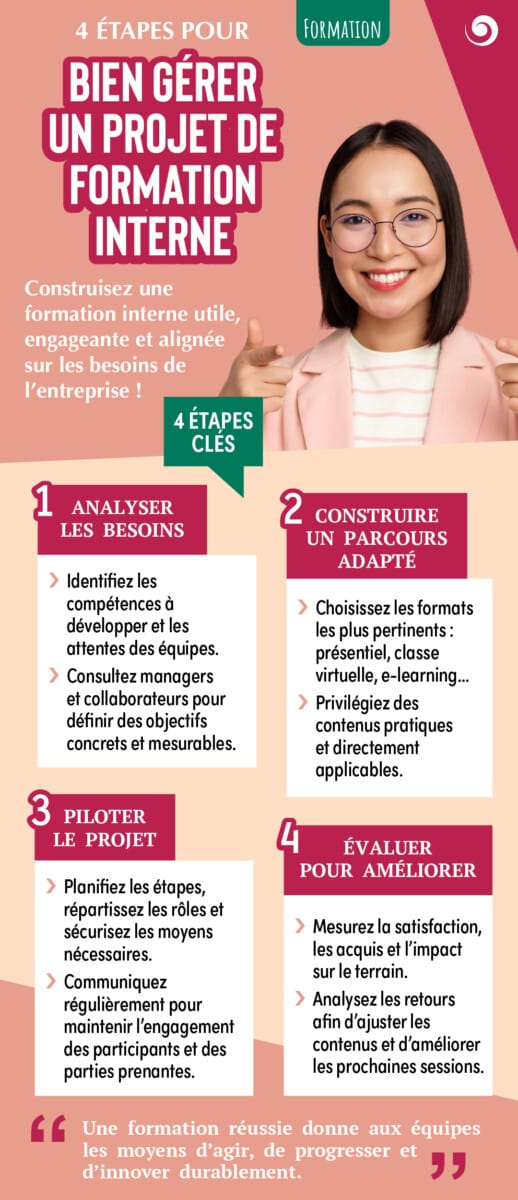
How can you develop an internal training programme that is useful, engaging and aligned with the organisation’s needs? Find out how to do it in four key steps!

Setting up an in-house training programme cannot be done on the fly. To develop skills, support the company’s evolution and strengthen team engagement, it is essential to develop a structured programme tailored to the actual needs on the ground. From analysing expectations to evaluating results, every stage helps to ensure the training’s effectiveness and long-term impact.
1. Analyse internal training needs
Identify the skills to be developed and the teams’ expectations.
Consult with managers and staff to set specific and measurable objectives.
How should we go about this in practice? Use interviews or a short questionnaire to identify specific needs and avoid training programmes that are out of touch with reality.
[Also read] Managing an internal training project in 4 steps
2. Designing a tailored programme
Choose the most suitable formats: face-to-face, virtual classroom, e-learning…
Focus on practical content that can be put into practice straight away.
Trick : Alternate between theory and practical exercises to help learners consolidate their knowledge and keep their attention focused.
[Training] Build and manage a training project
3. Lead the in-house training project
Plan the steps, allocate roles and secure the necessary resources.
Communicate regularly to keep participants and stakeholders engaged.
Tip: Appoint a project lead to coordinate the various parties involved and monitor deadlines throughout the roll-out.
4. Evaluate to improve
Measure satisfaction, outcomes and impact on the ground.
Analyse the feedback in order to adapt the content and improve future sessions.
How should we go about this in practice? Using an online follow-up questionnaire, carry out an assessment a few weeks after the training to gauge how effectively the skills learnt are being applied in the workplace.
[Training] Training occasional trainers
«Effective training empowers teams to take action, make progress and innovate in the long term.»