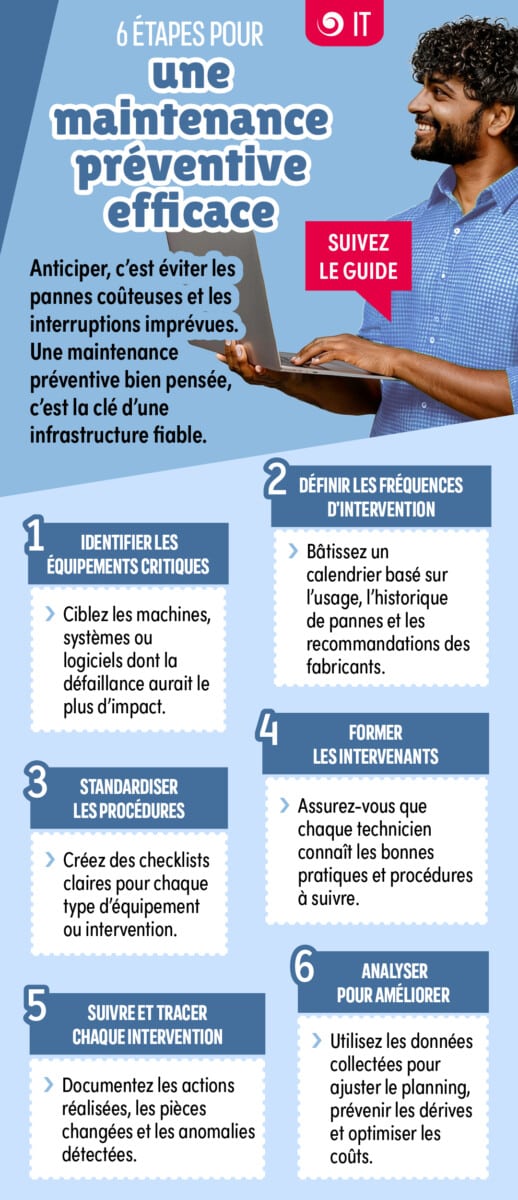
IT failures are costly: they lead to service interruptions, lost productivity, security risks and user dissatisfaction. Well-organised preventive maintenance helps to anticipate incidents before they impact business operations. Here are six best practices to adopt to enhance the reliability and performance of your infrastructure.

1. Identify critical equipment and services
Not all components of an infrastructure are equally important. The first step is to identify the assets that are essential to the running of the business:
- Production servers
- Network equipment (switches, routers, firewalls)
- Storage solutions
- Mission-critical business applications
- Cloud services
- Backup and security tools
The aim is to identify the components whose unavailability would have the most significant impact on operations. This analysis enables maintenance tasks to be prioritised and resources to be allocated efficiently.
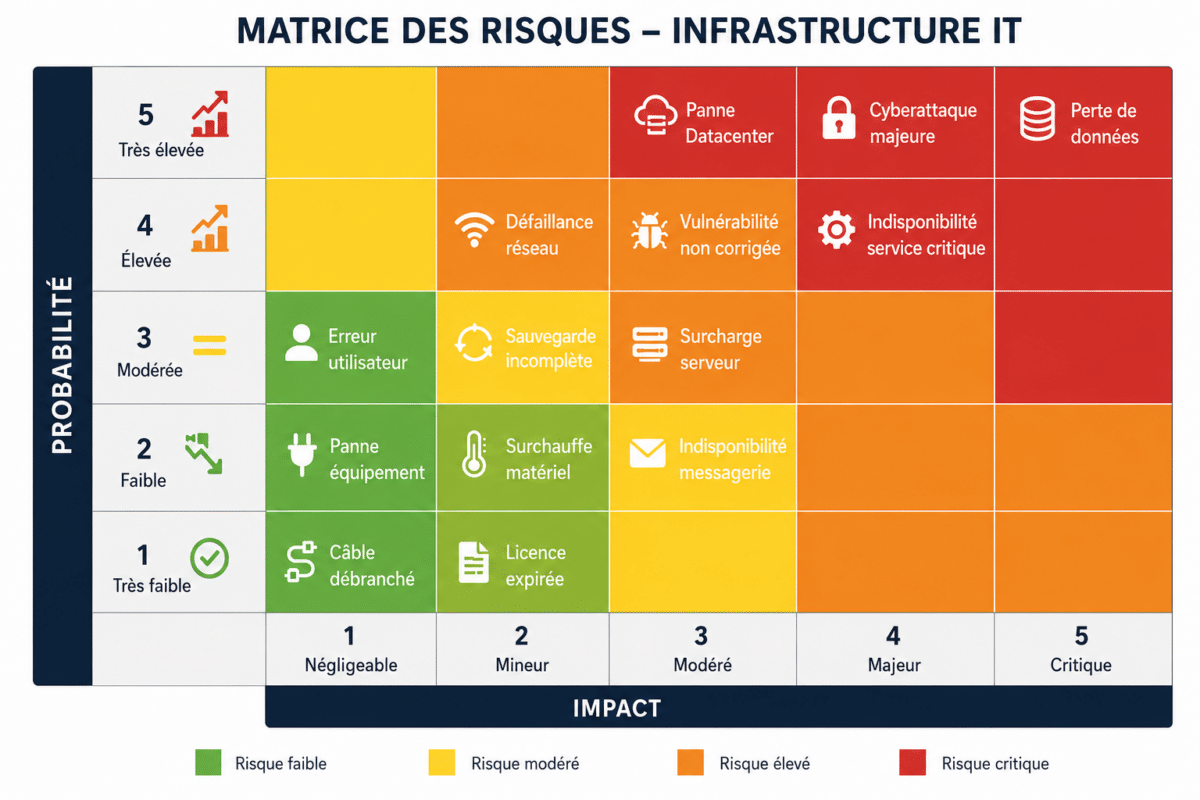
Good habit: draw up a criticality matrix (risk matrix) by assessing the business impact and the probability of failure for each piece of equipment.
2. Establish a structured maintenance schedule
Effective maintenance depends on regularity. Set maintenance intervals appropriate for each component:
- Daily backup checks
- Weekly review of system alerts
- Monthly security update
- Quarterly performance review
- Annual test of the disaster recovery plan (DRP)
The schedule must also take into account maintenance windows in order to minimise the impact on users and operations.
3. Standardise response procedures
Human error is one of the main causes of IT incidents. To minimise it, document routine procedures in detail:
- Server update
- Replacement of network equipment
- Backup management
- Monitoring system logs
- Safety system checks
Standardised procedures ensure consistent execution, even when a different technician is involved.
4. Provide ongoing training for technical teams
Infrastructure is evolving rapidly: new cloud technologies, cybersecurity, virtualisation, automation, artificial intelligence, and so on. A team that does not undergo regular training risks missing out on early warning signs or applying outdated methods.
The training must cover:
- Best practices for security
- Internal procedures
- The latest versions of the tools used
- Crisis management scenarios
- Advanced diagnostic techniques
A skilled team detects faults more quickly and significantly reduces downtime.
5. Ensure full traceability of operations
Every incident must be recorded in a tracking tool or ITSM platform in order to maintain a reliable record:
- Date and time of the operation
- Relevant technician
- Affected equipment
- Actions taken
- Replaced parts or components
- Results observed
This documentation makes it easier to analyse recurring incidents and improves knowledge sharing within teams.
Essential: centralise information in a CMDB (Configuration Management Database) or a document management tool accessible to all stakeholders.
6. Using data to anticipate incidents
Modern preventive maintenance is no longer limited to routine inspections. Thanks to supervision and monitoring tools, it is possible to detect the early warning signs of a failure:
- Abnormal increase in CPU usage
- Gradual saturation of storage capacity
- Increase in network traffic
- Unusual temperatures in the equipment
- Increasing number of system errors
Analysing this data enables a shift from preventive maintenance to a predictive approach, where maintenance is carried out before a breakdown even occurs.
Commonly used tools: Centreon, Zabbix, PRTG, Grafana, Datadog, Microsoft System Center