Used for automation, data analysis, artificial intelligence, web development and everyday scripts, it is an excellent gateway to programming. Visit 7 tips for quick and painless progress in Python....
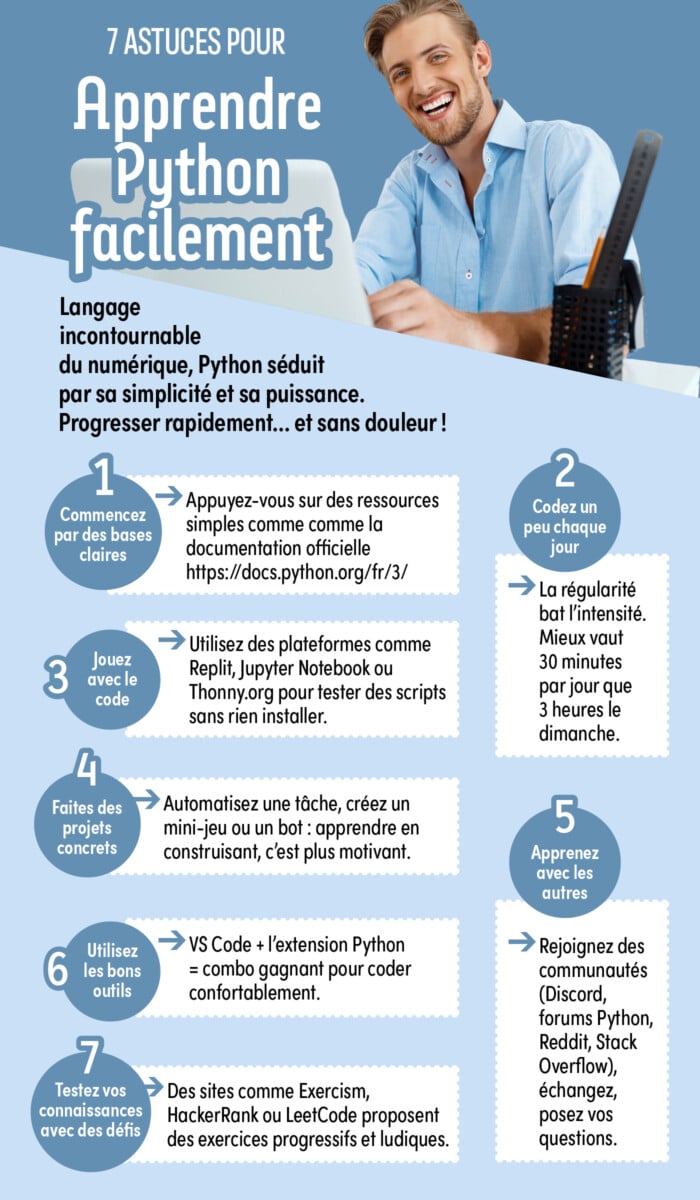
1. Start with a clear foundation
Before trying to do everything, take the time to understand the basics: variables, conditions, loops, functions, lists and dictionaries. Simple, well-structured resources, such as the official website python.org, language documentation at https://docs.python.org/fr/3/ and a tutorial to get you off to a good start.
2. Code a little every day
Regularity beats intensity. Better 30 minutes a day than 3 hours on a Sunday. The brain learns better by repetition than by saturation. In a few weeks, these small efforts add up and become automatic habits.
3. Play with the code
Learning Python doesn't have to be theoretical. Test, modify, break and start again. Use online platforms such as Replit, Jupyter Notebook or Thonny.org to test scripts without installing anything.
4. Make concrete plans
Automate a task, create a mini-game or a bot: learning by building is more motivating. Even if it's very simple, a project forces you to use several concepts at once and gives meaning to your learning.
Examples of mini-projects available:
- a little “guess the number” game.
- a euro/dollar converter; ;
- a password generator ;
- a calculator ;
- an interactive quiz; ;
- a script that automatically renames ;
5. Learn from others
You make much faster progress when you're not learning on your own. Joining a community allows you to ask questions, discover other ways of coding and stay motivated.
You can exchange ideas on Python forums, Discord servers, Reddit or Stack Overflow. Reading other people's questions is often just as instructive as asking your own. Often, a simple external explanation will help you to unblock the situation and better understand your mistakes.
6. Use the right tools
A good working environment makes learning much easier. Visual Studio Code, with the Python extension, offers excellent convenience: syntax highlighting, autocompletion, fast code execution, debugging and useful suggestions.
Other tools are also very useful, depending on your level:
- Replit for coding from a browser + the Python extension = a winning combo for comfortable coding
- Thonny for a simple start
- Jupyter Notebook to test line by line ;
7. Test your knowledge with challenges
To make lasting progress, you need to get away from the classroom and tackle small problems. Platforms such as Exercism, HackerRank or LeetCode offer progressive, stimulating and often fun exercises.
Learning Python doesn't require you to be a computer expert from the start. With a solid foundation, a little practice every day, concrete projects and the right tools, progress becomes natural. The most important thing is not to go fast, but to stay curious, regular and active.
You learn Python by coding. So test, build, explore... and have fun: that's often the best way to make progress.