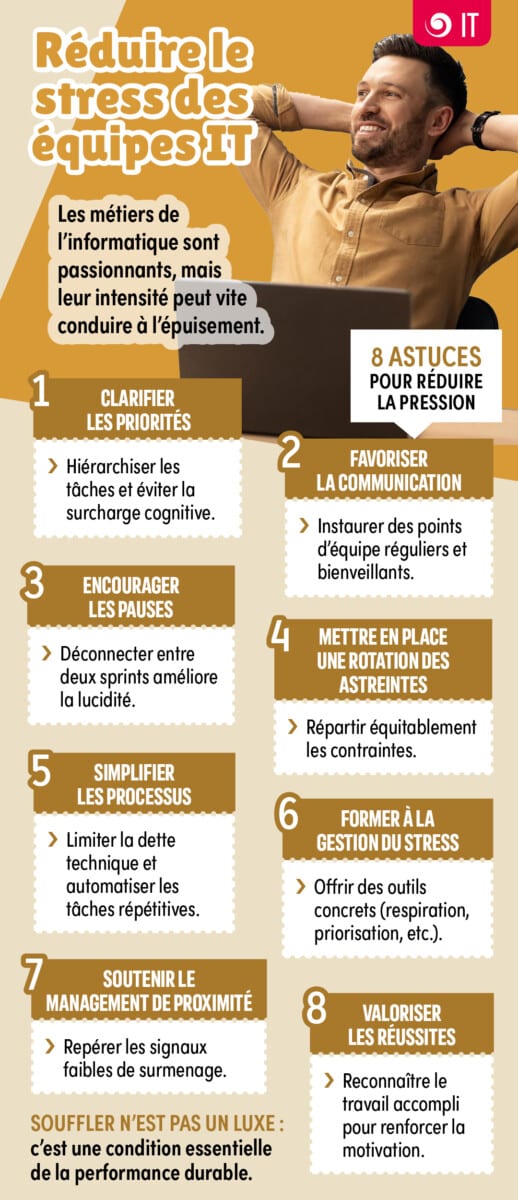
Between incidents, projects due for delivery, urgent requests, changing priorities and on-call duties, IT teams regularly face periods of intense pressure. To prevent this high-pressure environment from becoming a long-term situation, the way work is organised plays a vital role. Here are 8 best practices to keep in mind to look after the team whilst maintaining its effectiveness.

1. Clarify priorities
Provide clarity to avoid the «everything is urgent» effect.
Identify the tasks that are truly a priority and make trade-offs explicit. Everyone needs to know what needs to be dealt with immediately, what can wait and what can be postponed.
Quick reminder: A maximum of three priorities at any one time, clear responsibilities and realistic deadlines.
2. Encourage communication
Report any difficulties before they become critical.
Organise short, regular team meetings to identify bottlenecks, share important information and assess the workload. Gently encourage everyone to speak up straight away if they are feeling overworked or are experiencing difficulties. .
Quick reminder: ask regularly: «What’s holding you back? What do you need?»
3. Encourage breaks and time away from screens
Recovery is part of the job, especially after a busy period.
Avoid a constant stream of meetings, tickets and requests. Encourage breaks, safeguard periods of concentration and, as far as possible, stick to your off-duty hours.
Quick reminder: After an intense sprint or a major incident, make sure you allow plenty of time to recover.
4. Distribute on-call duties fairly
Do not let the burden always fall on the same people.
Establish a clear, fair and well-planned rota. Make provision for cover in the event of difficulties and take into account shifts worked at night or during rest periods.
Quick reminder: After a difficult shift, reassess the workload for the following day.
5. Simplify processes
Fewer unnecessary tasks also mean less pressure.
Identify repetitive tasks, unnecessary checks and unnecessarily complex processes. Automate whatever can be automated and set aside time regularly to reduce technical debt.
Quick reminder: to ask oneself: «Which repetitive task could be eliminated, simplified or automated?»
6. Provide training in stress management
To help teams develop simple, practical habits.
Suggest methods for prioritising tasks, managing time, improving concentration or recovering from stress. These tools should complement organisational measures, rather than being used to compensate for a constant workload.
Quick reminder: to have an effect on both work organisation and on individual resources.
7. Supporting frontline management
Spot the signs of overload and take prompt action.
Unusual tiredness, irritability, isolation, difficulty concentrating, repeated mistakes or a lack of motivation may be signs of work overload. Managers must be able to initiate a dialogue and work with the employee to find practical solutions.
8. Celebrate successes
Don’t wait for major projects to recognise the work that has been done.
Highlight progress, acknowledge contributions and celebrate collective achievements: resolving an incident, delivering a project, improving a process or colleagues helping one another. Recognition helps to give meaning to the efforts made.
Quick reminder: to make successes just as visible as problems.
To reduce stress in the long term, consider P.C.R.: Prioritise, Communicate, Recover.
A high-performing IT team is not one that is under constant pressure: it is a team that knows how to where to focus your efforts, when to ask for help and when to take a break.
Taking a breather is not a luxury: it is essential for sustained performance.