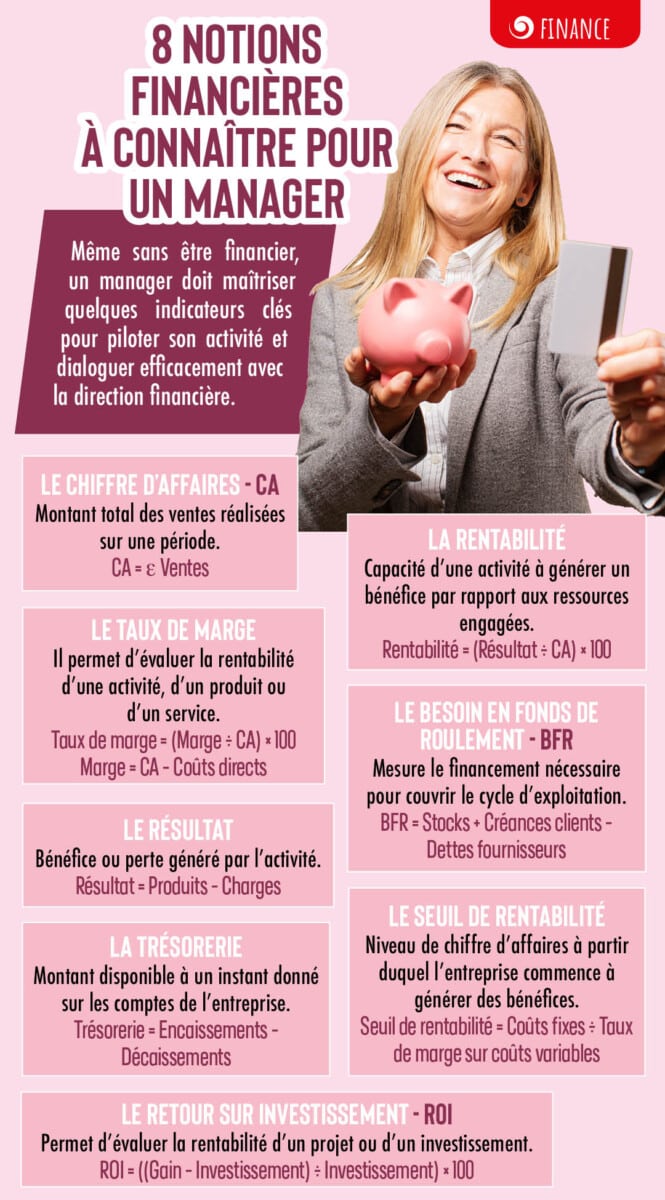
Turnover, margin, profitability, cash flow, ROI… Understanding financial indicators isn’t just for accountants. Every manager needs to understand these concepts in order to manage their business, draw up a budget, justify investments and liaise with the finance department. Discover the eight essential financial concepts you need to make the right decisions.

1. Turnover
Turnover refers to the total value of sales of goods and services made over a given period, excluding tax. It serves as an initial indicator of a company’s commercial performance.
Please note that an increase in turnover does not necessarily mean an increase in profits.
The formula:
Turnover = Σ Sales (excl. VAT)
Example: 500 products sold at €200 (excluding VAT) generate a turnover of €100,000.
The benefits for the manager: monitor the performance of their business, assess the extent to which sales targets have been met, and anticipate fluctuations in demand.
2. Margin and margin rate
The margin represents the difference between the selling price and certain associated costs. It helps to identify the most profitable products, services or activities.
There are two distinct indicators: the margin rate and the mark-up rate.
The formulas:
- Margin = Selling price (excl. VAT) − Cost used
- Margin rate = (Margin ÷ Cost used) × 100
- Brand rate = (Margin ÷ Selling price excluding VAT) × 100
Example: A product sold for €100, with a cost price of €60, generates a profit of €40. Its profit margin is 66.7 per cent and its gross margin is 40 per cent.
The benefits for the manager: adjust prices, keep costs under control and prioritise the most profitable activities.
3. The result
The result is the difference between revenue and expenses over a given period. When it is positive, the company makes a profit. When it is negative, it makes a loss.
In particular, the following can be distinguished:
- Operating profit : performance relating to day-to-day operations.
- The financial result : the balance of financial income and expenses.
- Net profit : the final result after taking into account all income, expenses and corporation tax.
The formula:
Profit = Revenue − Expenses
Example: Revenue of €500,000 and expenses of €450,000 result in a profit of €50,000.
The benefits for the manager: to measure the contribution of their work to the company’s results.
From turnover to profit
Adjust the amounts to simulate your financial performance.
Simplified educational simulation. Amounts exclude VAT.
4. Cash flow
Available cash refers to the cash and cash equivalents that the company can access immediately. It is used to pay suppliers, salaries and day-to-day expenses.
A profitable company may experience cash flow difficulties if its customers are slow to pay their invoices.
The formula:
Final cash balance = Opening cash balance + Cash inflows − Cash outflows
Example: With €20,000 available, €80,000 in receipts and €70,000 in payments, the final cash balance stands at €30,000.
The benefits for the manager: anticipate expenditure, monitor payment deadlines and plan investments.
5. Profitability
Profitability measures a company’s ability to generate a profit in relation to the resources it utilises.
It differs from profitability, which relates profit to turnover.
The formulas:
- Economic profitability (simplified approach) = (Operating profit ÷ Capital employed) × 100
- Net profit margin = (Net profit ÷ Turnover) × 100
Example: A net profit of €50,000 on a turnover of €500,000 represents a net profit margin of 10 per cent.
The benefits for the manager: to compare the performance of business activities, optimise resources and guide investment.
6. Working capital requirement (WCR)
Working capital requirements measure the financing needs arising from the timing differences between cash inflows and outflows in the operating cycle.
Large stocks or excessively long customer payment terms can increase this requirement.
The simplified formula:
Working capital = Stock + Trade receivables − Trade payables
Example: €40,000 in stock, €60,000 in trade receivables and €30,000 in trade payables result in a working capital requirement of €70,000.
The benefits for the manager: optimise stock levels, speed up invoicing and reduce payment collection times.
7. The break-even point
The break-even point is the turnover required to cover all fixed and variable costs.
Below this threshold, the business makes a loss. Above it, it makes a profit, assuming the cost structure remains constant.
The formulas:
- Margin on variable costs = Turnover − Variable costs
- Variable cost margin ratio = Variable cost margin ÷ Turnover
- Break-even point = Fixed costs ÷ Margin on variable costs
Example: With fixed costs of €100,000 and a contribution margin ratio of 40 per cent, the break-even point is €250,000.
The benefits for the manager: set realistic business targets and assess the viability of a new venture.
Calculate your break-even point
8. Return on investment (ROI)
Return on investment (Return on Investment (or ROI) measures the net returns generated by an investment in relation to its cost.
It makes it easier to compare several projects: purchasing software, staff training, process automation or a marketing campaign.
The formula:
ROI = [(Revenue generated − Total cost of investment) ÷ Total cost of investment] × 100
Example: Software costing €10,000 generates savings of €15,000 over the course of a year. Assuming there are no other costs, its ROI amounts to 50 per cent over this period.
The benefits for the manager: defend a budget, prioritise projects and assess their cost-effectiveness.
Calculate your return on investment