Speaking English fluently isn’t just about knowing vocabulary; it’s also about bringing a conversation to life: responding, keeping the conversation going, building on what’s been said and changing the subject with ease.

Well, actually, by the way… If you want to speak English more naturally and spontaneously, these little phrases make all the difference when speaking! Find out how to use them to link your ideas together, pick up on what the other person is saying and speak more fluently.
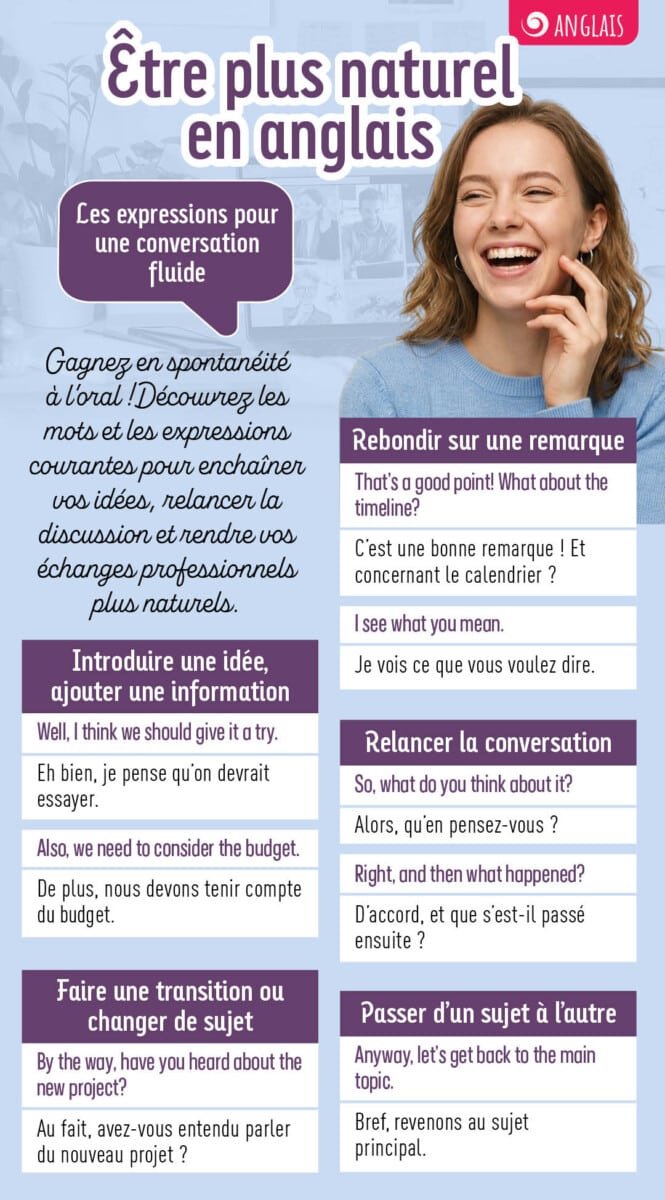
Speaking English naturally: introducing an idea, adding information
Well, I think we should try a different approach.
Well, I think we should try a different approach.
Well, I think we should give it a go.
Well, I think we should give it a go.
We also need to take the budget into account.
Furthermore, we must take the budget into account.
What’s more, it could save us some time.
What’s more, it could save us time.
Speaking English fluently: making a transition or changing the subject
By the way, have you heard about the new project?
By the way, have you heard about the new project?
That reminds me, have you booked the room?
That reminds me, have you booked the room?
Speaking of which, how’s your project coming along?
On that note, how is your project coming along?
Oh, one more thing – did you get my email?
Ah, one more thing – did you get my email?
So, regarding the new project, any updates?
So, any news about the new project?
Speaking English more spontaneously: how can you respond to a comment?
That’s a good point! What about the timeline?
That’s a good point! And what about the timetable?
Oh, really? That’s interesting!
Oh really? That’s interesting!
I see what you mean.
I see what you mean.
Actually, that sounds like a good idea!
Actually, that sounds like a good idea to me!
[Beware of false friends]
In English, actually means «actually», «in fact» or «in reality», not «at present».
It is very common in spoken language and is used to clarify a point, correct a piece of information or qualify a statement.
On the other hand, to say «at the moment», you should use currently or at the moment.
How can you get the conversation going again in a natural way?
So, what do you think of it?
So, what do you think?
Right, and then what happened?
Right, and what happened next?
So, what happened next?
So, what happened next?
What about you?
What about you?
How do you move from one topic to another?
Anyway, let’s get back to the main topic.
Anyway, let’s get back to the main topic.
Anyway, where were we?
Anyway, where were we?
Anyway, as I was saying…
Anyway, as I was saying…
Tip: speaking English more naturally
To speak more fluently, focus on using short words and phrases that bring the conversation to life.
To link your ideas together:
Well: well
So: well then, so
Also: in addition
Anyway: in short
By the way: actually
To respond and bounce back:
I mean: I mean
You know: you see
Exactly: absolutely
I see: I understand
Speaking of which: on that note
The right thing to do:
Use these common expressions rather than more formal connectors such as moreover or furthermore (furthermore, in addition), more commonly used in professional writing (reports, summary notes, commercial proposals, etc.) and formal presentations (prepared speeches, conferences, etc.).
This will make your conversations feel more natural and spontaneous!