Refusal of care, end-of-life decisions, tensions with relatives... Healthcare professionals are regularly faced with situations where technical expertise alone is not enough. At such times of uncertainty, the ethical approach can provide real support in analysing complex situations and making fair, well-reasoned decisions. Valérie Gisberti, a trainer specialising in management and communication, explains.

The day-to-day work of healthcare professionals is governed by a highly structured framework: the Public Health Code, recommendations for good practice, protocols and professional guidelines. These essential benchmarks ensure the safety of procedures, protect patients and professionals and guarantee the quality of care. However, clinical reality sometimes goes beyond these established frameworks.
Carers are regularly confronted with complex situations: refusal of care, end-of-life decisions, tensions with relatives, trade-offs between available resources. These situations are not just a matter of technical expertise. They involve values and expose professionals to uncertainty, discomfort and sometimes guilt.
It is precisely in these situations that the ethical approach becomes a valuable decision-making aid.
Law, morality and ethics: complementary points of reference
Three levels of benchmarks guide the actions of healthcare professionals.
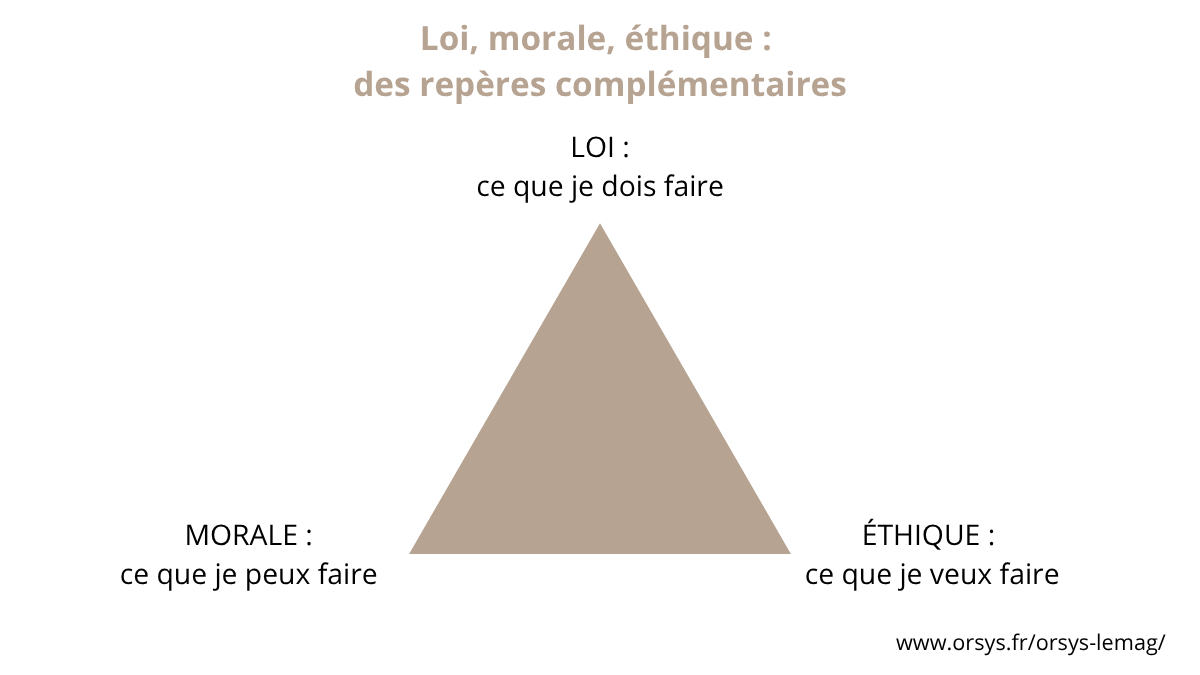
The law sets out rights and obligations: free and informed consent, professional secrecy, non-discrimination, protection of vulnerable persons, respect for dignity. It is an essential foundation.
The moral refers to the personal convictions and values held by the teams: humanity, commitment to care.
Ethics, It comes into play when these benchmarks are no longer sufficient to resolve a particular situation.
A decision may be legally compliant but still leave a lingering feeling of unease. Conversely, a protective intention may restrict a patient's autonomy.
The ethical approach does not replace the rules or clinical competence. It enables us to seek the fairest possible decision, taking into account the legal framework, professional values and the uniqueness of each situation.
Ethics therefore confronts carers with their own decisions and their own way of looking at the situation.
How do you identify an ethical dilemma?
An ethical dilemma can often be identified by discomfort: lasting hesitation, disagreements within the team, the feeling that no option is fully satisfactory.
Here are some examples of common situations:
- a lucid patient refuses to comply with vital treatment
- a patient's family decides to hide a painful family event from them
- a patient wishes to leave hospital against medical advice
- maintaining heavy treatment in a very elderly patient with multiple pathologies
- the use of a restraint or restrictive measure
- prioritising care when resources are limited
These situations illustrate what is known as an ethical dilemma in healthcare. This is a moment when several fundamental values or principles come into tension.
Naming the ethical dimension of a situation opens up a space for collective reflection, rather than remaining in technical or emotional opposition. The aim is not to decide for one person in particular, but to reflect on the ethical benchmarks that could guide professionals when faced with this type of situation.
The stages in a structured ethical approach
To analyse a complex situation, healthcare professionals can follow a structured approach. Here are the six steps to follow.
- Formulate the ethical question: a question that puts two ethical principles in tension and that cannot be resolved by a simple «yes» or «no».
- Describe the situation in detail clinical facts, context, patient's wishes, organisational constraints.
- Identify the benchmarks involved applicable legislation, professional values, fundamental ethical principles and stakeholder views.
- Analyse the possible consequences impact on the patient, their family and friends, the healthcare team and the organisation, in the short and long term.
- Justify one or more proportionate recommendations To find the most coherent options in the light of the factors analysed and to be able to explain the reasons for its choice.
- Communicating and monitoring Share the recommendations with all professionals and monitor their implementation.
This approach enables informed, traceable decisions to be taken and shared within teams. It reinforces individual and collective responsibility.
Why integrate ethical reflection into care practices?
Ethical reflection brings a number of practical benefits to healthcare teams:
- improve cross-industry cooperation providing a common framework for analysis
- help prevent or ease tensions in teams
- supporting professionals faced with emotionally challenging situations
- promote dialogue and building trust with patients and their families
When decisions are explained and justified, they are generally better understood, even when they remain difficult to accept.
Expert voice - Valérie Gisberti
«I've already had discussions on this subject with healthcare managers. Using a structured ethical approach in their establishment helps them to take a step back in their practice. It leads them to stop and think in depth about many of the dilemmas they encounter on a daily basis.»
In an increasingly complex healthcare environment, characterised by organisational constraints and rapidly evolving medical technologies, the ability to reflect on ethical issues is a key factor in the success of any company. an essential lever for quality and safe practices.
Ethics: a professional skill to be developed
An ethical approach is not just a matter of intuition or goodwill. It is acquired and developed through training, analysis of practices and teamwork. It concerns all professionals and presupposes :
- listening to different points of view
- constructive confrontation of arguments
- the ability to explain decisions taken
[Training] Ethical reflection in professional practice
Faced with the complex situations encountered in healthcare establishments, professionals need benchmarks and tools to structure their thinking and argue their decisions.
Key points:
- understand the main principles of ethics in healthcare
- identifying and analysing ethical dilemmas
- use a structured decision-support method
- developing collective thinking within teams
This training helps to improve the quality of decisions and ensure the safety of care practices.
Examples of practical work
- Based on a given situation, I ask them to identify the discomfort and ethical dilemma they are facing.
- Given an ethical dilemma, I ask them to formulate the corresponding ethical question.
- On the 2nd day of training, we deal with a ethical question.
- In some training courses, on the 2nd day, we reflect on how to talk about ethics in the establishment. How can we communicate to raise teams' awareness of the ethical approach?
Participants speak out:
«Useful in our business, important to put a meaning on the word ethics.»
«Many examples, concrete situations from our daily lives».»
«I'm discovering that the ethical approach concerns everyone, even non-health professionals.»
«In the end, ethics is something that's fairly clear, not that difficult to understand.»
In the healthcare sector, making decisions always means acting on the lives of others. Ethics does not provide ready-made answers. It proposes a method for thinking about action in the face of uncertainty, giving meaning to the choices made and acting appropriately. Developing an ethical approach to professional practice helps to ensure the security of decisions, improve the quality of care and support healthcare teams. It is by developing this approach on a day-to-day basis, as close as possible to clinical situations, that it becomes a genuine professional compass.