Ethical storytelling addresses a growing concern amongst organisations: how can one tell an engaging story without compromising the truth of the facts? In a climate where trust is becoming a strategic issue, communications professionals are called upon to balance emotion, transparency and credibility. This shift is fundamentally transforming the way content is conceived and disseminated. Clarisse Popower, an expert in responsible digital marketing, explains.

You’ve probably been in this situation before. After several weeks of work, a communications team finalises a campaign. The message is clear, the visuals are polished, and the narrative is compelling. At the approval meeting, everyone seems convinced. Then a question arises: «Can we back up what we’re saying?»
This simple question illustrates a profound shift in communication. For a long time, the success of content depended largely on its ability to attract attention. Today, expectations have changed. Audiences are exposed to a vast amount of messages, have immediate access to information and are better able to compare what is said with reality.
In this context, storytelling is no longer simply about captivating or persuading. It is also about building a lasting relationship of trust.
Storytelling is a powerful tool for conveying a message, sharing a vision or giving meaning to an action.
But the way it is used is changing. Organisations are now expected to craft narratives that are engaging, credible and responsible. That is the whole point of ethical storytelling.
Definition of ethical storytelling
Ethical storytelling can be defined as the process of crafting engaging narratives based on verifiable factsand real-life accounts and a accurate representation of reality. His aim is not merely to persuade, but to build a lasting relationship of trust with its audience.
Rethinking the role of storytelling
From the lever of persuasion to the lever of relationship
Storytelling has become an integral part of communication strategies because it meets a fundamental need: to understand the world through stories.
When a company tells the story of an innovation, when a local authority shares the impact of a project on its residents, or when a charity highlights the journeys of the people it supports, storytelling makes the information more tangible and memorable.
For a long time, this ability was mainly used for the purposes of persuasion. The aim was to make a message more appealing in order to encourage support or action. This approach has not disappeared, but it is no longer enough.
Audiences now expect more than just a compelling message. They seek to understand organisations’ motivations, choices and commitments. They are just as interested in the journey as they are in the outcome.
Storytelling thus becomes a tool for building relationships.
It is no longer simply a matter of conveying a message, but of building a dialogue based on trust and mutual understanding.
From emotion to responsible emotion
Emotion plays a vital role in any story. It captures attention, makes the story easier to remember and helps to forge a connection with the audience. However, emotion is not intended to replace the substance of the message.
Responsible storytelling uses emotion to make a subject more human, more accessible or more tangible.
It helps us to understand the practical consequences of a decision, the benefits of an initiative or the lessons learnt from an experience.
The account of a staff member who took part in a transformation project, for example, can provide greater insight than a long list of indicators. However, this account carries greater weight when backed up by factual evidence:
Testimonial:
«When we first started publishing our CSR report, our initial instinct was to highlight our successes,» explains the communications manager of an industrial SME. “Then we realised that the topics which generated the most interest were those where we also explained the challenges we faced. When we stated that we had only achieved 70 per cent of our emissions reduction target, the reactions were surprisingly positive. Above all, our stakeholders thanked us for our transparency.”
This account illustrates one of the cornerstones of ethical storytelling: trust does not stem from the perfection of the story, but from its sincerity.
Ultimately, emotion and evidence are not at odds with one another; they reinforce one another.
Read also : Brand storytelling: how emotion boosts consumer engagement
The pitfalls of traditional storytelling
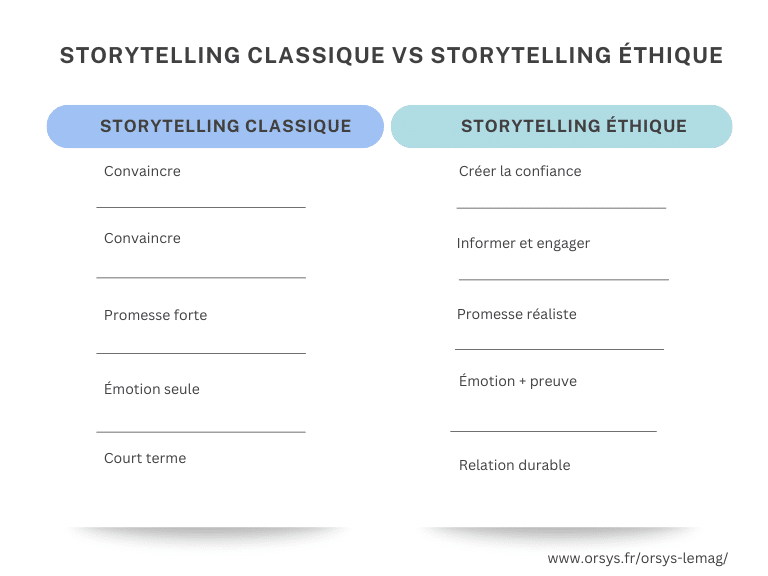
The overpromise
In an environment where every piece of content is vying to stand out, it can sometimes be very tempting to present things in the best possible light. Ambitious promises can attract attention and generate interest. However, they also set expectations very high.
When the actual experience matches the narrative presented, trust is strengthened. Conversely, when there is a discrepancy between the promise and reality, the organisation’s credibility may be undermined.
Ethical storytelling therefore prioritises accuracy over exaggeration. It highlights the results achieved without seeking to artificially inflate their significance.
Emotional manipulation
Emotion is a powerful tool. It is precisely for this reason that it must be used with discretion. Some narratives rely on very strong emotional mechanisms to provoke an immediate reaction. Others favour a more balanced approach, which allows the audience the opportunity to understand, analyse and form their own opinions.
Ethical storytelling falls within this second approach. It seeks to foster engagement without undermining the reader’s critical thinking. It prioritises explanation over impulsive reaction and encourages support based on understanding.
Greenwashing and disconnected narratives
Organisations today have numerous opportunities to showcase their environmental, social and societal commitments. But the public now expects more than just empty words. A narrative only becomes truly credible when it is underpinned by concrete actions, measurable results and verifiable commitments.
Conversely, when a story seems disconnected from perceived reality, it quickly raises questions.
Ethical storytelling is therefore based on a simple principle: telling the story of what is actually being done, rather than what could be done.
Case study: two ways of telling the same story
A company is launching a digital solution designed to reduce energy consumption in buildings.
Promotional version
«Thanks to our revolutionary technology, businesses can immediately reduce their energy consumption whilst actively contributing to the green transition. Our solution brings about a lasting transformation in organisations» energy performance and represents a major step forward for the environment.”
Ethical storytelling version
«When Alpha installed our solution at three of its pilot sites, its aim was to gain a better understanding of its energy consumption. After 12 months of use, it recorded an average reduction of 12 per cent in electricity consumption at the buildings where the system was installed.”.
»Results vary depending on usage patterns, the age of the infrastructure and the level of commitment from the teams. Nevertheless, this trial has identified several areas for improvement and confirmed the benefits of a phased roll-out."
What's new
The first version is based on general promises that are difficult to verify.
The second one presents:
- a specific context
- measured results
- verifiable data
- an acknowledgement of one’s limitations
- putting the results into context
Ethical storytelling does not seek to exaggerate reality. It seeks to make it understandable and credible.
The foundations of ethical storytelling
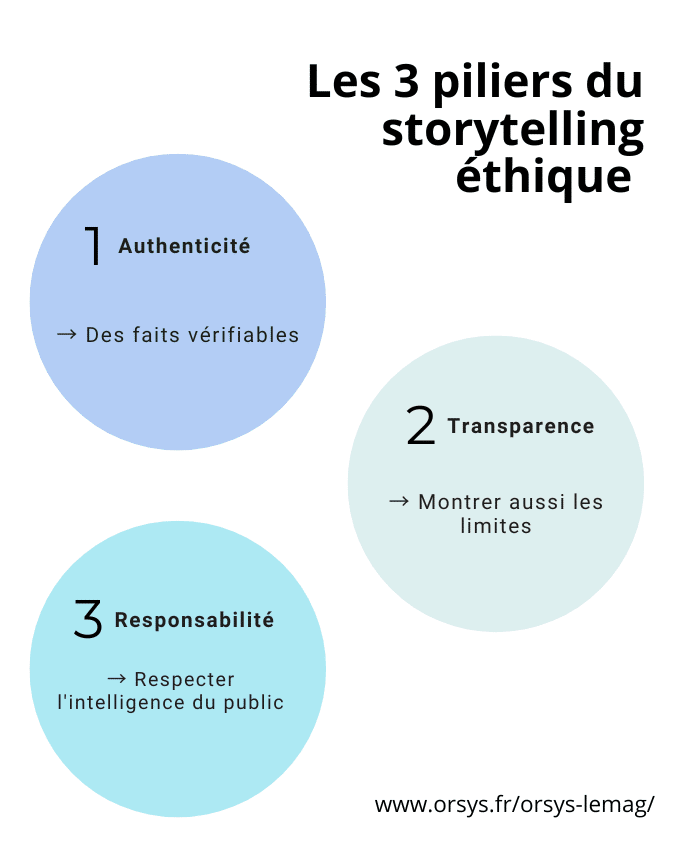
Grounded in reality: evidence and facts
The best stories aren’t necessarily the most spectacular. They’re often the most heartfelt.
The launch of a new service, the development of an organisation or the success of a project are already compelling stories when they are based on real-life experiences.
Testimonials, feedback, indicators and observable results help to give substance to the narrative. They reinforce its credibility whilst retaining its human dimension. The narrative captures attention; the facts help to hold it.
Examples of evidence:
- measurable indicators
- feedback
- testimonials
- external audits
- certifications
- independent studies
Evidence is not limited to mere figures. The key point is that it must be verifiable or corroborable.
Transparency and nuance
The challenges facing organisations are becoming increasingly complex: the green transition, digital transformation, quality of life at work and inclusion.
Ethical storytelling takes this complexity into account and prioritises explanations over simplifications: it takes the time to put information into context.
Sharing the progress made, whilst acknowledging the challenges that remain, often helps to strengthen the credibility of the message.
Transparency does not weaken the narrative. It gives it depth.
Respect for the audience and their attention
Attention has become a valuable resource. Faced with an ever-increasing volume of content, organisations may be tempted to publish more and more. However, the quality of a communication does not depend solely on its frequency.
Respecting your audience means producing useful, clear and relevant content. It also means recognising that the reader’s time is valuable.
Ethical storytelling therefore calls for a certain degree of editorial restraint. Every story must have a purpose and offer genuine value to its audience.
Towards more responsible and sustainable communication
Trust as a key KPI
For a long time, performance metrics have focused on visibility: number of views, click-through rates, impressions or shares.
Whilst these figures remain important, they only tell part of the story. Another question becomes crucial: does the content help to build trust?
This confidence can be assessed using a number of indicators:
- customer or subscriber retention rate
- Net Promoter Score (NPS)
- proportion of repeat visits to content
- average time spent on content
- recurring newsletter open rate
- level of satisfaction reported in satisfaction surveys
- volume of unsolicited positive mentions
- quality of comments and interactions
- reputation and online reputation indicators
- level of engagement amongst staff or stakeholders
These indicators make it possible to measure not only exposure to content, but also the quality of the relationship forged with audiences.
This trust has a direct impact on an organisation’s reputation, customer loyalty and its ability to engage its stakeholders. In the long term, it is a strategic asset just as valuable as visibility itself.
Alignment with CSR issues
CSR initiatives encourage organisations to rethink their practices across a wide range of areas. Communication is no exception to this. Responsible communication is not simply about talking about commitments; it also involves adopting practices that are consistent with the organisation’s values.
Ethical storytelling plays a key role in this approach. It helps to highlight the actions taken whilst promoting transparency and authenticity.
Read also : How can you align your marketing strategy with your company's CSR strategy?
Standing out in a saturated market
Every day, thousands of pieces of content are published across all communication channels. In this context, standing out is no longer based solely on creativity or visibility. Organisations that succeed in building a lasting relationship of trust enjoy a significant competitive advantage. Their content is listened to, shared and remembered more often. Credibility then becomes a key driver of performance.
How can you put ethical storytelling into practice?
Ethical storytelling is not simply about telling a more sincere story. It is based on a structured, six-step process that balances emotion, transparency and credibility.
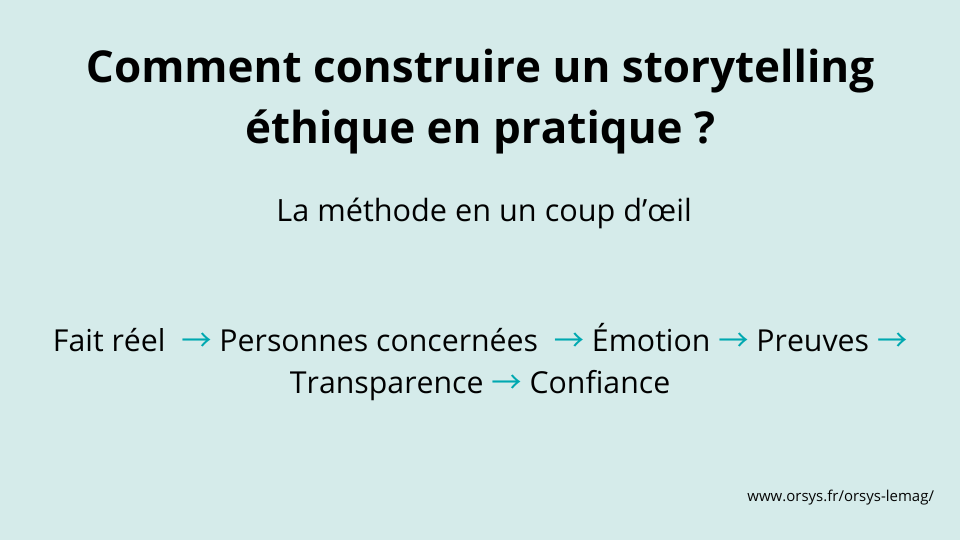
1. Start with an observable reality
Every story must be based on a true event:
- innovation
- project
- transformation
- success
- learning
Before constructing a story, it is important to answer one simple question: «What actually happened?»
For example, one company reduced its paper consumption by 40 per cent after digitising certain internal processes.
The event always precedes the account.
2. Identify the people concerned
Stories become memorable when they are brought to life.
Who has had this experience?
- colleague
- customer
- user
- partner
- beneficiary
The aim is to highlight the human stories behind the figures.
3. Look for evidence
A story gains credibility when it is based on verifiable facts.
Such evidence can take various forms:
- quantitative indicators
- studies
- audits
- certifications
- testimonials
- results observed
For example: «85 per cent of staff now use the tool every week» sounds more credible than «the tool has been successfully adopted».
4. Using emotion appropriately
Emotion helps to forge a connection with the audience. However, it should shed light on the subject, not replace the information. Here are a few questions to guide your writing:
- What obstacles were encountered?
- What lessons have been learnt?
- What changes have been observed?
The aim is not to provoke an immediate reaction but to foster understanding.
5. Outline the limitations as well
One of the most powerful features of ethical storytelling lies in its ability to acknowledge complexity. No transformation is perfect. Sharing the difficulties encountered, the adjustments made or the goals yet to be achieved often helps to strengthen the narrative’s credibility. Transparency does not weaken the story; it gives it depth.
6. Check for overall consistency
Before publication, one final question is worth asking: «If a reader were to check each of our claims, would they be able to verify their accuracy?» If the answer is «yes», the content is likely to be in line with the principles of ethical storytelling.
Ethical storytelling is therefore not about telling more stories. It is about to craft narratives rooted in reality, capable of forging a lasting relationship between the organisation and its audiences.
Ethical storytelling checklist
Before publishing your content, please check the following:
| Question | Yes | No |
| Is my account based on verifiable facts or findings? | □ | □ |
| Can the key figures or claims be substantiated by a source or evidence? | □ | □ |
| Does the emotion conveyed help us to understand the subject without exaggeration or manipulation? | □ | □ |
| Does the content accurately reflect reality, including any limitations it may have? | □ | □ |
| Is the message consistent with the organisation’s actual actions and commitments? | □ | □ |
Your result
5 «Yes»
Your storytelling is credible, transparent and in line with the principles of responsible communication.
3 or 4 «Yes»
Your account is relevant, but certain points need to be clarified further before publication.
0 to 2 «Yes»
Please note: your content may contain exaggerated claims or be out of step with reality. A critical review is recommended.
Develop responsible communication: get trained!
Responsible communication is not limited to disseminating messages about CSR. It involves rethinking the way content is produced in order to enhance its usefulness, credibility and impact.
ORSYS training courses enable participants, in particular, to:
- develop a responsible editorial strategy
- master storytelling techniques
- incorporating CSR issues into communications
- build stakeholder confidence
- measuring the impact of communication initiatives
Related courses:
Slow content and ethical storytelling: producing responsible content
CSR communication: enhancing your company’s image
Ultimately, ethical storytelling reflects a profound shift in communication. It is no longer simply a matter of capturing attention, but of creating meaning by balancing emotion, evidence and transparency. In a climate where trust is becoming a strategic asset, telling accurate stories is, more than ever, a key differentiator for communications professionals.