In an age where you have just a few seconds to grab someone’s attention, a poorly constructed sales pitch can cost you an opportunity before you’ve even started. If it’s too technical, too long or too company-focused, it often misses the mark. So, how can you immediately capture your audience’s interest and make them want to find out more? Véronique Perier, a consultant and trainer specialising in sales techniques, explains.

In the field, the same pattern keeps cropping up: dynamic, responsive sales teams, competent project managers, passionate experts… who, as soon as they start speaking, lose their impact. Their sales pitch starts off with good intentions, but quickly descends into a muddled monologue.
The conversation then shifts to a technical presentation: a list of features, the company’s history, a description of processes, highlighting certifications or the internal structure… Gradually, the prospect’s attention starts to wander. The prospect wonders: «And what’s in it for me?»
Because a pitch is neither a presentation nor a product sheet, and certainly not a company profile. It is a clear, benefits-focused message designed to grab attention and make people want to find out more.
Sales pitch: a tool used far beyond the sales team
A sales pitch isn’t just for salespeople. Any employee can use it to showcase an offer, an innovation or their expertise. Overly formal communication falls flat, whereas good storytelling makes a lasting impression and builds buy-in. But an effective sales pitch can’t be improvised.
Make the customer the hero of your story
In a market where every minute counts, your pitch is often the first impression… and sometimes the last. Yet many professionals still rely on a pitch that is vague, too long, too vague or too technical.
The first fundamental rule for crafting your pitch: your product isn’t the star of the show, but rather a partner that helps your prospect solve a specific problem, save time, secure a project or improve their results.
The aim is not simply to grab attention: above all, it is about creating desire. By helping your prospect to visualise the tangible benefits of your solution, you transform a simple sales pitch into a positive mental experience, which makes it easier for them to buy into the idea and make a decision.
The keys to a powerful and memorable pitch
Here are 7 essential best practices for grabbing attention, making a lasting impression and sparking the desire to find out more.
- Focus on the WHY, not the WHAT: Explain why the customer should choose you, rather than what you do.
- Tell an engaging story: Emotions help with memorisation. The story should raise awareness of—or even highlight—the issues identified, and convince the potential buyer that they will make a difference thanks to your solution. By giving concrete examples, your pitch will leave a lasting impression on your audience.
- Keep it brief: with reference to the American concept of’elevator pitch, your pitch needs to be concise enough to convince your listener in the time it takes to ride a lift (a fairly long one, as in the US, i.e. 30 to 60 seconds)
- Keep it simple: Choose words that everyone can understand. Making things easy to understand is key, especially if what you’re offering is complex! So avoid jargon or vague concepts that annoy people and make them want to stop the conversation.
- Highlight your value proposition: There are several things that can help you write and tailor your pitch: Who is your offer aimed at? What needs does it meet?
- What are the tangible benefits for your customers?
- Tailor your sales pitch: It is important to have a good understanding, at least in broad terms, of your contact’s background. This will enable you to tailor your pitch to their specific challenges and priorities.
- Adopt the correct posture : The aim is to make yourself indispensable to the buyer. Position yourself as a partner, not just a salesperson.
Read also : How can you make your sales pitch more effective?
Get trained!
Examples of methods for structuring a sales pitch
| Method | When to use it | Contribution to the sales pitch | Example of use |
| Challenger Sale | To grab their attention right from the start | Provide a compelling insight that captures the customer’s attention | «70% of companies miss out on opportunities because their pitch is too technical…» |
| SPICED | To structure the message | To clarify the situation, the issues and the implications | Structure your pitch around the problem, its consequences and the value you offer |
| MEDDIC | To lend credibility to the message and tailor it to decision-makers | Incorporating evidence and talking about ROI | Highlighting key figures or a specific client case study |
But even with a good approach, certain habits continue to undermine the effectiveness of the pitch.
The mistakes that scare off your prospective customers
To turn a descriptive sales pitch into a customer-focused narrative, there are certain mistakes to avoid:
Talking too much about your product
Simply listing features, performance specifications or claims such as «the fastest», «the simplest» or «the cheapest» is not enough to capture people’s attention. This kind of pitch remains self-centred and gives the prospect the impression that they are being subjected to a standard sales pitch.
Instead, link each element to a specific, measurable benefit for the customer.
Trying to say too much
An effective sales pitch gets straight to the point. When everything seems important, nothing really is! Too much information dilutes your message by obscuring the key points. Focus on 1 or 2 concrete benefits. If you’re using a presentation, limit yourself to a maximum of 5 or 6 slides.
Being too generic
Presenting your company, its history or its key figures right from the start is a traditional approach that may seem essential. However, your contact will only be interested in these details if they have already understood what they stand to gain by working with you. Start by addressing their challenges, their problems and the results you can deliver for them; only then should you back up your pitch with your references.
How to turn your pitch into a conversion driver
A sales pitch focused on customer benefits captures interest, builds a connection with your audience and significantly increases your chances of conversion.
It is a key tool to be shared with all teams in contact with customers – pre-sales, sales and after-sales – to ensure a consistent message and enhance the impact of interactions.
In practical terms, a well-structured pitch enables you to:
- better identify needs
- improve the appointment conversion rate
- strengthen customer loyalty in a highly competitive environment
By tailoring your pitch to each individual, their role and their environment, you’ll capture their attention from the very first few seconds. This allows your prospect to envisage the benefits of your solution in concrete and positive terms, which makes it easier for them to make a decision.
If your speech is well structured, your audience will be able to understand:
- the issue
- the solution
- your added value
Re-engage the conversation and get your conversation partner involved
If the person you’re speaking to is not very talkative or is a bit reserved, don’t hesitate to take the initiative by including open-ended or leading questions in your sales pitch.
«You’re probably wondering how long it will take to implement this solution.»
«You may be wondering how much you need to set aside to give yourself peace of mind.»
All you need to do now is suggest a more in-depth discussion at your next meeting!
Adjust the length of your sales pitch to suit the context
A pitch should be adaptable to the situation: a meeting, a trade fair, a phone call, a conference or a training session. Ideally, you should have two formats:
- A short version (1 to 2 minutes) to quickly grab someone’s attention during an initial meeting
- A more detailed version (3 to 5 minutes) for video conferences or face-to-face meetings
Testimonial :
«Previously, I was convinced that the priority was to reassure my prospects—often CIOs (Chief Information Officers)—about my company’s reliability and reputation. I would spend five minutes presenting key figures and a few reference clients before moving on to identifying their actual needs. Shifting my pitch towards a storytelling approach that highlights the benefits and results our clients have achieved thanks to our solutions has completely changed the attitude of the people I’m talking to. My meetings are very productive, and I’ve even noticed that decisions are made more quickly.» Sales Engineer, IT sector
Sales pitch: structuring your presentation using the PPP method
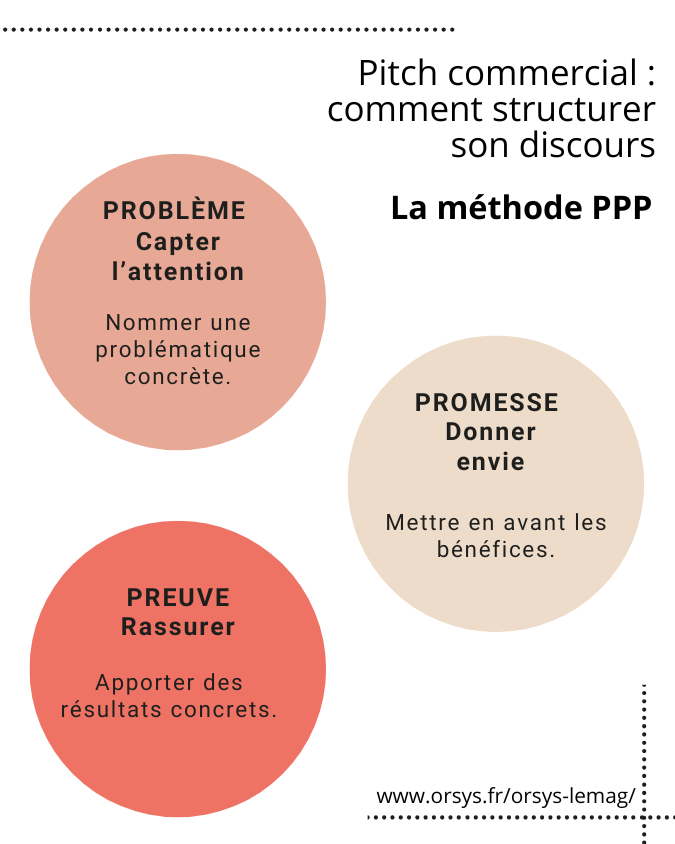
PROBLEM – The starting point that grabs your attention
Start your pitch by identifying a specific problem your client is facing. This step is essential for immediately creating a sense of connection and capturing their attention.
Example: «At present, your teams spend several hours a week manually consolidating data, which leads to errors, delays in reporting and makes decision-making more difficult.»
Why it works: your prospect recognises themselves in a real-life scenario, feels understood and listens.
PROMISE – What you bring to the table
Continue by highlighting the transformation your solution enables. The aim is not to describe your solution, but to clearly articulate the tangible benefits for the customer. In this way, you demonstrate what will change for them: time savings, improved performance, reduced risks or increased results.
Example: «I help sales teams craft a clear, impactful and customer-focused pitch that opens doors and boosts appointment conversion rates.»
Why it works: you’re not talking about your product, but about what you’re changing for it.
PROOF – What lends credibility to your promise
End your pitch with a concrete example that backs up your point: a measurable result, a client case study, or a statistic.
Example: «Recently, a team I worked with doubled its appointment conversion rate in just six weeks thanks to a revamped sales pitch.»
Why it works: providing evidence makes your promise tangible and immediately puts your listener at ease.
Examples of sales pitches: two different formats
Case study of a company offering shared sales management services.
Short version of the pitch
Issue: Our service was born out of an observation frequently made by small businesses: 70% of SME managers say that business development is a priority, but that they lack the time, in-house expertise in this area, or the resources to hire an expert.
Promise: Our bespoke solution addresses these bottlenecks by providing start-up and SME leaders with a part-time sales expert and operations manager, without the constraints of a permanent employment contract, whilst keeping your budget under control.
Evidence: You benefit from expert, bespoke sales management thanks to our offering, which combines operational and financial flexibility. With over 20 years’ experience, we provide you with the solid expertise you need to improve your company’s sales performance and grow your turnover.
Long version of the pitch
Our methodology is simple. We offer a 360° assessment of your sales situation based on 20 key questions. An outside perspective, combined with solid practical experience, helps to clearly identify what is working and what is holding back your results. We then provide you with a recommendation setting out the key drivers of efficiency and priority areas for improvement. Together, we develop your action plan, which may cover several areas of focus:
- Business strategy: define your targeted strategy to gain market share.
- Sales development and customer relations: implementing or optimising sales and prospecting techniques.
- Sales team training: supporting your staff to improve their skills in sales, negotiation and deal management.
- Outsourced sales management: managing your projects, ensuring their implementation and monitoring results.
This means you can be sure of gaining all the experience and skills of a sales director, with complete operational flexibility and without the constraints of permanent employment, whilst keeping costs under control and tailored to your needs. Whatever your business and your plans, our experts adapt. Their industry experience, combined with in-depth knowledge of management and marketing, ensures you use the right tools and metrics, and train your team to achieve your goals.
Get trained!
Examples of pitch customisation
For B2B management software
Tailored pitch for the operational management team:
«You explained to me that your staff currently consolidate data manually. You’ve now realised that this leads to errors and delays in passing information on to your management team. Our solution automates 80% of these tasks and centralises all information in real time. The result: your team saves an average of 6 hours a week, and you can assign them tasks with higher added value. Would you like us to arrange a meeting to explore how this solution could be applied to your organisation?»
Tailored pitch for the finance department:
«What you’re really looking for is the best way to improve the reliability of your reports, secure your data and gain a more reliable consolidated overview so you can make strategic decisions with confidence. Is that correct? If I were to offer you a turnkey solution that would also save you over 30% of the time spent on document management, would you be willing to consider this investment?»
For an innovative medical device for radiology
Tailored pitch for the radiologist:
«When carrying out scans, you are faced with a reality: patients who are anxious, difficult to position, or unable to fit into a standard scanner, which prolongs the scans and often means they have to be repeated.”.
Our open radiology system radically simplifies patient care and is suitable for all patients, including children and those with reduced mobility. Positioning is quicker, patients cooperate better, and you obtain high-quality images. The result: less stress during handling, fewer interrupted examinations, a smoother workflow and the ability to accommodate all patient profiles.»
Tailored pitch for the school’s management:
«Your facility must strike a balance between quality of care, patient appeal and financial performance. Our system is specifically designed to address these three challenges. Its broad scope means we can treat patients who currently require more extensive examinations or are sometimes referred to other facilities.”.
»You’ll increase your patient capacity, reduce cancellations and rescheduled appointments, and optimise the utilisation rate of your diagnostic facilities. It’s an investment that improves the patient experience and delivers a measurable financial return from the very first year."
In conclusion, with a well-structured, customer-focused sales pitch, you can, in just a few minutes, avoid getting bogged down in technical details, make a lasting impression and, above all, maximise your impact by forging an emotional connection that encourages your audience to trust you or take things further with you.