Deliver quickly, correct later... This logic has always fuelled technical debt. But over the last 3 years, a new vector has radically accelerated it: generative artificial intelligence. The consequences are slowing down teams, increasing costs and weakening projects. How can you reduce debt without rewriting everything? Discover the methods and tools for identifying, prioritising and reducing debt.
A strategic risk worth over €1,500 billion
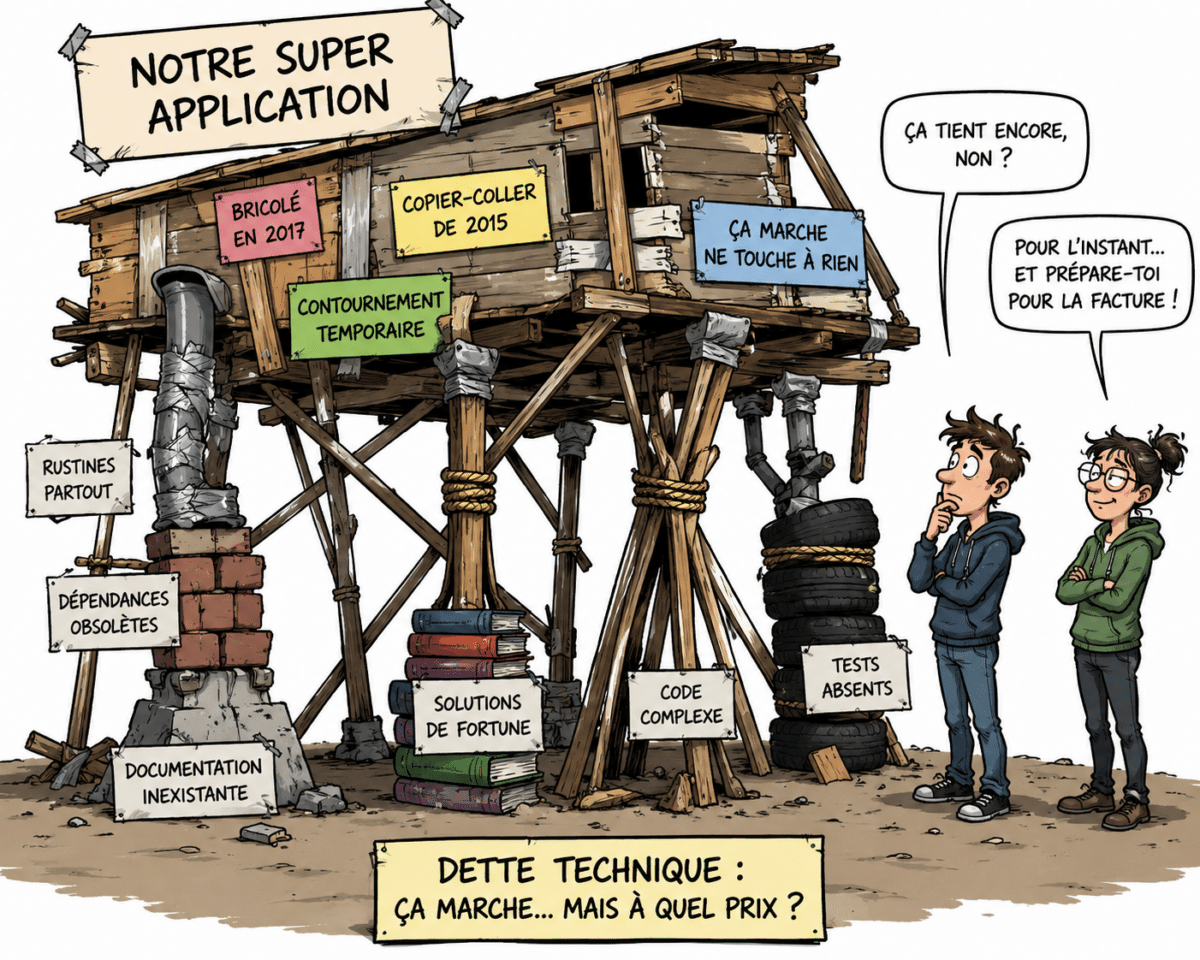
Formulated in 1992 by Ward Cunningham, an American programmer, pioneer of the agile movement and creator of the first wiki in 1995, the concept of technical debt draws a parallel between the compromises made during software development and a financial loan.
These trade-offs are often motivated by the need to deliver more quickly, to meet a deadline, to respond to a business emergency or to test a feature quickly.
These compromises can take many forms: insufficiently documented code, delayed or incomplete tests, an over-simplified architecture, quick fixes applied without an overall vision, or the choice of temporary solutions to meet a deadline.
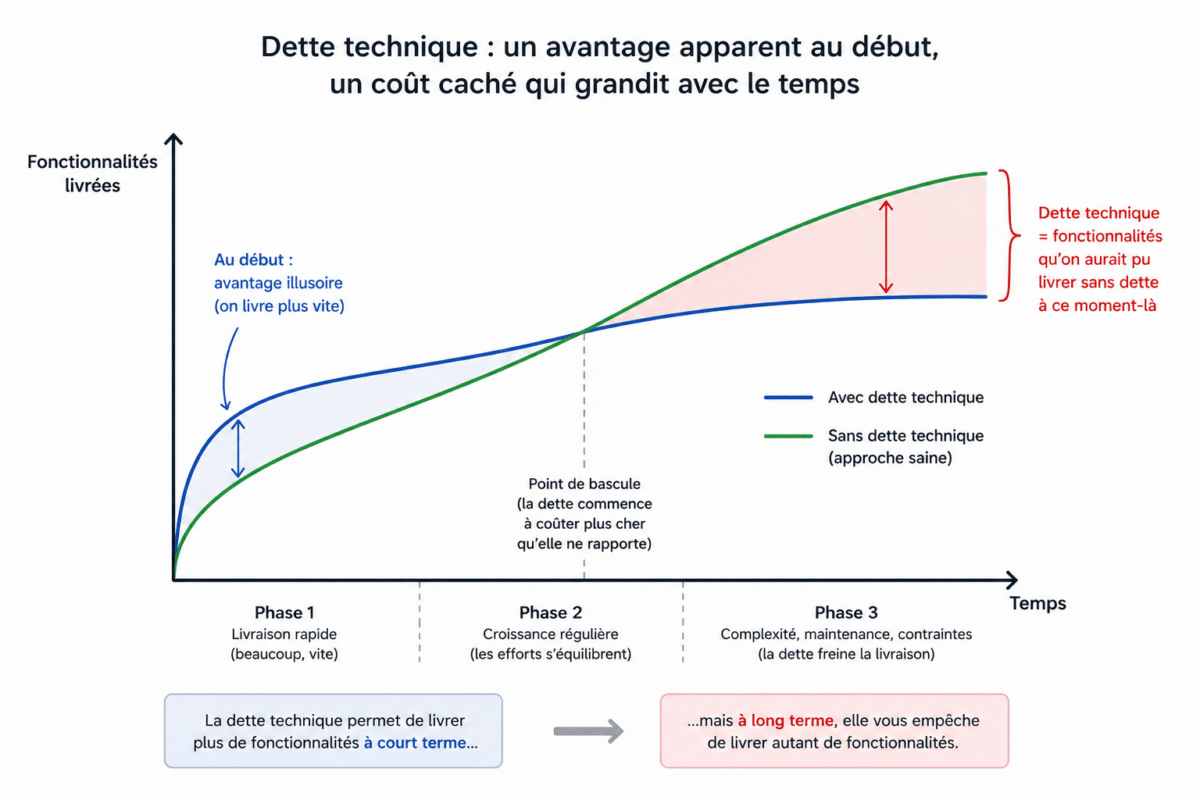
Every concession made in terms of code quality creates a «debt» that will have to be repaid later, with interest: bugs, increased complexity, project slowdowns and extra delays.
Thirty years later, the bill has become astronomical.
Figures that illustrate the scale of the problem
Key figures
- 1,400 billion in accumulated technical debt in the United States, This is the equivalent of the country's entire IT wage bill.
In the euro zone, CIGREF estimates the equivalent figure at several hundred billion euros. (CISQ, 2022) - 33 % of developers' time is absorbed by debt, that's 13.5 hours lost per week. (Stripe / Harris Poll)
- 63 % of professional developers cite technical debt as their main frustration at work. (Stack Overflow Developer Survey 2025)
- 40 % of IT budgets are consumed by maintenance and the correction of accumulated faults. (McKinsey Digital, 2024; Karmen, 2025)
- 50 % to accelerate delivery times for organisations that actively manage their debt. (Gartner)
- 13,000 per minute Average cost of a computer breakdown directly correlated with the accumulation of debt. (BigPanda, 2024)
Technical debt has become the main obstacle to the development of systems
What these figures don't say directly, but what surprises professionals: according to the CISQ 2022 report co-sponsored by Synopsys, technical debt is now the main obstacle to any development of the code base, In the face of regulatory constraints and a lack of skills.
This is no longer an engineering problem. It's a strategic constraint.
In France, in fact, 72 % of CIOs have made debt reduction a strategic priority for 2026, compared with 51 % in 2023 (IDC France).
An exponential slowdown
Another counter-intuitive fact: a feature which takes two weeks in a healthy code base may require four to six weeks in a heavily indebted base. Debt does not slow down projects linearly, it slows them down exponentially as it accumulates.
Anatomy of technical debt: the 6 types of debt that cripple your teams
Technical debt is not monolithic. To diagnose it and deal with it effectively, it is essential to distinguish between its different manifestations. Here are the six types recognised by the technical community, with their measurable impact.
1. Code debt
Code debt covers defects that are present directly in the source code: duplications linked to copy-paste, code that is too complex, development conventions that are not respected or lack of readability. These problems make development more time-consuming and increase the risk of errors. For example, when the same business rule is duplicated in several places, each modification has to be repeated, with the risk of forgetting part of it and introducing bugs.
According to SonarQube, a block of 10 lines duplicated 3 times generates up to 30 minutes of additional maintenance per modification. Over 10 changes per year, that's half a day lost, not counting the bugs introduced during partial updates.
2. Architectural debt
Architectural debt arises when the overall organisation of the application is no longer adapted to requirements: components that are too dependent on each other, rigid architecture or poorly distributed responsibilities. Often considered to be the «mother debt», it slows down development, complicates testing and encourages code duplication. The worse the architecture ages, the more costly and risky each upgrade becomes.
3. Test debt
Test debt arises when automated tests are insufficient or non-existent. Each modification to the code then becomes riskier, because it is difficult to quickly check that it has not introduced regression. Without this safety net, bugs are often detected late, sometimes during production, which increases the cost of correction and slows down teams. The lack of testing is therefore one of the main factors fuelling technical debt and reducing the ability to develop an application with confidence.
4. Documentation debt
Documentation that is missing, obsolete or out of sync with the code. This slows down the integration of new developers, creates knowledge silos and increases the risk of errors in existing systems. This type of debt explodes with staff turnover, a particularly acute problem in 2025 according to most of the CIOs surveyed.
5. Security debt
Security debt is the result of practices or components that no longer comply with current requirements: obsolete libraries, uncorrected vulnerabilities, secrets stored in the code or inadequate authentication mechanisms. Often invisible on a day-to-day basis, it can expose the company to major incidents, service interruptions or data leaks. The Log4Shell example (CVE-2021-44228, CVSS score 10.0) is still relevant today: five years after its disclosure, tens of thousands of systems are still using vulnerable versions. According to recent studies, 48 % of the code generated by IA contains security flaws.
6. DevOps / Infrastructure debt
DevOps and infrastructure debt arises when deployments remain manual, environments are not harmonised or automation (CI/CD) is insufficient. These weaknesses slow down production releases, increase the risk of errors and complicate the validation of changes. By limiting automation and quality control, they progressively amplify other forms of technical debt and hamper the ability of teams to deliver rapidly and with confidence.
Understanding the origin: Fowler's 4 quadrants
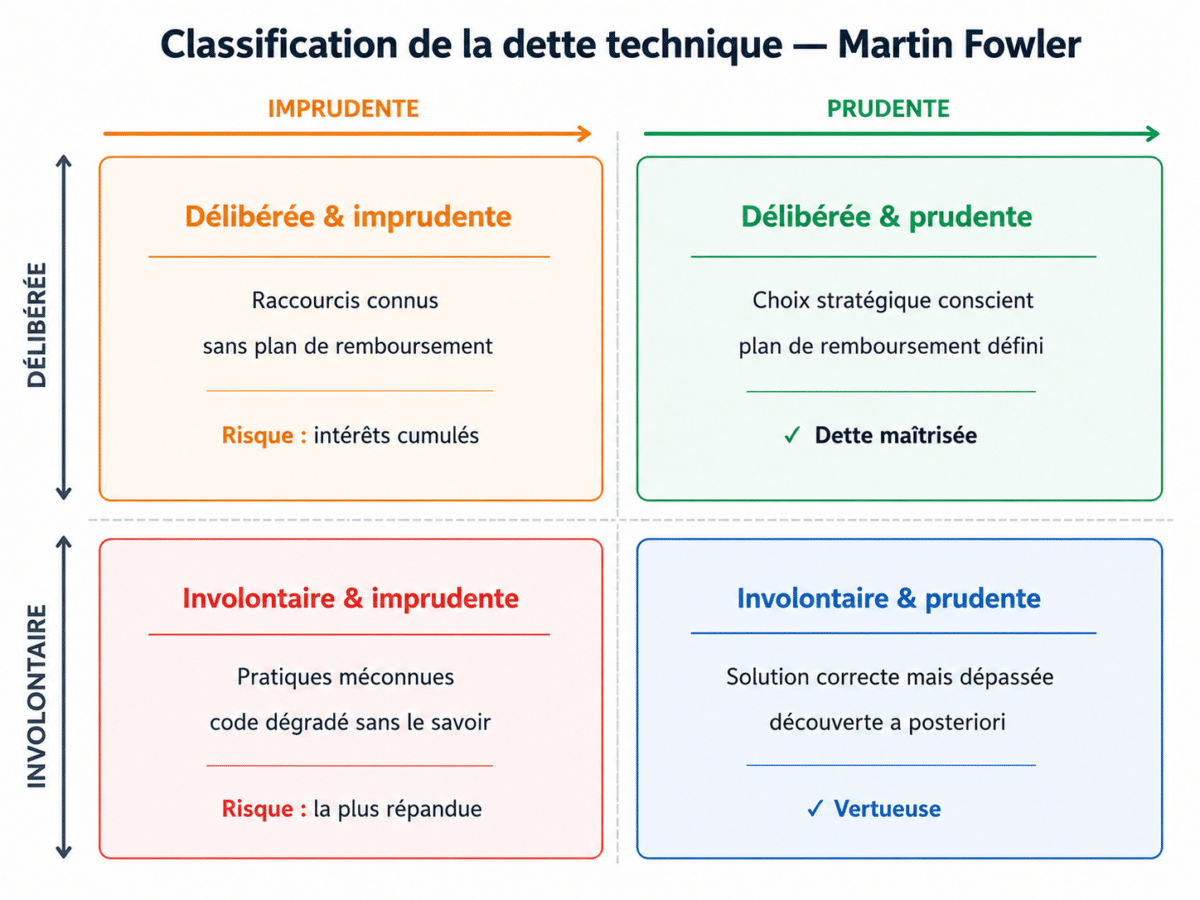
Before dealing with debt, we need to understand its origins. Martin Fowler, an internationally recognised expert in software architecture, a leading author on refactoring and a signatory of the Agile Manifesto, has proposed an approach that has become indispensable.
It is based on two axes: deliberation (intentional vs. unintentional) and prudence (assumed vs. imprudent).
This classification enables the nature of the technical debt to be identified, the risks to be measured and the remediation strategy to be adapted.
Deliberate and reckless
The team knows that it is creating debt (deadline pressure) but does not measure its impact. The sole priority is to deliver quickly, hoping that the problems will «never happen». This is the logic that ends up causing collapses.
Deliberate and prudent
Strategic debt«. A conscious choice to capture a market opportunity (e.g. rapid MVP). The team knows the consequences and has a repayment plan. It is the equivalent of a time-to-market call option. Legitimate provided it is documented and actually repaid.
Unwitting & reckless
The most widespread and the most insidious. It results from a lack of skills or ignorance of good practice. The team creates «spaghetti code» without even realising it. This is the type that static analysis tools reveal first.
Involuntary & cautious
A perfectly designed solution becomes a debt because a better approach emerges over time. It's a sign of continuous learning. It does not require urgency, but progressive planning.
4. Mapping before taking action: diagnostic tools
«You can't manage what you don't measure». Andrew Sharp (Info-Tech Research Group) points out that most IT Departments are unable to quantify the true extent of their technical debt, because it is diffuse and cross-functional. The first step is to make it visible.
Diagnostic tools
SonarQube (open-source & enterprise)
The market benchmark for code quality analysis. It automatically detects duplications, security vulnerabilities, potential bugs and best practice violations. It provides a technical debt ratio and estimated remediation time, and integrates natively into CI/CD pipelines.
Snyk (application security and open source dependencies)
Widely adopted in DevSecOps environments, Snyk analyses open source dependencies, containers, code and as-code infrastructure to identify known vulnerabilities (CVEs). Its direct integration into GitHub, GitLab, Azure DevOps or Bitbucket means that security debt can be detected at the development stage and patches automated where possible.
NDepend (.NET)
Particularly popular in the Microsoft ecosystem, NDepend goes further than traditional static analysis by estimating the remediation cost and «annual interest cost» of each quality rule violated. It provides advanced metrics on complexity, coupling and architecture. A valuable tool for architects wishing to prioritise technical debt according to its real financial impact.
CodeScene (behavioural and organisational analysis)
Original approach based on analysis of Git repositories and team work habits. CodeScene identifies code hotspots, high-risk areas, frequently modified files and the effects of developer turnover. The aim is to concentrate remediation efforts where the debt will have the greatest impact on future developments.
CAST Highlight (application analysis and IS portfolio)
CAST Highlight is widely used by large companies and IT Departments to obtain a macro view of application assets. CAST Highlight measures the software health, security risks, technological obsolescence, cloud readiness and maintainability of applications. It allows you to quickly identify the applications that are most indebted, so that you can prioritise modernisation investments.
Metrics to use
To manage debt over the long term, include these indicators in your dashboards:
- Test coverage ratio (percentage of code covered by automated tests)
- Cycle time time between the start of development of a feature and its release into production
- Technical debt per line of code (calculated automatically by SonarQube)
- Production incident rate and MTTR (Mean Time To Recovery)
- Code churn rate percentage of code rewritten in the two weeks following its commit (strong signal of poor quality)
5. AI and technical debt
AI tools like GitHub Copilot, Cursor or Claude Code have transformed software development in 2024-2025. According to the GitHub survey, 92 % of US developers now use AI assistants on a daily basis. Even more impressive: 41 % of the world's code is generated by AI (Mastering AI State of Vibe Coding 2026). But these figures mask a more complex reality: the technical debt generated by AI is becoming a major problem.
Vibe coding: a debt that's piling up fast
In February 2025, Andrej Karpathy (ex-Tesla, ex-OpenAI) popularised the term «vibe coding»: programming by entrusting the generation entirely to AI, without reading the code produced. The Collins dictionary voted it Word of the Year 2025.
In the first quarter of 2025, 25 % of the start-ups at Y Combinator, the world's most famous start-up accelerator, had codebases generated at 95 % per AI!
In July 2025, the METR (an AI research organisation) has published the most rigorous study to date on the real impact of AI tools.
Counter-intuitive result: experienced developers using Cursor and Claude have put 19 % of overtime to carry out their tasks, while feeling as though they are 20 % faster.
In September 2025, Fast Company headlined «The vibe coding hangover has arrived». Companies that had sprinted from idea to MVP in a weekend are discovering that maintaining, scaling and debugging that codebase is a different kind of problem that AI solves far less effectively when the underlying architecture is a patchwork of improvisations.
Figures that should give cause for alarm
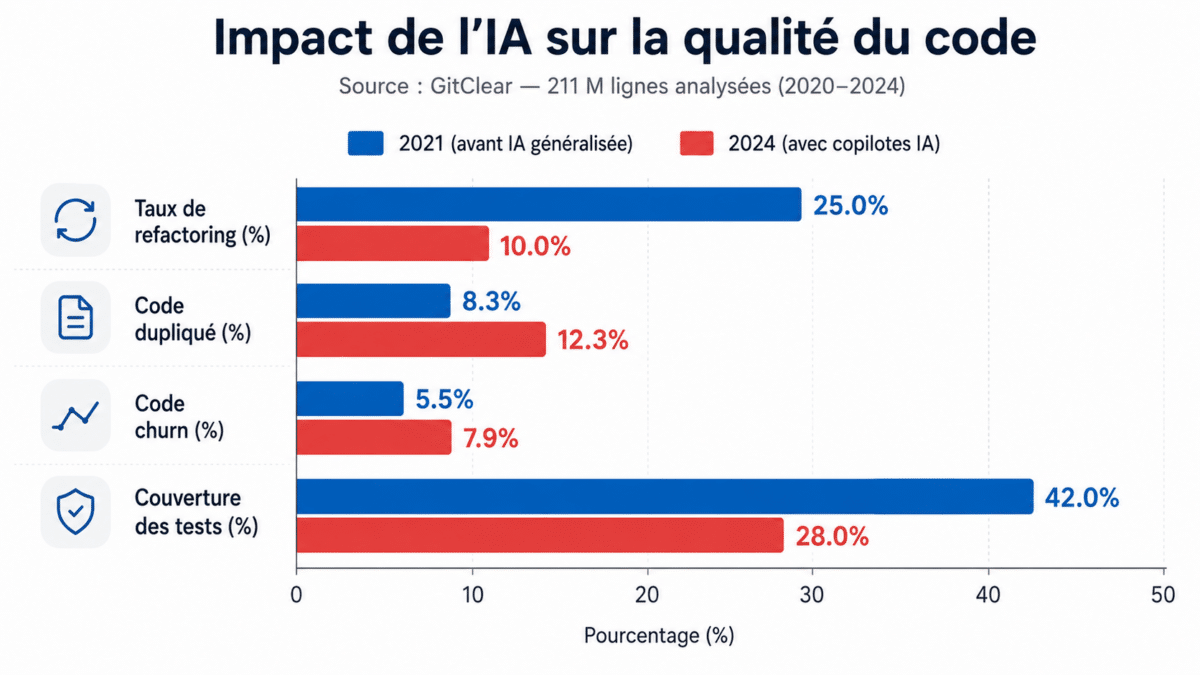
- ×8 multiplication of duplicated code blocks between 2022 and 2024 (GitClear 2025, 211M lines)
- -60 % drop in the refactoring rate, from 25 % to 10 % of modified lines (2021→2024)
- +44 % increase in code churn (lines rewritten less than two weeks after commit)
- 48 % Share of AI-generated code containing security vulnerabilities (multiple studies, 2025)
- 3× faster Vibe-coded projects accumulate debt three times faster than traditionally written projects (State of Vibe Coding 2026 report).
- 1,380 billion Projection of accumulated technical debt between now and 2027 for AI-generated code alone (sector analysts)
Why does AI generate debt?
Language models generate code based on statistical patterns in their training data. They have no access to your project's internal abstractions, shared utilities or existing modules. The result: suggestions that work in isolation but systematically duplicate what already exists.
The «invisible debt» of AI Unlike traditional technical debt, where shortcuts are conscious decisions, the debt generated by AI accumulates invisibly. It is hidden in suggestions that appear to be correct but lack the architectural reasoning needed to stand the test of time.
According to Deloitte (2025), more than 40 % of junior developers deploy AI-generated code that they do not fully understand.
How can AI be used to reduce debt?
AI doesn't just create debt: used properly, it can be a powerful debt reducer. Emerging practices that are currently working :
Systematic verification («Vibe, then verify»)
70 % of developers already use static analysis tools. SonarQube users report significantly more positive impacts on quality and rework costs than non-users. The rule: all AI code must pass a quality gate before merge.
AI-assisted refactoring
Teams have used Claude to automatically correct over 5,000 issues SonarQube on legacy codebases. A documented case (ELEKS, 2026): the team set up a branch dedicated to SonarQube remediation, configured an automatic formatter, and used an AI agent to correct issues by category. Result: large-scale remediation without blocking development.
Spec-driven development vs vibe coding
The approach spec-driven (specify, plan, implement, verify) adds an initial burden but eliminates requirements drift by design. Vibe coding delivers prototypes quickly but hits a documented wall three months down the line, where the debt becomes a significant maintenance overhead.
Automatically generated documentation
Automatic natural language processing (NLP) technologies enable technical documentation to be produced and updated automatically from code. In this way, they limit the documentation debt, which is one of the most difficult to correct manually.
AI speeds up code generation. It doesn't speed up understanding of the system. If your team doesn't understand the code it is merging, you are creating «instant legacy code». If your team doesn't understand the code it's merging, you're creating "instant legacy code", code that nobody feels they own from the first commit.
Debugging code you haven't written is significantly more difficult than debugging code you have written. The speed of generation is worth nothing if it exceeds your verification capacity.
6. The reimbursement strategy: 4 proven pillars
Pillar 1: Integrating reimbursement into the sprint rhythm
The most effective method is to set aside a fixed percentage of development time to deal with debt. The 80/20 approach: 80 % of the sprint for new features, 20 % for debt reduction is favoured by many agile teams.
Pillar 2: Prioritise business impact, not convenience
Not all debts are created equal. Prioritising only the debt that's «easy to fix» is like paying off a €500 revolving credit while letting a 5 % home loan run.
The prioritisation matrix must cross three dimensions:
- Business impact: loss of turnover, risk of non-compliance, deterioration in customer experience, etc.
- The cost of inaction: how much does this debt cost each month in maintenance and incidents?
- The complexity of remediation: how much effort is required to pay off this debt?
Pillar 3: Speaking the language of management
To obtain the necessary budgets, CIOs and lead devs have to translate technical problems into quantified business risks.
Rather than asking for a server to be replaced «because its processor is saturated», explain that this bottleneck is costing the sales department a thousand transactions a day. This translation is the sine qua non for the debt to go from being a «development problem» to a «strategic risk for the company».
Pillar 4 - Measuring for long-term management
Reducing technical debt is not a one-off project but an ongoing process. Integrate technical metrics into your dashboards in the same way as traditional KPIs: test coverage rate, cycle time, debt per line of code (SonarQube), MTTR incident rate, and code churn rate as a leading indicator of poor AI code quality.
7. Reducing without rewriting: methods and best practice
The good news is that you can't solve technical debt by rewriting everything. Architects and lead devs have a number of tried-and-tested patterns for moving forward without stopping everything.
The Boy Scout rule: gradual improvement
Leave the code a little better than you found it. This simple rule, derived from movement Clean Code (Robert C. Martin), recommends systematically improving the code adjacent to any modification. On an active codebase, the cumulative effect is massive without ever blocking a release. According to GitHub, 60 % of developers spend more time maintaining existing code than writing new code! You might as well make the most of that time.
The Strangler Fig pattern: migrating without a big bang
Borrowed from Martin Fowler, this pattern consists of gradually building a new system in parallel with the old one, by redirecting traffic. feature by feature. The old system is gradually «strangled» until it disappears. This is the monolithic exit strategy used by BNP Paribas, La Poste and many French IT Departments: a façade (API Gateway, BFF) is introduced in front of the legacy, and then move the functions one by one. No disruption to service, no wholesale migration.
The Mikado method: refactoring in complete safety
Still little known, the Mikado method, formalised by Ola Ellnestam and Daniel Brolund, is particularly useful when the codebase is highly coupled. The principle is simple: attempt the desired refactoring, identify the dependencies that break, represent them in the form of a graph, then go back. The dependencies are then dealt with one by one, starting from the base of the graph, until the initial change can be made without breaking the tests.
This approach enables progress to be made in controlled stages, without triggering cascading regressions. It is ideal when direct refactoring would be too risky, or when each change seems to lead to a series of impacts that are difficult to anticipate.
Hexagonal architecture: isolating the legacy domain
Proposed by Alistair Cockburn, the hexagonal architecture (Ports & Adapters) is a major architectural lever for teams wishing to modernise without rewriting.
The principle: the business domain is isolated at the centre, surrounded by ports (interfaces) that adapters implement. The database, the REST API and the message broker are all interchangeable adapters. Result: you can replace a legacy dependency (old Oracle database, SOAP, MQ Series) without touching the business logic. This is the approach adopted by several French ESNs to modernise banking IS without stopping production.
Branch by Abstraction and Feature Toggles: deploy without breaking
For organisations practising continuous deployment, there are two techniques for refactoring large areas without creating long, divergent migration branches.
Branch by Abstraction (Paul Hammant): we introduce a layer of abstraction around the component to be replaced, gradually migrate the callers behind this layer, then remove the old implementation when the traffic is zero. No merge conflict, no freeze.
Feature Toggles: gradual deployment without disrupting production
Feature toggles allow new code to be deployed while leaving it disabled by default via a configuration variable. The feature can then be activated gradually, for example on a small percentage of traffic, before being rolled out across the board.
In the event of an incident, the flag can be deactivated in a matter of seconds, without any rollback or redeployment. This approach greatly reduces the risk of sensitive migrations, particularly in the French retail sector, where it is being used to gradually evolve e-commerce information systems towards microservices architectures.
TDD as a lever for debt reduction
Test-Driven Development (TDD) is not just a testing method: it's a design pattern. By writing the test before the code, the developer is forced to design a usable API (the test is the first consumer) and to inject the dependencies (impossible to mock what is not injectable). The natural result is code with no «God» classes and no strong coupling - in other words, code that does not generate architectural debt from the first iteration.
Summary: Which method for which context?
Boy Scout rule → active codebase with continuous flow of features
Strangler Fig → leaving a monolith without stopping service
Mikado Method → highly coupled codebase, high-risk refactoring
Hexagonal architecture → isolate the legacy domain to replace adapters
Branch by Abstraction → gradual migration to continuous deployment
TDD → prevent architectural debt at source (new code)
8. Code governance: establishing a sustainable quality culture
Reducing existing debt is one thing. Not recreating it is quite another. This is where code governance comes in: a set of practices, rules and rituals that make quality a collective responsibility and not the concern of an isolated developer.
1 - Definition of Done (DoD) extended to quality
The first line of defence against future debt is the Definition of Done (DoD). A story is only «done» if it satisfies non-negotiable technical criteria, in the same way as functional criteria.
Examples of criteria to include:
- Test coverage ≥ team threshold (e.g. 80 % for new code)
- Quality Gate SonarQube past: zero new blocking bugs, zero new critical duplications
- Code review approved by a senior peer, using a standardised reading grid
- Updated module documentation
- No hard-coded secret, dependency on critical CVE corrected
Formalising these criteria in Jira, Linear or Azure Boards makes them visible and enforceable. When a Product Owner asks you to «override to meet the deadline», the DoD is the structural response, not an individual negotiation.
2 - Quality doors in CI/CD
A CI/CD pipeline without Quality Gates is a highway to debt. Quality Gates are automatic stop conditions that block merge or deployment if thresholds are crossed.
In France, studies show that 81 % of codebases analysed contain high-risk or critical vulnerabilities, and 90 % of open-source components are more than 10 versions behind (Black Duck, 2025). Quality Gates are the only way of mechanically stopping this drift.
3 - Code review as a collective safety net
The code review is not a stylistic exercise or a formal validation. It is a transfer of knowledge and a collective safety net. Each merge request reviewed by a senior peer is an opportunity to :
- Detect unintentional & imprudent debts before they are committed
- Sharing domain knowledge: reducing silos, vectors of documentary debt
- Applying house standards and reinforcing architectural consistency
Good practice for effective reviews: an objective reading grid (compliance with conventions, presence of tests, documentation, absence of duplication), a limited size of PM (< 400 lines), a review deadline guaranteed by the team process. Reviews of 2,000-line MRs are pointless. You approve without reading.
4 - Visible and prioritised debt backlog
Technical debt can only be managed if it is named and visible. Create a dedicated label or epic in your backlog tool (Jira, Linear, Azure DevOps): each identified item of debt is recorded there, along with its estimated impact and the cost of remedying it. This backlog is shared with the Product Owner and management.
What it changes: when a developer discovers a duplication while working on a feature, he no longer has to choose between «correcting it now (and risking missing the deadline)» and «ignoring it (and creating imprudent debt)». He creates a ticket in the debt backlog, estimates it and submits it for prioritisation. Transparency is key.
5 - Further training and coding dojos
Unintentional and reckless debt, the most common form of debt, arises from a lack of skills. The only sustainable answer is to continually upgrade skills. Formats that work in French companies :
Coding dojos Weekly 1h30 sessions on code katas (refactoring of deliberately degraded code). Ideal for instilling Clean Code, TDD and SOLID reflexes.
Architecture Decision Records (ADR) Short documents (1 page) that record each architectural decision: the context, the options considered, the choice made and its consequences. Prevents document debt and facilitates onboarding.
Targeted peer programming On high-risk areas (payment, authentication, tax calculations), pair coding is not a luxury: it's quality assurance. According to recent European studies, peer programming reduces the number of defects introduced by 15 %, for a time overhead of only 10-15 %.
Making technical debt a business issue
Technical debt is no longer a problem confined to development teams. It is a strategic issue that has a direct impact on growth, productivity and capacity for innovation. And AI is making it worse at an unprecedented rate.
For software architects and lead developers, the message is twofold.
Technically: use static analysis tools (SonarQube, CodeScene), build modular testable architectures, automate dependency monitoring. And when it comes to AI: adopt a «vibe then verify» culture. The speed of generation is worth nothing if it exceeds your ability to understand and verify.
Strategically: make the debt visible in the dashboards, translate technical problems into quantified business impacts, set aside 20 % of sprint time for repayment, and defend the quality budget as you would defend any high-ROI investment.