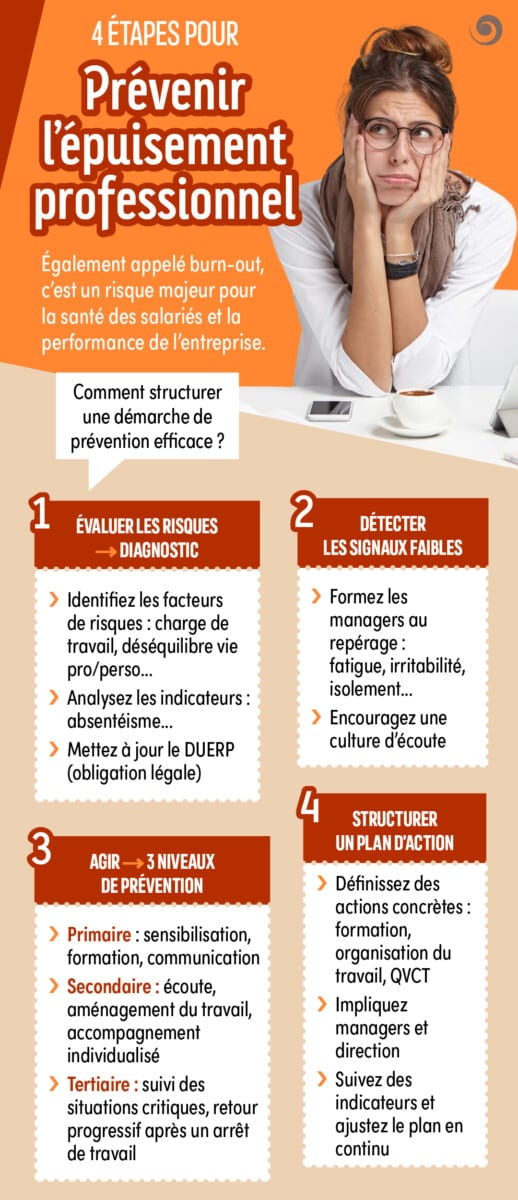
Burn-out is a major risk to employee health and business performance. HR therefore has a key role to play in prevention. But how do you structure an effective prevention approach?

First of all, what is burn-out?
[Definition]
The World Health Organisation (WHO) defines burn-out as a syndrome resulting from chronic occupational stress that has not been successfully managed.
It is characterised by three dimensions:
- a feeling of loss of energy or exhaustion
- increasing distance from work, negative emotions or cynicism about one's job
- reduced professional effectiveness
So how can HR take effective action against burnout? It requires a structured approach.
1/ Assessing risks: diagnosis
First, identify the risk factors workload, work/life imbalance...
Next, analyse the indicators Absenteeism...
Then update the DUERP This is a legal obligation.
2/ Detecting weak signals
On the one hand, train managers to spot fatigue, irritability, isolation...
On the other hand, encourage listening culture.
The warning signs of burnout can be detected individually chronic fatigue, physical pain, social isolation...
There are also warning signs at company level Reduced productivity, tension in teams...
«Anticipation is the key to success. The earlier prevention is implemented, the more human and economic impact is limited.»
3/ Taking action
3 levels of prevention
Primary prevention :
awareness-raising, training and communication.
Secondary prevention :
listening, work organisation, individual support.
Tertiary prevention :
monitoring critical situations, gradual return to work after time off.
4/ Structuring an action plan
Finally, define concrete actions training, work organisation, quality of life and working conditions.
Involve managers and management.
Track indicators and adjust the plan on an ongoing basis.
[Also read]