With stakeholders becoming increasingly demanding, communicating about a company’s CSR commitments is no longer merely a matter of making announcements. Between corporate communications, sustainability reporting and promises made to the market, companies must adopt clear, transparent messages backed up by evidence. How can they distinguish between these different approaches and avoid the pitfalls of greenwashing? Hélène Toye, an expert communications trainer, explains.

These days, customers, employees, investors, partners, institutional regulators, suppliers and potential candidates for your job vacancies are scrutinising every move your company makes. They are no longer satisfied with your financial performance alone. They also assess your social, environmental and societal impact.
In this context, the reporting on your CSR commitments is no longer merely a tool for raising visibility. It is becoming a genuine driver of trust, appeal and commitment. Clumsy or overly superficial communication can breed mistrust. Conversely, a clear and credible strategy strengthens your image and unites your stakeholders.
However, not all CSR-related communications are of the same nature or meet the same standards.
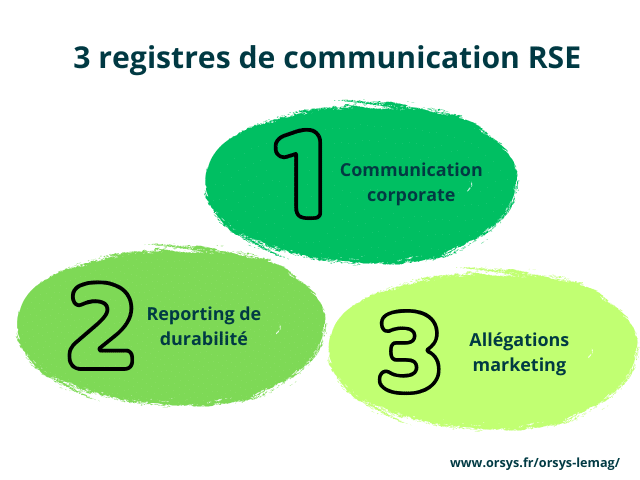
It is useful to distinguish between three types of speech:
- corporate communications, which outlines the company’s commitments and strategy (the «Our Commitments» pages on the corporate website, and statements by senior executives)
- sustainability reporting, which is based on structured and standardised information intended for investors and regulators (non-financial reports, CSRD)
- environmental or social claims, used in marketing or advertising to promote a product or service («eco-friendly», «carbon-neutral», «good for the planet»).
These different categories do not entail the same objectives or the same levels of risk, particularly in terms of reputational, commercial and legal risks.
A clear CSR communication strategy
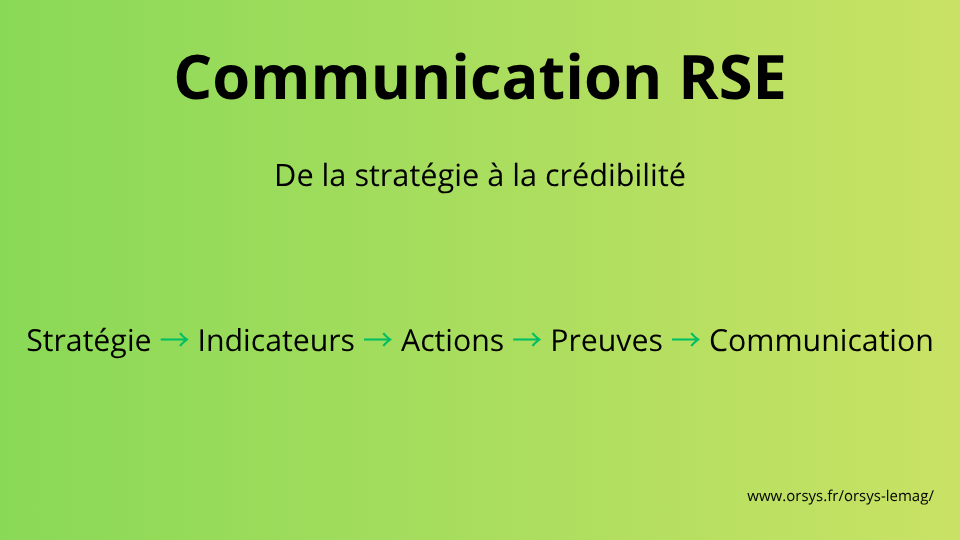
Your CSR communication must, first and foremost, be based on a coherent approach. Without a solid CSR strategy, your communication risks being vague, or even counterproductive.
In practical terms, this means that you will need to:
- to clarify the company’s ESG priorities in terms of environmental, social and governance impacts and its contribution to the local community
- present relevant performance indicators
- document actions using tangible evidence
- to distinguish between what has already been achieved, what is currently in progress and what is still a target
- have sensitive messages reviewed by the relevant CSR, legal, compliance and business teams
Draw on recognised certifications (ISO 14001, B Corp, sector-specific labels, etc.), independent audits, carbon assessments and non-financial reports. These elements reinforce the credibility of your commitments and inspire confidence in your stakeholders.
ADEME (the French Agency for Ecological Transition) also recommends basing CSR communication on verifiable, progressive and contextualised data. It emphasises the need to clearly distinguish between what the company has already achieved and its stated objectives. This requirement is reinforced by the tightening of European and national regulations on misleading environmental claims.
Read also : CSR, an opportunity for change to benefit your company
Why communicate about CSR?
Communicating about your company’s CSR commitments enables your company to:
- to strengthen its reputation and build trust of its stakeholders,
- to give meaning to their work and bring staff together based on shared values
- meet the expectations of investors and partners
- align its communications with the growing regulatory requirements regarding sustainability reporting, due diligence and substantiation of claims
However, CSR can sometimes be seen as a constraint or a source of sacrifice. That is why it is essential that you adopt a a positive and informative tone, without making exaggerated claims. Highlight the tangible benefits for your business and for all your stakeholders.
Testimonial
«We realised that simply talking about effort and constraints didn’t inspire anyone. By highlighting the tangible benefits, such as energy savings and improved working conditions, our message has become much more unifying.»
Arthur, Head of Internal Communications – manufacturing company
4 pillars of authentic CSR communication
Stakeholders today expect messages that are authentic, consistent and in line with the reality on the ground.
There are several principles that should guide your communications:
- transparency and honesty : Highlight your company’s successes, whilst acknowledging areas for improvement.
- simplicity and educational value : explain the issues clearly, without using technical jargon.
- consistency : align yourself with your company’s culture, its internal practices and its overall strategy.
- reliability : base your arguments on statistical data, indicators tracked over time, standards and recognised labels.
Testimonial
«We chose to communicate only about what we had actually put in place, even if it meant appearing less ambitious. Paradoxically, this strengthened our clients» confidence.”
Carla, Head of Communications – SME in the services sector
At a time when there is widespread scepticism towards official statements, it is better to communicate less, but more effectively, and above all to back up what you say with evidence.
Example
Camif: words that match deeds
Camif’s communication is credible because it is based on concrete and measurable economic decisions. The company offers a range of mainly manufactured in France (around 70 %), representing 73 to 77 % of its turnover, and draws on a network of more than 100 French manufacturers. It also sets out a clear positioning with 100 % of its products manufactured in Europe.
This consistency is reflected in strategic initiatives designed to make an impact:
- More than 500 life cycle assessments (LCAs) have already been carried out, highlighting a an average reduction of 45 % in CO₂ emissions for eco-designed products compared with imported equivalents.
- The company aims to 1,500 ACVs by 2027 and a full product traceability by 2028.
His commitment is also reflected in his stance and his practices: moving away from large-scale imports, promoting ‘Made in France’ products, and awareness-raising campaigns such as his Black Friday boycott, or internal staff engagement (climate initiatives, digital moderation, measured engagement).
Making your CSR communication visible: the tools to use
CSR communication is aimed at a wide range of audiences. It must therefore make use of appropriate channels and a variety of formats to maximise its impact.
Internally :
- Specialised newsletters
- CSR section on the intranet and collaborative platforms
- Training courses and awareness-raising workshops
- Testimonials from committed staff members
The aim: to make CSR a collective endeavour, understood and embraced by everyone.
Externally :
- Dedicated pages on the website
- Social networks
- CSR or sustainability reports
- Press releases, events, partnerships
Example of a social media post
L’Occitane posts content on Instagram and LinkedIn about:
- its recycling campaigns for empty bottles
- the origin of its natural ingredients
- its partnerships with local producers in Provence
Why it works: immediate visibility, storytelling, raising public awareness.
Formats play a key role here. Videos, infographics, podcasts and stories from the field help to make these commitments more tangible, more human and more accessible.
A coherent multi-channel strategy, tailored to the target audiences and messages, promotes understanding and buy-in.
All communications, including internal ones, must be rigorous and accurate in order to avoid any misinterpretation or uncontrolled dissemination.
CSR communication: how to avoid the pitfalls!
If not handled properly, CSR communication can undermine your company’s credibility. Among the most common mistakes are:
- Greenwashing or socialwashing, which involves exaggerating one’s commitments. This can also take the form of a vague message, a lack of evidence, a hidden scope, or a minor benefit that is blown out of proportion.
- Communication that is too technical or abstract, and difficult to understand.
- The lack of dialogue with stakeholders and the failure to take their expectations into account.
- Low staff engagement, creating a disconnect between the organisation’s external messaging and the reality on the ground.
- The use of general promises without a date, a basis for comparison or a definition
- The confusion between objective, path and outcome
- Inaccurate or misleading use of labels or certifications (lack of explanation, unclear scope, misunderstanding).
The risks:
| Type of risk | Consequences/penalties |
| Legal and regulatory | – Fines and financial penalties – Orders to remove or amend posts – Civil liability in the event of harm to the consumer – Compliance with legal obligations (Consumer Code, European directives) |
| Finance | – Costs associated with campaigns that need to be withdrawn or corrected – Expenditure relating to penalties |
| Reputational | – Loss of credibility and trust amongst internal and external stakeholders – Impact on the employer brand and commercial appeal – Damage to the brand’s reputation |
Example
The claim «made in France» illustrates the risks of vague marketing. A garment may be presented as such even though only the assembly stage takes place in France, whilst the materials and the majority of the production come from abroad. Without further clarification, this statement may mislead the consumer. Conversely, transparent communication involves detailing the stages of manufacture, for example: «assembled in France from Italian fabric». This approach ensures that the information provided is clear and complies with regulatory requirements.
Measuring, engaging and ensuring the long-term sustainability of your communications
To make progress, it is essential to measure the impact of your CSR communications using relevant indicators.
Key performance indicators to monitor:
- Audience engagement rates
- Brand perception
- Internal mobilisation
- Media coverage
Also involve your stakeholders (customers, suppliers, local partners) to strengthen the legitimacy of your commitments, for example by sharing their testimonials or feedback.
Finally, take inspiration from leading companies, train your teams and anticipate societal changes to ensure your CSR communication is part of a sustainable approach.
Get trained!
CSR communication: enhancing your company’s image
Learn how to design and implement an effective CSR communication strategy, tailored to your internal and external challenges, whilst avoiding the main pitfalls of greenwashing and engaging your stakeholders.
Practical exercise example: carry out an assessment of your CSR practices (analyse your organisation’s labels, product labels and CSR messaging; identify what works, what is confusing, and suggest areas for improvement in responsible communication).
Participants speak out:
«A really good training session! It gave me some great ideas. I’m leaving with a list of suggestions and actions to take.»
Communicating your CSR commitments must not be reduced to opportunistic rhetoric, nor should it be limited to mere window-dressing. It is about building a clear strategy, based on tangible evidence, driven by transparent communication and supported by relevant tools. When it is sincere, informative and consistent, CSR communication does more than simply provide information. It inspires trust, mobilises and engages. It then becomes a genuine driver of sustainable value, both for your company and for all its stakeholders.
And what about you? How can you ensure that your CSR communication is a true reflection of your actions and a means of fostering long-term support?