The smart building is no longer merely a technological trend. It is also a structural response to the major climate and regulatory challenges facing local authorities. But how can these challenges be turned into action? What measures can be taken to improve the energy performance of your buildings? And what key skills need to be developed to make this transition a success? François-Xavier Jeuland, a smart building specialist, provides some insights.
With the construction sector accounting for nearly 45 % of energy consumption in France and around 25 % of greenhouse gas emissions, accelerating the digital transition has become imperative.
For IT departments, technical services and facilities managers, the challenge is to transform what is often a diverse portfolio of assets into connected assets capable of meeting regulatory requirements. Indeed, the majority of schools, administrative buildings and sports halls, for example, must comply with the Tertiary Sector Decree and the BACS Decree. The Tertiary Decree mandates a reduction in energy consumption of 40 % by 2030 and 60 % by 2050. The BACS Decree, for its part, requires the gradual installation of interoperable automation and control systems.
Digital technology thus becomes a key ally in achieving a compliant and sustainable low-carbon pathway, from the design to the operation of a building.
Designing more energy-efficient buildings through digital technology and smart building solutions
Energy-efficiency refurbishment should no longer be viewed solely through the prism of thermal insulation, but also through a native digital integration right from the design or planning stage of the works. Smart buildings do, in fact, make it possible to to move from empirical management to predictive and model-based management.
The digital twin and BIM: planning before building
To prioritise investments effectively, local authorities must have a clear and dynamic overview of their building stock. A systematically updated database of plans, based on a common classification system for spaces and facilities, is a good starting point. Where available, BIM (Building Information Modelling) can also serve as one of the foundations for creating a true digital twin of a building.
This virtual model is not just a simple 3D model. It is a dynamic database that enables the simulation of renovation scenarios, the forecasting of energy savings and the assurance of consistency across technical designs for all trades.
By incorporating digital considerations right from the planning stage, the technical departments ensure that the infrastructure will be ready for long-term operation.
Before launching a smart building project, ask yourself three questions:
- Do you have a reliable overview of your assets?
- Is your building data centralised?
- Will your future devices be able to communicate with one another?
The importance of the digital master plan
The roll-out of digital services requires a cross-functional approach to avoid duplication and siloed investment. The implementation of a digital master plan is essential for establishing a multi-level strategy covering infrastructure, data governance and system interoperability. This strategic document enables public decision-makers to rely on open, standards-compliant solutions, thereby avoiding dependence on a single supplier. The certification process then becomes a valuable tool for structuring a quality approach, enhancing the value of the building stock and guaranteeing the quality of services provided to users. Depending on the priorities and nature of the building, reference frameworks such as R2S (SBA) for connected buildings, Smartscore (Wiredscore) or Flex Ready (Think Smartgrids) can be cited to optimise electrical flexibility.
Optimising operations through data and connected systems in smart buildings
Once the work has been completed, the challenge lies in the actual operation of the building. This is where the smart building reveals its full potential by transforming raw data into tangible energy savings.
From smart control to real energy efficiency
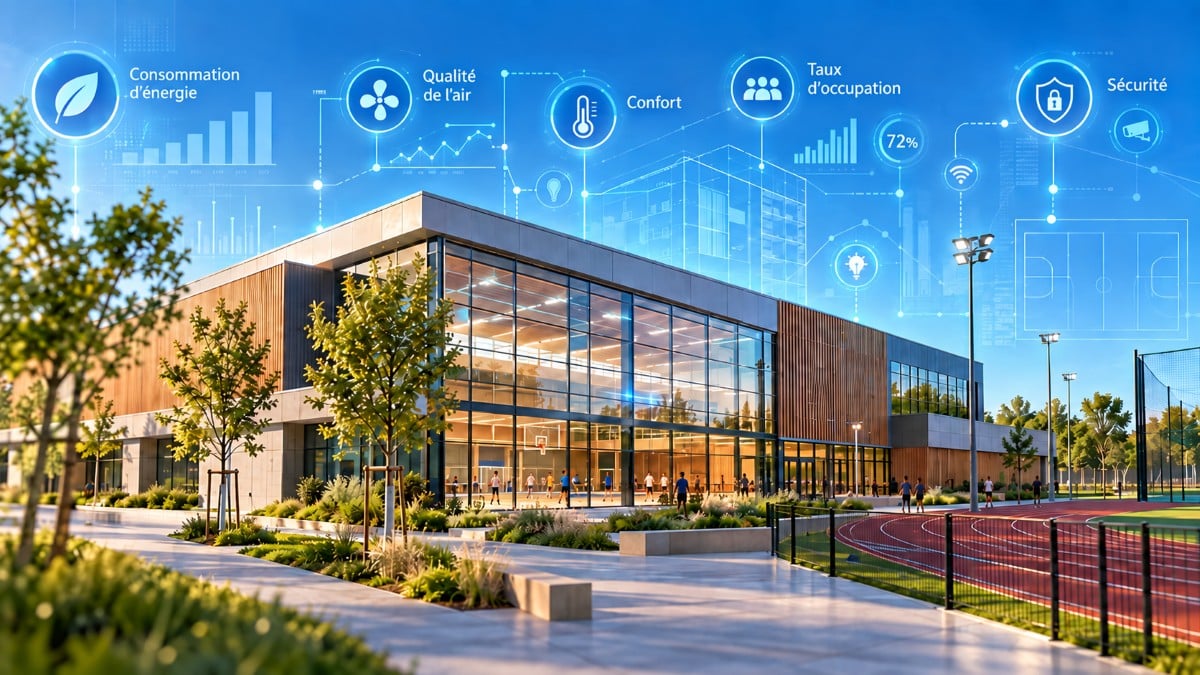
Unlike traditional building management systems, the smart building is based on a systems-based approach in which heating, ventilation, lighting and security systems communicate with one another. The installation of IoT (Internet of Things) sensors enables real-time measurement of actual occupancy levels in offices or classrooms, as well as humidity and air quality. These smart control solutions can generate immediate savings of between 15 and 25 % on energy bills. Digital technology thus makes it possible to adjust consumption to actual needs, eliminating unnecessary waste in unoccupied buildings.
[To remember]
Even the best sensor will not deliver any savings if the data is neither analysed nor shared. Indeed, it is estimated that less than 10 % of the data generated on average in a building is actually used.
Artificial intelligence for predictive maintenance
Artificial intelligence now acts as a «super assistant» for fleet managers. By analysing vast amounts of historical and real-time data, AI is able to identify anomalies in consumption or predict breakdowns before they occur.
This predictive maintenance not only reduces operating costs (by up to 20 % according to some studies), but also extends the service life of technical equipment. AI facilitates the transition to «service-oriented» buildings, where the comfort of public sector staff and citizens is optimised automatically and transparently.
«Start with the buildings that consume the most energy: that’s where you’ll see the quickest return on investment.»
Supporting the digital transition of smart buildings in a responsible and inclusive manner
The success of a smart building project depends not only on technology, but also on organisations’ ability to manage the data value chain and to involve people.
Managing data and ensuring cyber security
Data is the raw material of energy performance. Managing it (collection, storage, analysis) is a new strategic skill that local authorities must acquire or strengthen. For IT departments, cybersecurity remains the top priority.
As buildings become increasingly connected, they are exposed to the risk of cyber-attacks that could cripple essential services. It is therefore imperative to implement robust security protocols, in line with the recommendations of bodies such as ANSSI, to protect this critical infrastructure. Furthermore, new European directives such as NIS2 and the Cyber Resilience Act are particularly significant for the smart building sector.
Digital simplicity and change management
A digital project is only sustainable if it is itself resource-efficient. It is crucial to promote digital solutions whose environmental impact is less than the benefits they generate for the building. Furthermore, the human element is the key factor for success. Developing a digital culture at all levels – from elected representatives to technical staff – is essential to breaking down the traditional silos between the building and IT sectors. Success depends on close, cross-functional collaboration to meet the new expectations of citizens.
And what about you?
Is your property portfolio ready for smart buildings?
| Yes | No | |
| My local authority has precise details of the energy consumption of each of our buildings. | ||
| Most of our buildings are fitted with a Class A or B building management system. | ||
| Building data is centralised and contextualised using a common classification system for spaces and facilities. | ||
| My local authority follows a smart building master plan that has been approved by the IT and facilities departments. | ||
| Our teams and/or service providers are trained in BIM, the IoT and cybersecurity. |
Four or five «yes» answers? You’ve already got a solid foundation.
Fewer than 4? Call in a design consultancy or a smart building project management consultancy*.
*Project Management Assistant
Best practice in smart buildings
The smart building market in France is experiencing sustained growth, driven by a strong drive for innovation and a stringent regulatory framework.
Case study: the Grand Est region’s smart building strategy
The Grand Est region, winner of the Smart Building 2025 Awards in the «exemplary SMART strategy» category, perfectly illustrates how digital technology can transform a local authority.
Managing a very large portfolio of secondary school and administrative buildings, with consumption data that is scattered and difficult to consolidate, makes compliance with the tertiary sector decree complex to manage. The region has implemented a comprehensive strategy aimed at centralising all property data on a single, interoperable platform. The focus has been on training internal teams and using the data to prioritise energy-efficiency refurbishment work at the most critical sites. The result is optimised data governance, enabling precise, real-time management of energy consumption and better allocation of renovation budgets. This approach has not only delivered rapid energy savings but has also strengthened the digital expertise of the regional technical services.
[Testimonial]
This has been confirmed by the Grand Est region’s property and project management department. « We started from scratch, bearing in mind that we had a wealth of static, raw and dynamic data on our 3,000 buildings: 2D plans covering our entire property portfolio, digital models, point clouds, photogrammetry and open data, as well as dynamic data such as building management systems, temperature sensors in the premises and smart meters. The idea was to bring all this data together into a single hub – a dynamic digital twin – so that we could gain a comprehensive overview of all our buildings at a single glance. »The aim is to transform asset management into an interactive, georeferenced, predictive and connected system.”
Feedback from the Grand Est region:
- Centralise all the data
- Building a digital twin
- Prioritising renovations
- Training teams
- Monitoring consumption in real time
Mastering the vocabulary of smart buildings to communicate more effectively with stakeholders
Training, a des key success factors for your local authority
To ensure a successful transition:
- Insist on system interoperability to avoid closed, proprietary solutions
- Share digital infrastructure to minimise costs and environmental impact
- Invest heavily in training
The lack of in-house expertise and cross-functional roles is now recognised as the main obstacle to achieving climate targets.
The key skills to be developed include:
- embed cybersecurity from the design stage
- understanding the concept of a building’s digital twin
- define, implement and operate energy dashboards
- to understand the principles of the IoT and interoperability
- coordinate the work of the IT teams, technical departments and operations staff
Are you ready to transform your property portfolio?
Discover the ORSYS training programme:
Your practical action plan: where to start?
This week:
- Identify your most energy-intensive buildings
- compile a list of the data already available
- set up a steering group comprising, in particular, IT specialists and technical departments
- Choose an initial pilot building
- Identify the skills your teams need to develop and, where appropriate, those that should be outsourced
In conclusion, smart buildings are a key ally in achieving carbon neutrality by 2050 and meeting the 2030 targets. However, the findings of the Observatory for Connected and Responsible Real Estate (OICR) are clear: the sector risks falling behind due to a lack of professionals with dual expertise in building technology (BIM, CIM, building management systems, etc.) and digital technology (AI, IoT, cybersecurity). For IT departments, technical teams and property management services, upskilling is therefore no longer an option. It is an essential prerequisite for the success of public policies on the energy and digital transitions.