Some people command attention the moment they walk into a room. We call this «charisma», as if it were the preserve of a privileged few. But what if that weren’t true? Charisma is not a mysterious gift, but a dynamic between people. It does not arise solely within the individual, but in the space they create with others, and can therefore be developed. An analysis of the mechanisms of charisma and practical ways to strengthen your own presence, by Aurélien Mizeret, an expert specialising in emotional management.

When we talk about charisma, what exactly are we talking about? Where does this extraordinary, mesmerising power that some of us possess come from?
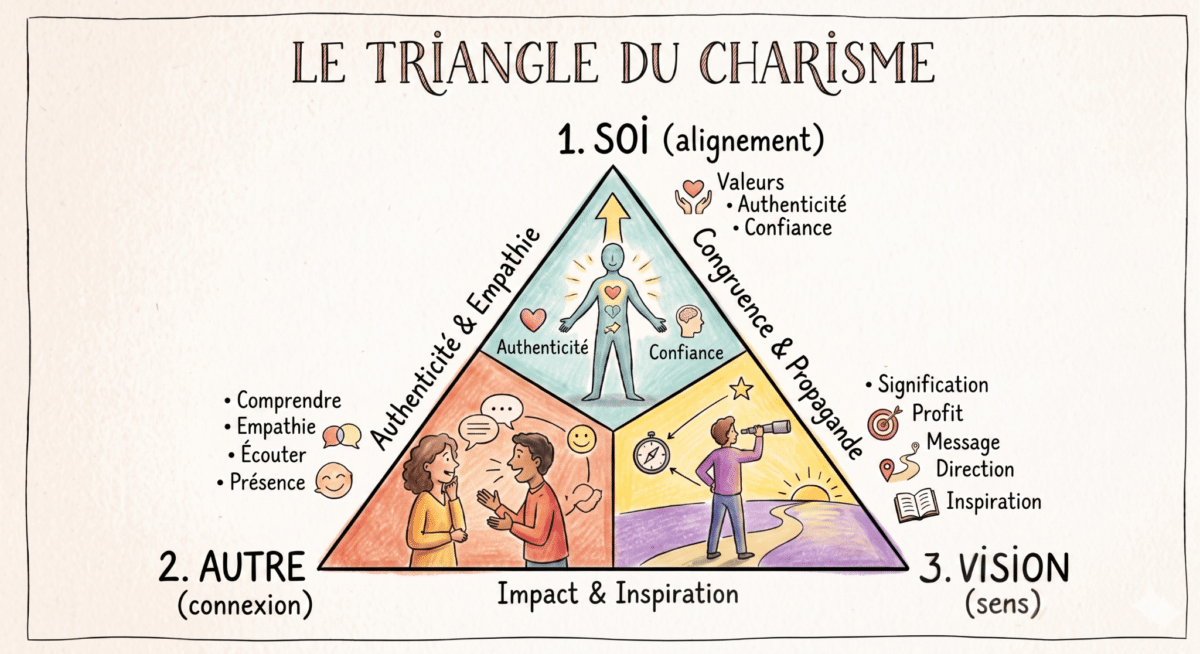
As the training sessions on this topic progressed, a conviction took hold: «We are never charismatic on our own». Attraction exists only with and through the other. These words, for example, are merely symbols displayed on the screen until someone reads them. It is your reading of them, your interpretation, your sensitivity that brings them to life. The same applies to charisma. Charisma involves a relationship with oneself — one’s presence, intention and energy — and a relationship with others. It could be summarised as follows: «If a tree falls in the forest and nobody is there to hear it, does the sound exist?». It is through the gaze of the other person – which acts like a mirror – that the magnetism generated by the speaker takes effect. So what are the factors that make someone appear charismatic?
Be the messenger, not the message
Charisma stems first and foremost from a certain quality of presence. An awareness that what one embodies is greater than oneself. Ultimately, a charismatic person is merely the «vehicle» for the message they wish to convey.
Martin Luther King was not charismatic simply because he described the violence of racial segregation in the 1960s. He was charismatic because he used his feelings and sensitivity to transform his emotions into a powerful megaphone: I have a dream. By transforming violence through a positive vision of the future for his country and his children, Martin Luther King conveyed an electric energy to the crowd that galvanised people far beyond his own supporters.
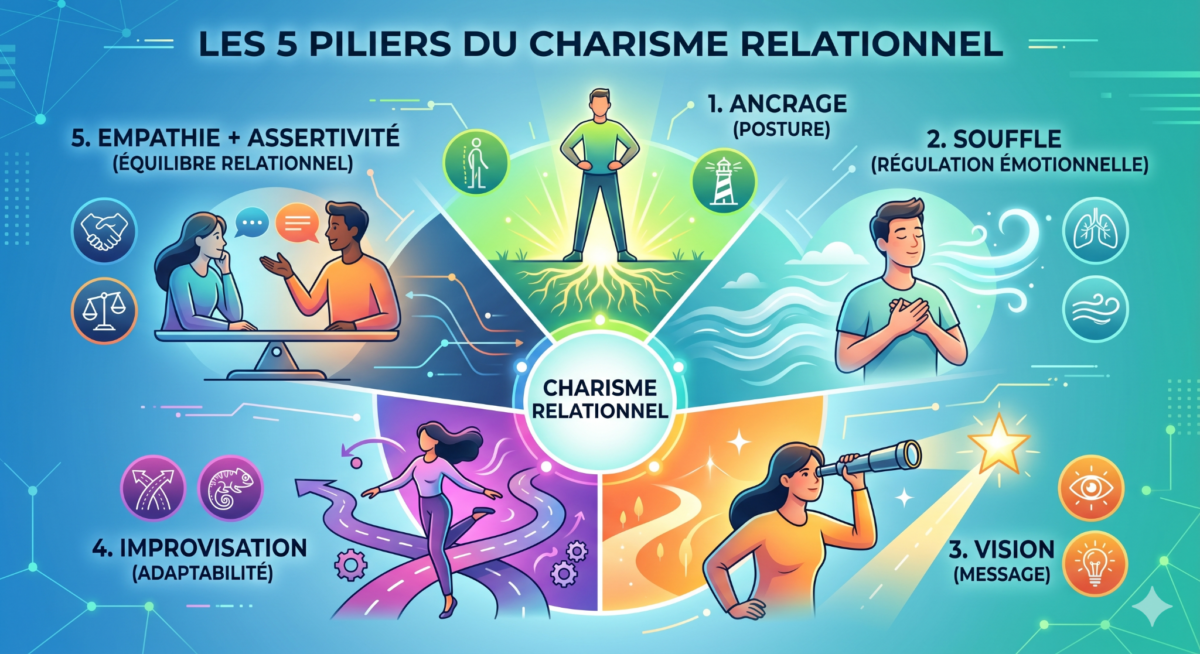
Grounding: inhabiting one’s body to inhabit space
If charisma is an «embodiment», it inevitably begins with the body. Have you ever noticed how some people walk into a room and instantly command the attention of everyone present, without saying a word? It’s not magic; it’s physics. To develop this confidence, you must first work on grounding yourself. Just as a tree can only spread its branches if its roots are strong, your power of conviction depends on your physical stability.
A good, simple and practical approach is to adopt Power Postures. Before a major challenge, don’t hunch over. On the contrary, open up your posture, plant your feet firmly on the ground and straighten your spine. By changing your posture, you send a biological signal to your brain: you’re ready. The alignment between how you feel, what you think and what your body expresses (congruence) is the key to power.
Testimonial :
«For a long time, I confused charisma with volume. The real turning point came when I stopped simply posting instructions on the wall and instead spent five minutes on the morning briefing, explaining why we needed to change our work pace. The difference was immediate: the crossed arms and sighs disappeared. My team didn’t see an authoritarian boss, but a transparent and credible manager.» Sophie, a team leader in industry
Breath: the remote control for your emotions
The real enemy of self-confidence is not incompetence, but the stress that clouds our judgement. Stage fright – that visceral fear of the unknown or of being judged – has the power to paralyse us. Yet there is a practical solution, accessible to everyone and available instantly: breath control.
Building your confidence means relearning how to breathe. It means moving from shallow, chest-based breathing – the kind associated with urgency – to deep, abdominal breathing. This is not just about relaxation, but about physiological mechanics. By regaining control of your breathing, you create a space for healthy reflection before speaking.
To make this a regular part of your routine, using a cardiac coherence app such as RespiRelax on a daily basis can be helpful. It helps you train your body to relax, so that you’re ready when the time comes and stress tries to take over.
The practical exercise – The decompression chamber
You’re just a few minutes away from an interview or a meeting. Now’s the time to use your inner remote control. Step away for a moment and give yourself three minutes to follow this quick routine:
- Find your centre: sit or stand with your spine straight to free up your diaphragm. When sitting, you can arch your back slightly to improve your posture. Plant both feet firmly on the floor and relax your shoulders to embody your posture.
- Breathing in (in 5 seconds): once you’re settled, breathe in slowly through your nose whilst counting to five in your head. Let your stomach expand gently, followed by your chest.
- Exhalation (over 5 seconds): exhale slowly through your mouth, counting to five again. Let your stomach deflate naturally.
- Consistency: repeat these cycles continuously, without pausing between inhaling and exhaling, to achieve a soothing rhythm of six full breaths per minute.
By imposing this mechanical rhythm, you send a direct biological signal to your brain: you bypass the nervous system’s alarm mechanism.
The art of improvisation: daring to say «Yes, and…»
We often lack confidence because we’re afraid of the unexpected. «What if I don’t know what to say?»
Techniques drawn from theatre, and in particular from improvisation, are fantastic tools for learning. Instead of freezing up when faced with the unexpected, you learn to embrace it. This is the «Yes, and…» principle. I accept the suggestion (the reality, the comment, the objection) and then build on it. Developing your verbal fluency and creativity helps you overcome the fear of a blank mind. You no longer strive for perfection; instead, you aim to be adaptable and attentive in order to improve your quick-witted responses.
Example
In meetings, some colleagues make comments that suggest they have doubts or reservations about what you are proposing. When you defend the project, you instinctively reply: «Yes, but don’t worry, we’ve thought through the consequences.»
Try saying this instead: «Yes, I hear you – what would the consequences be? And how could we deal with the situation?»
Using the «Yes, and…» technique, you can turn defensive opposition into creative understanding, whilst opening yourself up to others and boosting your charisma.
| Situation | Without active monitoring (reactive mode) | Involving mindfulness practice (conscious mode) | Impact generated (the benefit) |
| Meeting facilitation | A rapid tone of voice, a closed-off demeanour, an evasive gaze or eyes fixed on the sheet music. | A calm voice, an open posture, a grounded presence, and circular eye contact. | It inspires confidence and naturally captures the audience’s attention. |
| When faced with an objection | On the defensive, an immediate justification, a rising tone, an interruption. | Listening right to the end, a moment’s silence to take it all in, using «Yes, and…». | De-escalates conflicts and turns opposition into collaboration. |
| Stress peak / Pressure | Rapid, shallow (thoracic) breathing, physical agitation, loss of consciousness. | Deep abdominal breathing, a deliberate pause to refocus. | It helps you keep your cool and reassure the teams around you. |
| Listening to a colleague | Multitasks (looks at their phone), prepares their reply before the other person has finished speaking. | Full engagement, putting the phone down, following up and rephrasing with empathy. | Makes the other person feel valued and understood, and fosters a sense of loyalty. |
| Dealing with the unexpected | Visible frustration, inflexibility, and an excessive focus on the problem and the person to blame. | Flexibility, a quick acceptance of reality, and an immediate focus on solutions. | Boosts mental agility and maintains the group’s momentum. |
| Complex decision-making | Acting hastily out of anxiety or, conversely, being paralysed by the fear of failure. | Perspective, mental clarity, objective assessment in line with core values. | Promotes sustainable strategic choices rather than short-term stopgap measures. |
Relational approach: the balance between empathy and assertiveness
Finally, building self-confidence means rejecting the false dichotomy between letting yourself be walked all over and walking all over others. A healthy and charismatic approach to relationships is a dynamic balance between two extremes:
- Empathy : understanding others and their motivations, and accepting their differences
- Assertiveness : non-violent self-assertion, asserting one’s needs and one’s will
The pitfall to avoid is falling into the trap of «too much» or «not enough». Too much empathy without assertiveness leads to frustration. Too much assertiveness without empathy leads to conflict and arrogance.
True charisma lies in striking this balance: being able to express one’s own fundamental needs whilst respecting those of others.
In situations where a manager needs to set someone straight, this assertive yet empathetic approach is crucial.
Example
An employee fails to meet the deadline for submitting a deliverable. The manager clearly expresses their dissatisfaction using a simple method: DESC. Describe, Express, Solve and Conclude.
Describe: We had agreed that client X’s file was to be submitted by 20 April, and it is now 22 April.
Express: This situation is making us both feel uncomfortable, and I’m worried about how our relationship with our client will develop from here.
Resolve: How can we deliver this as quickly as possible? What challenges are you facing with this project? Do you need any additional resources?
Conclusion: In future, I would like you to keep me informed of any difficulties or potential delays you may encounter whilst working on your deliverables. Our credibility and responsibility as a team depend on it. I trust you to honour our commitments.
When a manager sticks to the facts whilst expressing their feelings about a difficult situation, they build buy-in, strengthen their credibility and boost their staff’s commitment. By using the DESC method in an assertive and empathetic manner, the manager combines the interplay of facts and emotions to strengthen their stance, without pretence.
Read also : Charisma at the service of your managerial leadership
Training: Self-affirmation and assertiveness
Emotion
Charismatic speakers share a common skill: they know how to convey emotion. They perfectly embody the four main areas of emotional intelligence defined by Daniel Goleman:
- Self-awareness: They recognise their own emotions and appreciate the influence this inner force has on their decisions.
- Self-control: Far from being overwhelmed by this energy, they know how to channel it with precision and clarity to remain true to their values.
- Social awareness: Deeply empathetic, they intuitively perceive and understand the emotions and needs of those around them.
- Relationship management: They draw on this sensitivity to inspire, bring people together and use their influence to serve a greater cause, thereby fostering a natural sense of loyalty.
Temporality
A charismatic person possesses another essential characteristic: a sense of time. This refers to the alignment of the Past, Present and Future.
Charismatic individuals are aware that their life experience and personal history serve the narrative. They draw on their life experiences to derive their legitimacy. It is through their past that they construct their narrative footprint by a narrow margin.
These individuals also draw on the current situation to describe the problem they wish to solve for, by and with the group.
Finally, they offer a positive vision of the future which aims to sweep the audience along on a wave of renewal : solving the problem, together. They embody hope and combat fears. It is this emotion that creates the appeal. By necessity, because they are convinced, they become convincing.
As the saying goes: « »It is not because things are beautiful that we love them; it is because we love them that they are beautiful.’
The two forms of charisma
Not all forms of charisma are the same. To be precise, there are two easily identifiable types of charisma: formal charisma and substantive charisma.
- Formal charisma: It refers to a stature or presence made possible by a particular physical build or demeanour. It is found in certain great orators, speakers or artists. General de Gaulle’s height of two metres gave him an extraordinary aura. Similarly, the body language of Mick Jagger – who, when he takes to the stage, exudes an animalistic power that electrifies thousands of people – is a manifestation of this charisma. The quick wit and sharp repartee of certain orators are also clear examples of it.
- Core charisma: It is based on values. Mother Teresa and Nelson Mandela were not charismatic because of their physical stature or body language, but when they entered a room, the atmosphere would change. The power of conviction and commitment shown by these figures creates a remarkable presence.
In the professional world, lasting charisma is often rooted in fundamental qualities: consistency, steadfastness and authenticity.
That is precisely what we mean when we talk about charisma: a quality of presence – to oneself, to others and to the world. Have you ever thought about this in relation to yourself? How could you enhance the quality of your presence from today onwards?
Put theory into practice
Charisma is not developed through reading alone. It is developed through experience, by engaging with reality, by daring to put yourself on the line – sometimes quite literally. It is by acting, speaking and embodying the person you wish to be that you become that person.
Here are some examples of practices to develop:
- To speak up
- Dare to improvise
- Working on your posture
- Learning to breathe
- Receiving feedback
Get trained!
If you’d like to try out these techniques for breathing, posture, improvisation and public speaking in a supportive and stimulating environment, take a look at the training programme Drama workshop: developing your charisma and self-confidence. It is a human laboratory where one learns, not to play a part, but to finally become one’s true self, with ease and pleasure.
Testimonial
Anne-Laure, Marketing Manager
«Before the training, I had mainly identified difficulties relating to charisma, rather than to public speaking itself, particularly in certain situations or when dealing with specific people such as senior management. It’s a particularly interesting topic to explore.”.
One of the course’s key strengths lies in the wide range of practical exercises, both individual and group-based. For example, we worked on anchoring techniques using memories to tap into internal resources, on posture through group exercises, and on assertiveness through role-plays and model phrases. One particularly memorable exercise involved practising self-praise, which helps participants to recognise their own achievements and develop a greater sense of self-worth.
The workshop also included role-play exercises, conducted in a light-hearted manner, designed to encourage everyone to express themselves whilst addressing personal and professional issues. We also covered the fundamentals of rhetoric with a view to achieving greater coherence in communication.
»Since the training, I’ve become aware of certain resources I have at my disposal, and of my authenticity. This has enabled me both to boost my self-confidence and to increase the impact I have on the people I’m talking to – which was my aim. And so we’ve come full circle!”
The charisma checklist. How can you tap into your charisma in everyday life?
✔ Before speaking
Have I made clear the message I want to convey (not just pass on)?
Am I linking what I’m saying to a vision?
Have I worked on my posture?
Have I been breathing mindfully for at least 2 minutes?
✔ During the exchange
Am I really listening?
Do I acknowledge objections («Yes, and…»)?
Am I speaking with conviction rather than justifying myself?
Is my body consistent with my words?
✔ After the'intervention
Have I managed to set up a connection?
Have I inspired you to take action?
Have I acted in line with my values?
Ultimately, charisma is the true embodiment of the relationship between oneself and others, used to convey a message through emotion. With the right techniques, it is achievable and can be learnt! So, are you ready to take to the stage? ?